School leavers: Here’s what to study to match South Africa’s critical skills list

South Africa’s Critical Skills List highlights STEM, healthcare, finance, and education careers in shortage, guiding learners to in-demand professions.
Image: Freepik
As matric results are released this week, thousands of South African school leavers are facing one of their first major life decisions: what to study next.
The answer could well lie in the latest official Critical Skills List, published by the Department of Home Affairs.
The list identifies occupations in shortage – roles in which South Africa faces skill gaps, both locally and for which foreign workers can qualify for critical skills visas.
STEM careers top the list
South Africa’s economy has a persistent shortage of skilled workers in science, technology, engineering, and mathematics (STEM). Among the roles highlighted:
- Engineering – civil, mechanical, chemical, electrical, and mining engineers. Qualifications required: Bachelor’s degree in the relevant engineering field. These engineers are in demand across infrastructure, energy, mining, and manufacturing sectors.
- Information and communication technology (ICT) – software developers, systems analysts, ICT project managers, and data scientists. Qualifications required: Bachelor’s degree or an advanced diploma in IT or computer science.
- Science – physicists, chemists, biologists, environmental scientists, geologists, mineralogists, and other specialised researchers. Qualifications required: Bachelor’s degree in the relevant science field, with honours or postgraduate degrees for advanced research roles. For example, geologists and mineralogists are essential to the mining and environmental sectors.
Health and healthcare professionals
The Critical Skills List also signals shortages in the health sector:
- Specialist medical practitioners (including surgeons and other specialised doctors)
- Dentists
- Pharmacists
- Physiotherapists and allied health professionals
- Health researchers
Qualifications: Bachelor’s degree in the relevant health field, with postgraduate specialisation required for certain specialist roles.
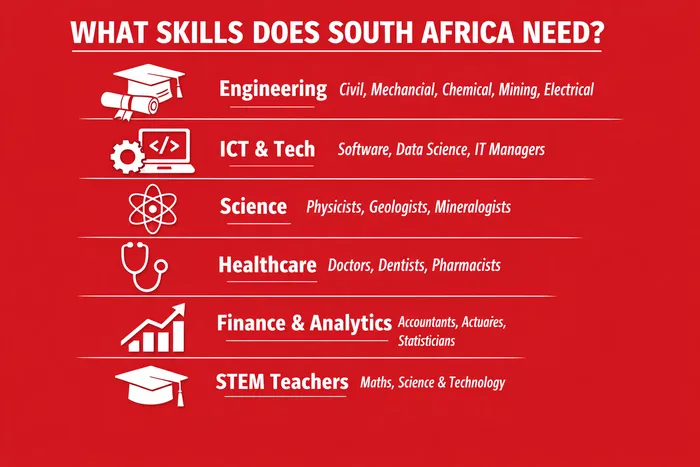
South Africa's most-needed skills.
Image: ChatGPT
Education: STEM teachers
South Africa continues to face a shortage of teachers in maths, science, and technology, particularly for Grades 8-12.
Qualifications required: teaching diploma or bachelor’s degree in education with a subject specialisation.
These shortages highlight the ongoing need to train the next generation of skilled professionals.
Finance, analytics and business roles
Certain technical finance and analytical positions are also in demand:
- Chartered accountants
- Actuaries
- Statisticians
- Financial analysts
Qualifications: Bachelor’s degree in accounting, mathematics, statistics, or finance; professional certification is required for chartered or actuary status.
Technical and support roles
The list includes engineering and ICT technicians, who typically require advanced diplomas or certificates rather than full degrees.
These roles are essential for implementing and maintaining complex systems in manufacturing, energy, ICT, and mining sectors.
Mapping study to careers
The Critical Skills List is a factual guide showing which sectors are experiencing shortages and which careers can offer better employment prospects. For school leavers, it provides concrete direction on what to study after matric:
- Those interested in infrastructure, manufacturing, or energy might focus on engineering degrees.
- Learners drawn to technology and software can pursue ICT degrees or advanced diplomas.
- Students interested in the natural sciences, the environment, or mining can look at degrees in physics, chemistry, geology, or mineralogy.
- Those considering healthcare can target medicine, dentistry, pharmacy, or allied health sciences.
- Prospective teachers can pursue education degrees with STEM specialisation, addressing shortages in schools.
- Students with strong numerical and analytical skills might pursue accounting, finance, actuarial science, or statistics.
By focusing on roles highlighted in this official list, learners can plan their studies based on actual national skill shortages, ensuring their qualifications meet labour market needs rather than relying on generic advice.
IOL BUSINESS