South Africa makes history by declaring gender-based violence a national disaster
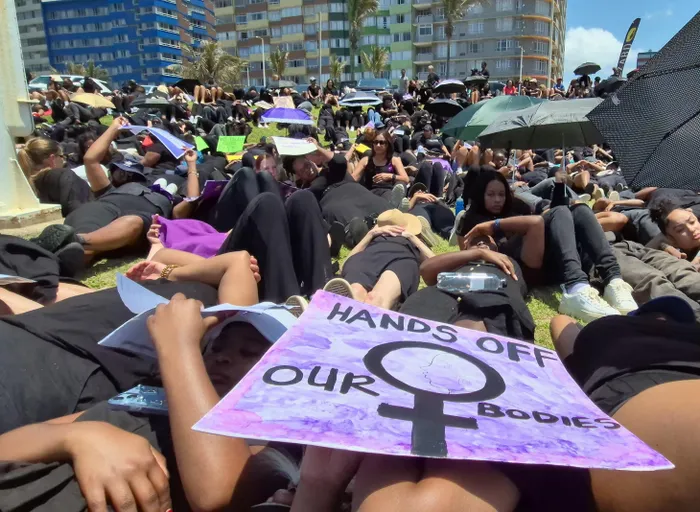
DOZENS of women descended on the Durban beachfront on Friday and observed a national 15-minute of silence aimed at protesting against gender-based violence and femicide, which South Africa has, under the National Disaster Management Act, declared a national disaster. The women dressed mainly in black and purple were part of nationwide silent protests against the scourge.
Image: SIBONELO NGCOBO Independent Newspapers

Nqolokazi Nomvalo is an admitted attorney of the High Court of South Africa who advocates for women and children's rights
Image: Supplied
South Africa’s greatest strength has always been its people. Our ability to draw from a diverse social culture and community spirit has enabled us to organise powerfully in the face of injustice. From bustling urban centres to rural heartlands, ordinary citizens have shown that advocacy here is not a whisper but a roar.
It is this collective energy, this refusal to be silenced, that has propelled gender-based violence and femicide (GBVF) from the margins of political discourse into the heart of national policy.
On 21 November 2025, the National Disaster Management Centre (NDMC) formally declared GBVF a national disaster. The declaration was made by Dr Bongani Elias Sithole, Head of the NDMC, acting under Section 23 of the Disaster Management Act No. 57 of 2002. The announcement was welcomed by Minister of Cooperative Governance and Traditional Affairs, Velenkosini Hlabisa, who affirmed that the classification reflects the gravity of GBVF as a threat to life and dignity, and pledged that the government will mobilise the full machinery of the state to confront it.
By invoking this law, GBVF is no longer treated as a rhetorical crisis but as a legally binding disaster classification, compelling the state to act with urgency and accountability. This declaration is not only a matter of statutory compliance. It is a constitutional imperative.
Section 9 of the Constitution guarantees equality before the law and prohibits discrimination, while Section 12 affirms the right to freedom and security of the person, including the right to be free from all forms of violence. Section 10 enshrines the right to dignity, a right that is daily violated when women and children live in fear. To declare GBVF a national disaster is to recognise that these constitutional promises cannot remain aspirational. They must be defended with the full force of law and policy.
This groundbreaking decision was not born in isolation. It is the culmination of years of relentless activism, courtroom battles, and public demonstrations that demanded accountability.
We remember the successful prosecution of Luyanda Botha, sentenced to three life terms for the rape and murder of University of Cape Town student Uyinene Mrwetyana in 2019. Her name became a rallying cry. It sparked nationwide protests and forced the government to confront the epidemic of violence against women.
We recall the Christiana Regional Court’s sentencing of Boikanyo Seemohela to 18 years for the rape of his nine-year-old nephew, and other heavy sentences handed down across the country. These prosecutions are not isolated victories. They are proof of civil society’s unyielding fight to ensure that perpetrators face the full weight of the law.
Yet, the declaration of GBVF as a national disaster marks a decisive shift. For years, leaders described GBVF as a national crisis. But a crisis is rhetorical. It signals urgency without binding obligations. A disaster, by contrast, is a legal classification under the Disaster Management Act. It triggers formal state responsibilities, including coordinated national responses, emergency funding, and structured accountability. In short, a crisis acknowledges pain; a disaster demands action.
This distinction matters profoundly. It means GBVF is treated with the same seriousness as floods, pandemics, or fires. It obliges the government to mobilise resources, enforce accountability, and act decisively. But it also places a moral burden on all of us. Laws and declarations alone cannot heal the wounds of a nation scarred by violence. We must build communities where women are safe in their homes, children are protected in their schools, and survivors are met with compassion rather than stigma.
South Africa has declared GBVF a disaster. Let us now declare, with equal conviction, that we will not rest until every woman and child walks free from fear. This is not only a legal imperative. It is a moral revolution.
The world is watching, and so too is our youth. History will remember whether we rose to meet this moment, not with hesitation, but with courage.
(Nomvalo is an admitted attorney of the High Court of South Africa and an advocate for women and children's rights. Her views don't necessarily reflect those of the Sunday Tribune or IOL)
SUNDAY TRIBUNE