Something borrowed, something new: The making of JP Pietersen the coach
UNITED RUGBY CHAMPIONSHIP
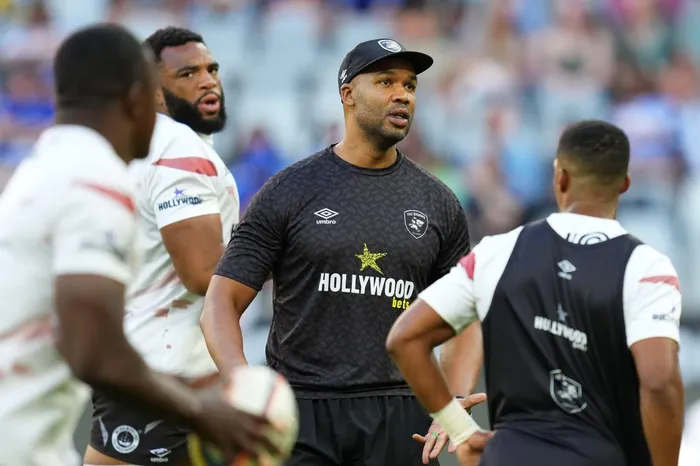
JP Pietersen's journey at the Sharks started as an 18-year-old who walked to training because he had no transport and earned R500 a month from his Sharks scholarship.
Image: Backpagepix
The old adage “something old, something new, something borrowed” would appropriately describe JP Pietersen’s approach to rugby coaching.
His name, in fact, is borrowed in a sense — his Christian names are Jon-Paul Roger, after the great British Lions fullback JPR Williams, who made a telling impact on JP’s father during the Lions’ 1974 tour. Funnily enough, JPR Williams stayed behind after that Lions tour and spent a season at Kings Park playing for Natal.
On a serious note, the new Sharks coach is his own man, but the first to admit that he has been influenced by some of the sport’s best coaches since the day he arrived at the Sharks Academy as a penniless student. The year before, he had played for Mpumalanga Schools, having not long before converted from lock to outside centre. He had hated playing in the pack, and his rugby shot through the roof when a wise coach saw that his heart was not in the second row.
“I was a big Sharks supporter at school — my uncle, Christy Noble, had played in the Natal Currie Cup-winning team of 1990 — so when I arrived at Hans Scriba’s Sharks Academy and saw heroes like Butch James walking around the stadium, I knew I had my home.”
Home the "Shark Tank" has been. Apart from a few seasons abroad, Pietersen has spent his entire adult life at Kings Park. He amassed 197 caps between 2005 and 2020, and when he retired, he immediately took up a coaching role at the Academy, where it all started for him. Five years later, he is the head coach. That is some journey for the 18-year-old who walked to training because he had no transport and earned R500 a month from his Sharks scholarship.
“My coaching style is a cross-pollination of influences. I was lucky enough to play under some brilliant coaches, and I learned a bit from each one of them to arrive at a style that is my own,” the 39-year-old said.
Pietersen’s first coach in 2006 was Dick Muir, who was assisted by John Plumtree.
“I like how Dick built the players' confidence and gave them the freedom to make decisions on the field. Plum had come from New Zealand and was instrumental in getting us to move the ball because we had been one-dimensional. Plum was hard on us about not being complacent — it is easy for that to happen when you are winning."
At the Boks, Pietersen’s first coach was Jake White.
“Jake was excellent in his analysis. Technically, he was always ahead of the game. He was confident in his plan. In 2006, we were at Twickenham. We had just beaten England after a horror season in which Jake came close to being fired. He said in the changing room: ‘This time next year, you will be holding the World Cup.’ I learned from Jake to be sure of your plan and then back it all the way through.”
Next up was the colourful Peter de Villiers.
“Peter was great in how he took the pressure away from the players. He took responsibility for all the off-field stuff so that the players could concentrate on the rugby. Heyneke Meyer took over from Peter. He was a very human coach. He was big on what he could get out of people. He was massive on what individuals could give to each other for the better of the whole. He would give anything for the team.”
Pietersen said his two seasons in Japan under the Wild Knights’ Robbie Deans, the successful Crusaders coach, were a rich education.
“I learned plenty from Robbie about the analysis of individuals. He was big on not getting too emotional pre-game, but to be more technical and confident in your game plan. Robbie had this brilliant thing called ‘mini-coach connections’ where the players are split into groups according to their position. For instance, the centre and fly-half would sit together and come up with a plan on how to tackle the opposition. As a player, you are a coach in that you have to analyse your opposition."
“I had to ‘coach’ the Japanese players, and they could hardly speak English. It made me concentrate and think carefully. We got there, and I banked some good skills.”
Pietersen was further enriched by playing stints under Fabien Galthie (Toulon) and Richard Cockerill (Leicester).
“You take what you like and leave what you don’t like,” he concluded.
* Mike Greenaway is a senior rugby reporter at Independent Media and contributor on our Last World on Rugby podcast on our YouTube channel, The Clutch