Proteas T20 World Cup: Key takeaways before crucial Super 8 match against India
T20 World Cup
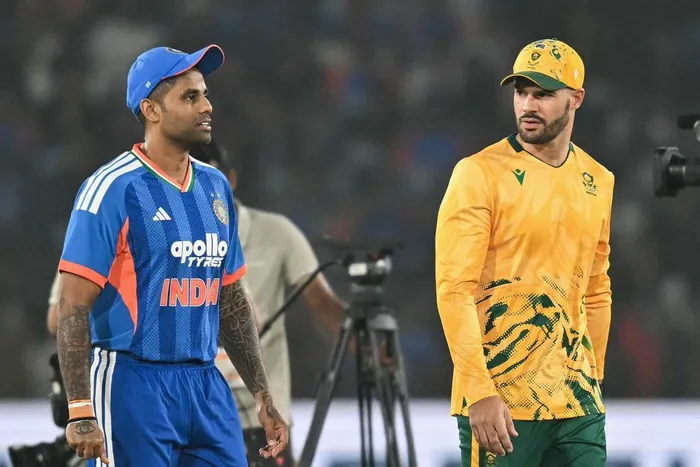
India captain Suryakumar Yadav and his Proteas counterpart Aiden Markram will lock horns in the Super Eights clash on Sunday.
Image: AFP
THERE seems to be an unwritten, yet uncomfortably rigid rule in the universe that says that the closer one gets to an objective, the more the pressure mounts, and the greater the chances of a wobble, a slip, a dip in one’s method.
The Proteas cricket team are well aware of this, and as a well-drilled unit, they have been successful at eliminating the little errors that could lead to great disappointment.
This is why, as South Africa prepare for their Super 8 clash against India, their route through the T20 World Cup qualification phase — against Canada, Afghanistan, New Zealand and the UAE — along with a warm-up defeat to India, has offered a range of lessons.
Here are seven key takeaways the Proteas are likely carrying into the India encounter.
1. Starts matter — even against lower-ranked sides
The match against Canada underlined the importance of professional starts. South Africa were expected to win, but early wickets and periods of stagnation showed how quickly momentum can shift in T20 cricket.
Against India, who are far more ruthless in capitalising on slow beginnings, the Proteas will know that powerplay efficiency with both bat and ball is non-negotiable.
2. Handling nerves in high-pressure spells
Kagiso Rabada’s visible nerves during the Afghanistan match stood out. Whether it was rhythm, execution, or simply the tension of defending a total, the moment highlighted how fine the margins are in knockout-style cricket.
India’s batting line-up is far less forgiving than Afghanistan’s. Rabada and the pace unit will need clarity of role and composure at the death. The Afghanistan experience should sharpen that focus rather than shake confidence.
3. Different pitches demand flexibility
The UAE fixture exposed the squad to a surface that behaved differently from earlier matches. Pace off the ball, subtle variations and recalibrated lengths became more important than outright speed.
India are adept at reading conditions quickly. South Africa’s exposure to contrasting pitches in the group phase gives them a broader reference point. The bowling attack, particularly the seamers, will need to assess conditions early and adjust without hesitation.
4. Middle-order responsibility
New Zealand tested South Africa’s middle-order resilience. When early momentum dips against disciplined opposition, the innings can unravel if no one anchors proceedings.
The Proteas will have learned the value of one batter taking ownership — rotating strike, absorbing pressure and setting up the final surge. Against India’s varied attack, that stabilising presence becomes crucial.
5. Death overs discipline
Across the qualifying matches, there were moments where execution at the death — with both bat and ball — fluctuated.
Loose deliveries in the final overs against Afghanistan and periods of conservatism with the bat against New Zealand offered reminders of how decisive those closing exchanges can be. India are particularly strong in that phase, both through their finishers and their specialist death bowlers.
South Africa’s takeaway: clarity in plans, backed by conviction. Half-measures will be punished.
6. Fielding standards cannot dip
T20 tournaments magnify small errors. In tight games, a misfield or dropped chance can shift momentum immediately.
While the Proteas have generally maintained high fielding standards, there were patches in the qualifying matches where intensity wavered. India’s deep batting order means opportunities may be limited. Any chance offered must be taken.
7. The India warm-up loss as reference
The warm-up defeat to India provides a recent, direct comparison point. Warm-up matches do not carry tournament points, but they offer tactical clues.
India’s tempo, bowling variations and ability to apply scoreboard pressure were on display in that encounter. South Africa now have firsthand evidence of the pace at which India are operating.
Rather than dwell on the result, the Proteas can use it as a calibration exercise — assessing match-ups, bowling combinations and batting tempo required to compete.
Conditions and adaptability remain central
Against Canada, Afghanistan, New Zealand and the UAE, the Proteas have encountered varying conditions and levels of opposition. They have had to defend totals, chase under pressure, and navigate surfaces that behaved differently from one venue to the next.
Those experiences should reduce the element of surprise against India. The key question is not whether South Africa have faced challenges — they have — but how effectively they apply those lessons under greater pressure.
Rabada’s moment of visible tension, the shift in pitch behaviour in the UAE game, the tighter phases against New Zealand, and the professional expectation against Canada all form part of a learning curve that now converges in the Super 8.
India will test every facet of South Africa’s game: powerplay aggression, middle-over control, death execution and mental resilience.
The Proteas enter the clash with practical experience from contrasting scenarios. Whether those lessons translate into performance against one of the tournament’s strongest sides will determine how far they progress from here.