T20 World Cup: Proteas ready for a high-stakes challenge
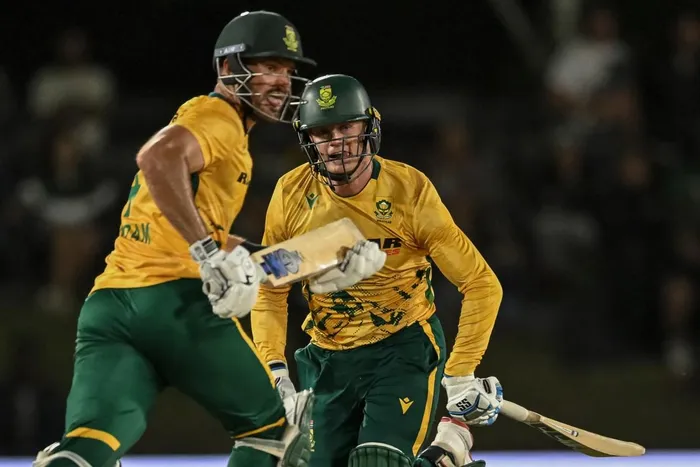
The Proteas are set to embark on yet another attempt to bring home the ICC T20 World Cup.
Image: AFP
DIE HARD, dedicated cricket fans, but especially Proteas supporters will once again be decked out in their “gees” apparel on Saturday, when the T20 World Cup gets under way.
The South Africans enter the ICC Men’s T20 World Cup 2026 determined to build on their dramatic run to the final in 2024 – where they finished runners-up – and this time go all the way. The tournament begins in India and Sri Lanka on February 7, with South Africa drawn in Group D alongside New Zealand, Afghanistan, Canada and the United Arab Emirates.
Led by captain Aiden Markram, the Proteas squad blends seasoned match-winners with emerging talent. The cool-headed Markram’s leadership will be vital for a batting unit that also features Quinton de Kock, Dewald Brevis and David Miller, the veteran finisher whose fitness was recently confirmed ahead of the event.
The bowling attack boasts genuine fast bowling threats in Kagiso Rabada, Anrich Nortje and Lungi Ngidi, supported by spin options such as Keshav Maharaj and all-round capability from Marco Jansen – a player many analysts see as one of the Proteas’ key match-winners.
South African fans will have an opportunity to ease themselves into the competition, seeing as the Proteas will begin their campaign against Canada on Monday, February 9 in Ahmedabad before facing Afghanistan on February 11, New Zealand on February 14 and UAE on February 18.
So what lies ahead of them as they prepare for these clashes? What should they beware of, and what should they take into account as they prepare?
Group D challengers: quality and unpredictability
Afghanistan
Afghanistan arrive in India with momentum. They were semi-finalists at the 2024 T20 World Cup and have continued to produce strong T20I performances.
Their squad includes experienced match-winners such as captain Rashid Khan, Rahmanullah Gurbaz, Mohammad Nabi and Mujeeb Ur Rahman. Their spin attack and hard-hitting batters make them a genuine threat in sub-continental conditions.
Also remember, Afghanistan come into this tournament off the back of series victories over the West Indies and Zimbabwe in their last two T20I bilateral series. And two years ago, Rahmanullah Gurbaz finished as the top run-scorer in the tournament, while Fazalhaq Farooqi topped the wicket tally.
New Zealand
The Black Caps are another team with real pedigree in big tournaments. Led by Mitchell Santner, New Zealand have a balanced squad with dangerous T20 batters like Finn Allen, Rachin Ravindra and Glenn Phillips, alongside seasoned bowlers such as Lockie Ferguson and Ish Sodhi.
Despite a recent T20 series loss to India, they remain capable of beating any side on their day and will be eager to avoid a repeat of their 2024 group-stage exit.
Canada
Canada return to the World Cup stage after their debut in 2024, where they secured a memorable win over Ireland.
Though they lost out to the USA and Pakistan as they bowed out in the first round of that tournament, this time around, they qualified unbeaten through the Americas Regional Final, with captain Dilpreet Bajwa and top order batters like Navneet Dhaliwal and Yuvraj Samra providing stability and firepower.
While they are outsiders on paper, their qualification form suggests they can be competitive. And in T20 Cricket, in high pressure games, one good performance with bat or ball could swing a contest sharply.
United Arab Emirates
The UAE are playing their third T20 World Cup and will look to improve on past campaigns. Led by Muhammad Waseem, and with contributors such as Haider Ali and Junaid Siddique, the UAE can surprise in conditions that favour spin and tactical batting.
They will be keen to build on their qualification success and test the established sides in Group D.
Tough road to the Super Eights
It’s worth noting that only the top two teams from Group D will advance to the Super Eights, where each match becomes even more unforgiving. For the Proteas, the key will be consistency – converting good starts into victories, backing their depth in all departments and handling pressure situations better than their rivals.
That goes without saying, of course.
Additionally, South Africa have never won a Men’s T20 World Cup title, but they came agonisingly close in 2024 when they lost the final by a narrow margin.
This time around, with a mix of experience and talent, a wily coach in the dugout, and a group that offers both challenge and opportunity, their 2026 campaign promises to be one of the most compelling in recent memory.