
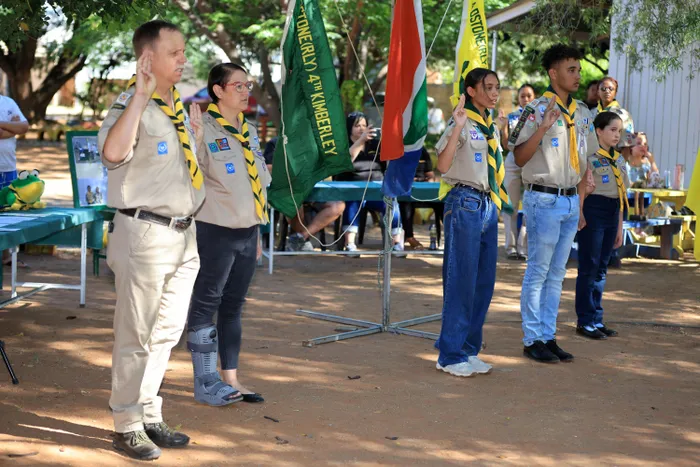
SCOUTS South Africa traces its roots to 1908, shaping young people through adventure, service, and leadership. Grounded in strong values, it guides Cubs and Scouts toward responsibility, citizenship, and excellence through the respected Springbok badge.
Image: Danie van der Lith / DFA
MORE than a century ago, a small group of boys gathered around campfires on Brownsea Island in England. Their leader, Lieutenant-General Robert Baden-Powell, had a simple but powerful idea: teach young people character, self-reliance, and service through adventure.
From that modest camp in 1907, a movement was born that would circle the globe, and reach South Africa within a year.
By 1908, Scouting had taken root on South African soil. At a time when the country was deeply divided, young people began meeting under a shared uniform and a shared purpose. They learnt outdoor skills, discipline, and leadership, but more importantly, they learnt respect, responsibility, and service to others. What started as a small youth initiative soon became one of the oldest and most influential youth movements in South Africa.
Over the decades, SCOUTS South Africa grew with the country. It became one of the first organisations to actively challenge segregation by hosting racially integrated activities in 1977, long before democracy arrived. In 2000, the movement opened its doors fully to girls, reinforcing its belief that Scouting is for everyone.
Through changing times, its core values never wavered.
At its heart, SCOUTS South Africa exists to help young people grow into capable, carring, and responsible adults. The aim is not simply to teach knots, camping skills, or survival techniques, but to develop the whole person spiritually, mentally, socially, and physically.
Three principles guide everything a Scout does. The first is duty to God, encouraging spiritual growth and respect for faith. The second is duty to others, which includes service to the community, loyalty to the country and care for the environment. The third is duty to self, teaching personal responsibility, resilience and lifelong self-development.
These principles are not taught in classrooms. They are learnt around campfires, on hikes, during community projects and through teamwork. Scouting believes in learning by doing, making mistakes, solving problems and growing through experience.
For many, the Scouting journey begins in the Cub Pack. Cubs are usually between the ages of seven and eleven, and their world is built around imagination, play and discovery.
When a Cub makes their promise, they say:
“I promise to do my best, to do my duty to God and my country, to keep the Law of the Wolf Cub Pack, and to do a good turn to somebody every day.”
The Cub Law is simple but powerful: The Cub gives in to the Old Wolf. The Cub does not give in to himself or herself.
It teaches respect, discipline and self-control in a way young children can understand. The Cub motto, “Do your Best”, becomes a guiding phrase, not about being perfect, but about trying, learning and improving.
As Cubs grow older, they move into the Scout troop. Here, responsibility deepens and independence grows. Scouts are expected to lead, serve and think for themselves.
The Scout Promise is taken seriously:
“On my honour, I promise that I will do my best to do my duty to God and my country, to help other people at all times, and to obey the Scout Law.”
The Scout Law, made up of 10 points, shapes daily behaviour. It speaks of trust, loyalty, helpfulness, courtesy, kindness to animals, obedience, cheerfulness under difficulty, thrift and cleanliness in thought, word and deed. Together, these values form a moral compass that Scouts carry with them long after they leave the movement.
The Scout motto, “Be Prepared”, is more than a slogan. It is a way of life, being ready to help, ready to lead and ready to face challenges with confidence.
Within SCOUTS South Africa, advancement is not about competition but about personal growth. Scouts progress through stages that build skills, leadership ability and service to others. At the summit of this journey stands the Springbok Scout Award.
The Springbok badge is the highest honour a Scout can achieve in South Africa. Its roots lie in the King’s Scout and Queen’s Scout awards of the British tradition, but after South Africa became a republic in 1961, it was proudly renamed to reflect the country’s own identity.
Earning the Springbok badge is no small feat. Scouts must demonstrate advanced outdoor skills, complete significant community service, plan and lead expeditions, and show leadership within their troop and community. All requirements must be completed before the Scout turns 18.
Those who earn the Springbok badge wear it with quiet pride. It represents perseverance, service and integrity, proof that the Scout has lived the Promise and Law, not just spoken them.
More than a hundred years after its arrival in South Africa, Scouting remains deeply relevant. It continues to shape young people who are confident, compassionate and prepared to serve. Many former Scouts go on to become community leaders, professionals and volunteers, carrying the values they learnt into every part of life.
SCOUTS South Africa is more than uniforms and badges. It is a story passed from generation to generation, a story of campfires and service, of learning to lead, and of young people discovering that they can make a difference in the world, one good turn at a time.