CAF’s fair play award to Morocco exposes Afcon’s credibility problem
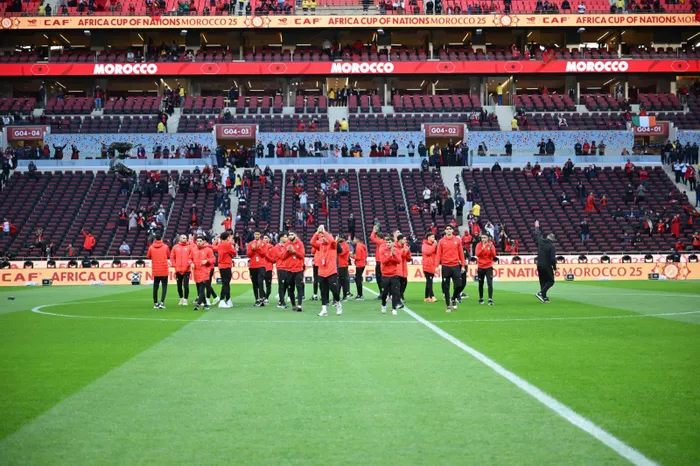
Morocco were awarded the fair play award after Sunday's Africa Cup of Nations final against Senegal in Rabat.
Image: AFP
CAF’s decision to award Morocco the fair play prize after Sunday’s Africa Cup of Nations final would be laughable if it were not so revealing. In a match defined by controversy, disruption and repeated breaches of sporting conduct, the gesture landed not as recognition, but as an insult to both Senegal – the eventual winners – and to the very principle of fair play itself.
The final at the Prince Moulay Abdellah Stadium in Rabat will live in infamy after being marred by controversy. Senegal believed they had opened the scoring late on, only for the goal to be ruled out following a VAR review. Then, in stoppage time, the hosts were awarded a contentious penalty for a challenge that appeared anything but a foul.
After furious protestations from the Senegalese players, including a brief walk-off, the match resumed. Real Madrid’s Brahim Diaz attempted a Panenka, which was easily collected by Edouard Mendy, sending the game into extra time.
In extra time, Pape Gueye scored early to give Senegal the lead, and they held on to seal a famous and deserved victory.
Almost immediately after the final whistle, evidence of Morocco’s poor sportsmanship began circulating on social media. Throughout the rain-soaked match, ball boys were seen attempting to disrupt Mendy by removing the towel he used to dry the ball.
Similar behaviour had already been observed earlier in the tournament. During Morocco’s semi-final against Nigeria, stewards were seen interfering with Super Eagles goalkeeper Stanley Nwabali in the same manner.
As tournament hosts, Morocco were already viewed by many as beneficiaries of an uneven playing field. Bafana Bafana coach Hugo Broos publicly raised concerns about logistics after South Africa were assigned a training ground within the same complex as Morocco, a potential quarter-final opponent. Those concerns were compounded by a series of questionable refereeing decisions during the group stages, which left many observers wondering whether Morocco were being “handed the competition”.
In the build-up to the final, Senegal also complained about accommodation, training facilities, ticketing and general logistics. Then there was the towel-stealing incident itself. Yehvann Diouf, Senegal’s reserve goalkeeper, was eventually tasked with guarding Mendy’s towel, while another clip showed Morocco defender Achraf Hakimi throwing it over the advertising boards.
At this stage, CAF awarding Morocco a fair play prize feels more like a provocation. Fair play is meant to embody respect for opponents, officials and the spirit of the game – not gamesmanship from the sidelines, logistical advantages behind the scenes, or behaviour that repeatedly crossed the line of sportsmanship.
Senegal won the trophy on the pitch through resilience and composure amid chaos. Morocco, meanwhile, were left with uncomfortable questions that no post-match award can paper over. CAF may want to project an image of order and integrity, but moments like these only reinforce the growing perception that African football’s biggest stages remain undermined by contradictions between what is celebrated and what is clearly seen.
IOL Sport
* The views expressed are not necessarily the views of IOL or Independent Media.
** JOIN THE CONVERSATION: Send us an email with your comments, thoughts or responses to iolletters@inl.co.za. Letters should be a maximum of 500 words, and may be edited for length. Anonymous correspondence will not be published. Submissions should include a contact number and physical address (not for publication).