
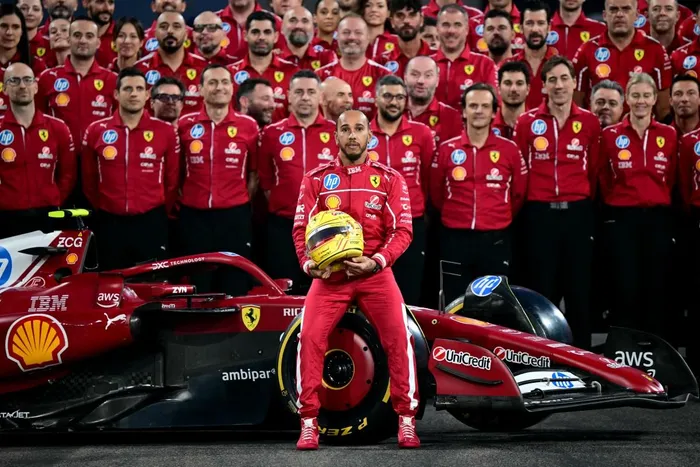
Lewis Hamilton’s 2025 Ferrari reports reveal a team reluctant to embrace driver insight, highlighting structural issues that may have limited their performance. Photo: AFP
Image: AFP
The harsh scrutiny of Lewis Hamilton’s documents submitted to Ferrari throughout the 2025 season has exposed a fatal flaw in the team’s approach to F1: arrogance.
What should have been a collaborative effort to extract maximum performance from a struggling car and team instead exposed, at times, a group of individuals unwilling to accept guidance, even from one of the sport’s most accomplished drivers.
Hamilton, a seven-time world champion, compiled carefully drafted reports throughout the season, detailing suggestions on car setup, team communication, and weekend execution in an effort to help Ferrari reverse their ongoing downward form.
His experience with Mercedes, where his technical input and communication with engineers played a key role in the team’s domination of the turbo-hybrid era, shows just how influential a driver’s insight can be when properly harnessed.
Yet, at Ferrari, his input was met with open criticism. Former Ferrari team principal Maurizio Arrivabene did not mince his words when discussing Hamilton’s submissions, comparing the Briton’s approach to that of Sebastian Vettel during his tenure at the Italian team.
“Sebastian Vettel also sent such dossiers. He wrote, spoke, and shared everything,” Arrivabene stated, bluntly adding that these efforts were “almost useless.”
“I don’t want to say anything bad about Sebastian, but everyone should mind their own business. When a driver starts playing engineer, that’s it. Then it’s really over. Drivers spend two or three days in the simulator and get a general impression, but the devil is in the details.
"When the car is on the track, the driver must provide relevant feedback so that the engineers can make targeted improvements – especially when there is potential,” he added.
The irony is hard to ignore.
There was once a driver at Ferrari who wielded immense engineering influence while the entire team reaped the rewards, winning two world championships for the Scuderia – Niki Lauda. His technical feedback and close collaboration with the team in the mid-1970s were pivotal to Ferrari’s success. While it was a different, less information-driven era of racing, the principle remains: the person feeling what’s happening on the track should always be listened to.
In modern times, however, a driver with Hamilton’s level of expertise seems to encounter resistance rather than listening ears at Ferrari.
Hamilton’s influence at Mercedes highlights the contrast. There, his feedback and collaboration with the pitwall were integral to multiple championship campaigns, allowing the team to fine-tune strategy, manage tyre degradation, and extract every fraction of performance from the car.
Ferrari, on the other hand, have struggled to find a driver of comparable influence since Michael Schumacher left, and the team’s communication this season often reflected that gap.
Charles Leclerc, despite driving for Ferrari since 2019, has yet to mount a credible challenge for the title, leaving Ferrari with little hope of contending against McLaren or Red Bull in 2025.
There were multiple occasions this season where Hamilton’s interactions with the Ferrari pitwall appeared strained. Radio communications frequently suggested confusion or disregard, with the seven-time world champion at times sounding incredulous at the team’s decisions.
In the final race, frustration boiled over when Hamilton openly questioned whether he was being ignored – a stark contrast to the seamless driver-engineer collaboration expected at a team of Ferrari’s calibre.
Despite the criticism, Hamilton’s submissions were thorough, born from years of experience at the highest level. But Arrivabene’s response underscores an uncomfortable truth about modern Ferrari: a culture that appears reluctant to embrace external insight in favour of maintaining internal hierarchy.
Ferrari Chairman John Elkann told both drivers to talk less and that their driving was not up to standard after the Brazil GP, which created worldwide headlines. Ferrari quietly worked through the issue, with both drivers saying they understood his intentions.
Hamilton openly admitted he felt “anger and rage” when asked about his first season with Ferrari. Coming from a nurturing team under Toto Wolff, the cold walls of Ferrari seemed to affect the Champion, who has not yet found the spark he showed with Mercedes.
Arrivabene’s reaction suggests the modern Ferrari F1 team has become too proud to accept help from the ‘outside’. While driver feedback will never replace the work of engineers, the team’s unwillingness to fully integrate Hamilton’s insight may have cost them opportunities this season.
A little humility could go a long way next year for the once-great Ferrari, allowing technical brilliance and driver expertise to restore the Scuderia to its rightful place at the front of the grid. History has shown that when Ferrari embraces collaboration rather than ego, the results can be championship-winning.