Toyota Gazoo Racing South Africa gears up for Dakar 2026 with four strong crews
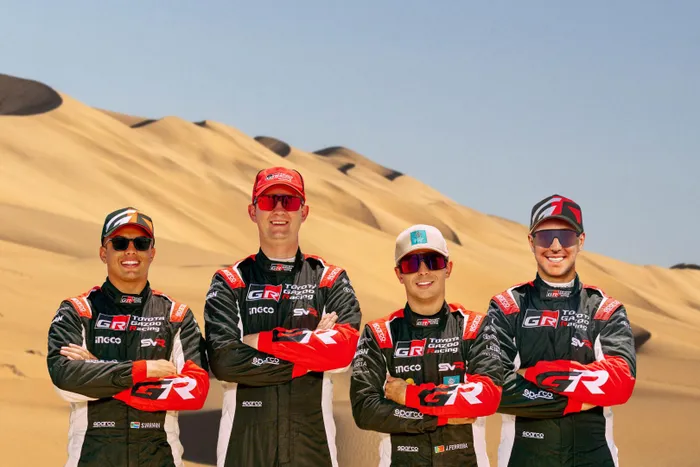
TGRSA Team Principal Shameer Variawa expressed confidence in the team’s readiness saying that the team has worked incredibly hard throughout 2025, both in competition and behind the scenes, to ensure that they arrive at Dakar with a package capable of performing from the very start.
Image: Suppliede / Toyota South Africa DAKAR
TOYOTA Gazoo Racing South Africa (TGRSA) is primed for another major Dakar campaign, fielding four experienced crews and the latest GR Hilux IMT Evo for the 2026 rally (January 3-17).
The route again delivers a long, varied test of endurance – nearly matching the record for special-stage kilometres since the Dakar moved to Saudi Arabia – and TGRSA heads into it with confidence after a full year of development and competitive preparation.
TGRSA announces their teams
TGRSA will enter four crews in Dakar 2026:
- Car #211 Juan Cruz Yacopini (ARG) / Daniel Oliveras (ESP)
- Car #213 Saood Variawa (RSA) / Francois Cazalet (FRA)
- Car #218 Guy Botterill (RSA) / Oriol Mena (ESP)
- Car #240 João Ferreira (POR) / Filipe Palmeiro (POR)
Each crew brings distinct strengths. Yacopini and Oliveras are proven Dakar campaigners with strong event pace; Variawa and Cazalet arrive as reigning South African Rally-Raid (SARRC) champions; Botterill and Mena offer consistency and Dakar experience; Ferreira and Palmeiro contribute European rally-raid pedigree and navigational skill. All four will race the refined GR Hilux IMT Evo, developed through 2025 to sharpen durability, handling and cockpit comfort for diverse sand and rock conditions.
TGRSA Team Principal Shameer Variawa expressed confidence in the team’s readiness: “The team has worked incredibly hard throughout 2025, both in competition and behind the scenes, to ensure we arrive at Dakar with a package capable of performing from Day 1.
“Our testing programme with the latest GR Hilux IMT Evo has been extensive, and we’ve refined every area we possibly can. Dakar is unlike anything else in motorsport, but I believe we’re going into this year’s race with a strong, united team and four highly capable crews.”
Toyota out to make its mark … again
Toyota South Africa Motors vice-president of Marketing Glenn Crompton underlined the event’s strategic value: “Dakar is more than a race for us – it is the ultimate proving ground for the Hilux brand. The environment is harsh, the distances extreme, and the conditions unpredictable.
“It gives us an unmatched platform to demonstrate the Quality, Durability and Reliability that define Hilux, while also helping our engineers to keep building ever-better cars. At the same time, the event resonates deeply with fans around the world. We are proud of the role TGRSA plays on this global stage, and we look forward to another exciting chapter in 2026.”
Development and preparation
TGRSA’s 2025 cycle focused on making the GR Hilux IMT Evo tougher and more usable over long stages. Improvements targeted robustness, suspension and drivability across shifting sand and rock, along with cockpit comfort and serviceability – practical gains that matter across Dakar’s long daily kilometres.
The team combined simulation, track testing and prolonged field running to expose and fix weak points before the start line.
An intense test of resilience
The 2026 route balances outright speed and strategic patience. Organisers have included fewer bivouacs but introduced two marathon stages (one in each week) that force crews to overnight without external mechanical help – a stern demand on planning, mechanical sympathy and self-reliance.
The mix of long-fast tracks, rolling dunes and technical sectors means teams must pair speed with careful preservation of car and crew if they are to prosper across the two weeks.
The route
The rally begins and ends on the Red Sea at Yanbu. After a prologue on January 3, competitors loop north, curl east and south, then return west to Yanbu, with a rest day in Riyadh on January 10.
Across 13 stages, the route sweeps north from Yanbu before curling east and south, eventually bending westwards again to return to the Red Sea coast. Every kilometre will challenge competitors with fast gravel tracks, rolling dunes, rocky passages, and demanding navigation.
And with the second marathon stage looming near the end, fortunes could shift dramatically in the final days.