TOYOTA GAZOO Racing unveils GR GT and GR GT3: race tech for road and track

Toyota Gazoo Racing has revealed their GR GT and GR GT3 prototypes, marrying ultra-low centre-of-gravity architecture, a new 4.0L V8 hybrid lineage and aero-first engineering — a road-legal racer and FIA GT3 contender.
Image: Supplied / TOYOTA GAZOO Racing
Toyota’s performance arm, TOYOTA GAZOO Racing (TGR), has pulled the covers off two striking prototypes — the GR GT and the GR GT3 — signalling a major step in the brand’s motorsport-to-road-car agenda.
Built around a single engineering philosophy — an ultra-low centre of gravity, extreme rigidity at light weight, and aero-first packaging — the pair represent Toyota’s boldest effort yet to fuse race-bred technology with road-going usability.
The GR GT targets purists who want a road-legal car with true competition DNA; the GR GT3 is the full-blooded FIA GT3 racer for customer teams.
GR GT — a road-legal race car for purists
Toyota engineered the GR GT from the ground up as a road car that behaves like a race car. The project began by locking in the lowest practical driver seating position, then arranging powertrain, transaxle and hybrid systems around that anchor to achieve an exceptionally low centre of gravity and a cockpit where driver and machine feel unified.
Under the skin, the GR GT uses Toyota’s first all-aluminium body frame with aluminium and CFRP panels and large castings at structural nodes for high stiffness. The new compact 4.0-litre V8 twin-turbo forms the heart of a hybrid drivetrain paired to a rear transaxle.
Targets include very high system output and torque, a near-ideal weight distribution and a packaging layout (hot-V turbos, dry sump) that keeps the engine low. An all-new eight-speed automatic works with a CFRP torque tube and wet-start clutch to sharpen response.
Aerodynamics led the design: engineers defined the ideal aerodynamic form before styling, producing a low, purposeful silhouette with large intakes, expansive cooling channels and a rear section optimised for high-speed stability. Double-wishbone suspension front and rear, bespoke Michelin Pilot Sport Cup 2 tyres, Brembo carbon brakes, and a multi-stage vehicle stability system round out the performance package.
Inside, the driver-centric cockpit emphasises visibility, reach and quick control access — function over ornamentation, tuned for both high-speed clarity and everyday usability.
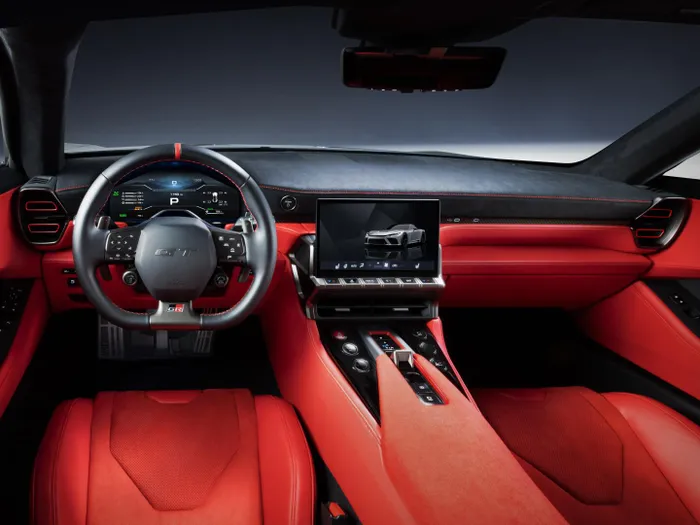
Inside the GR GT and GR GT3, functionality takes priority over ornamentation. The cockpit is shaped around visibility, reach and the intuitive placement of controls.
Image: Supplied / TOYOTA GAZOO Racing
GR GT3 — race car, built to win
The GR GT3 translates the GR GT’s architecture into a competition car built to FIA GT3 rules. It shares the low CG, aluminium structure, aero-first body and the same 4.0-litre V8 lineage, but every element is focused on race durability and predictable, confidence-inspiring handling under extreme conditions. The GR GT3 is aimed at professional teams and gentleman drivers alike, offering a balance of performance and drivability so crews can extract pace without an unforgiving trait list.
TGR plans a customer support programme to back teams with technical assistance, parts supply and development data, mirroring the car’s intent to be competitive across varied grids.
Development, testing and engineering philosophy
Both cars were honed using high-end simulation and extensive real-world testing at Toyota Technical Centre Shimoyama, Fuji Speedway and the Nürburgring Nordschleife, among other circuits, plus public road work to tune comfort and drivability. The team embraced an iterative “drive to failure, repair, refine, repeat” approach to root out weaknesses early and refine performance.
Sound and soul
Considerable effort went into the GR GT’s V8 character: exhaust tuning aims to give the driver aural feedback that reflects throttle, gear and load — not merely volume, but an expressive soundtrack that deepens the human-machine bond.
Charting Toyota’s performance future
Beyond immediate product goals, TGR sees the GR GT and GR GT3 as engineering schoolhouses — platforms to pass motorsport knowledge to a new generation of designers and engineers. Both prototypes are slated for launch around 2027, with further technical specifics promised as development proceeds.