Should World Rugby follow FIFA’s lead to prevent top teams clashing in the World Cup quarter-finals?
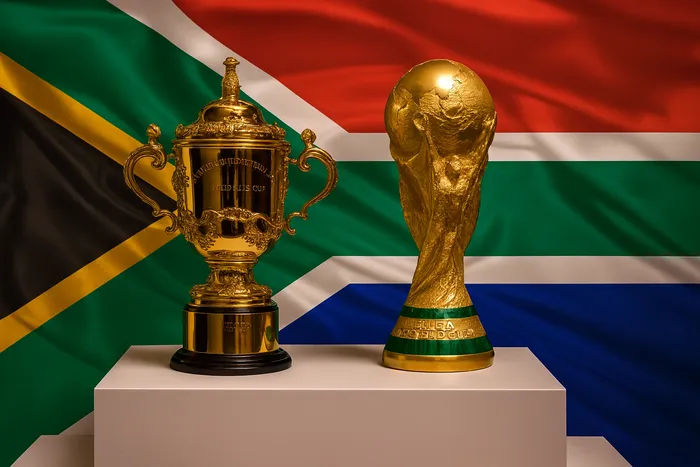
An AI-generated image of the Rugby World Cup and FIFA World Cup trophies side-by-side.
Image: AI-generated: ChatGPT
The draw for the football World Cup was conducted on Friday, and threw up a number of exciting scenarios for the beautiful game at next year’s tournament in North America.
Because of how the teams were ranked, the draw ensures that the top two teams in the world rankings – Spain and Argentina – will only meet each other in the final if they win all of their games.
Crucially, if the top four – Spain, Argentina, England and France – all win their games, they can only meet each other in the semi-finals. It has been like this for ages, and is one aspect of the draw that receives praise from around the world.
Another event that happened earlier this week was the draw for the 2027 Rugby World Cup in Australia. New Zealand, ranked second in the world, were drawn into Pool A, while world number one and current holders South Africa were placed in Pool B.
Because of this, the top two teams are set to collide in the quarter-finals. This has resulted in a lot of criticism of the draw, with former Springbok captain Corne Krige calling it “rigged” to ensure that the top Southern Hemisphere countries knock each other out.
It also doesn’t make sense that the draw takes place so far from the tournament, as so much can change over the next two years. It’s better than the 2023 draw, which took place in 2020, a whole three years before the World Cup. By the time 2023 rolled around, the top four teams – Ireland, South Africa, New Zealand, and France – were all on the same side. By the semi-finals, Ireland and France had already been eliminated.
World Rugby could take a leaf out of FIFA’s book when it comes to organising tournament draws. By ensuring that the top-ranked teams are placed on opposite sides of the bracket, as FIFA does for their World Cup, the likelihood of the best teams meeting before the semi-finals is minimised.
This preserves competitive integrity and guarantees more exciting match-ups deeper into the competition, keeping fans engaged and broadcasters satisfied.
The criticism over the 2027 Rugby World Cup draw highlights the risks of a less structured approach. FIFA’s method rewards teams for their ranking and consistent performance, creating a pathway where the strongest sides are more likely to meet at the latter stages rather than eliminating each other too early.
Adopting a similar system in rugby would make the draw feel fairer and more balanced while still leaving room for surprises and upsets.
Ultimately, sport thrives on unpredictability, but fairness should not be compromised in the process. World Rugby has an opportunity to refine its draw system and prevent scenarios where fans are denied potentially epic semi-finals or finals because of an uneven bracket.
Learning from FIFA’s example could help ensure that the biggest games happen at the most appropriate moments, giving both players and supporters the tournaments they deserve.
IOL Sport
* The views expressed are not necessarily the views of IOL or Independent Media.
** JOIN THE CONVERSATION: Send us an email with your comments, thoughts or responses to iolletters@inl.co.za. Letters should be a maximum of 500 words, and may be edited for length. Anonymous correspondence will not be published. Submissions should include a contact number and physical address (not for publication).