Will Cyril Ramaphosa's R54bn water plan sink or swim?
Infrastructure Funding
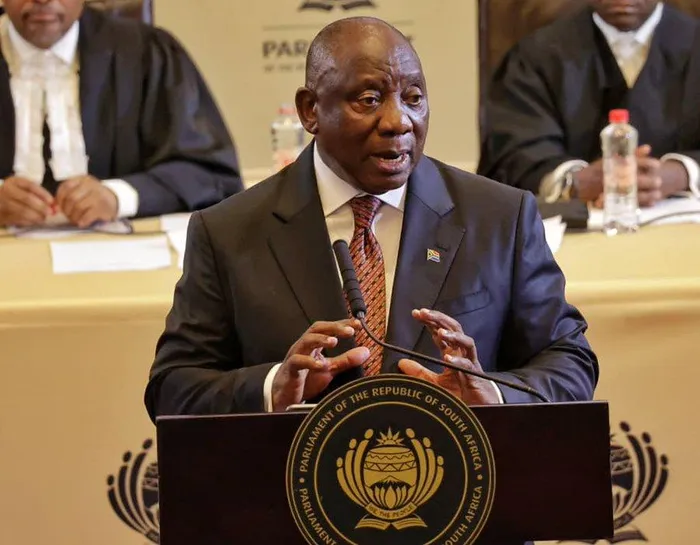
A governance expert says that President Cyril Ramaphosa’s National Water Crisis Committee is not going to yield substantial results because what is required is consequence management, not centralisation.
Image: GCIS
President Cyril Ramaphosa’s R54 billion six-year performance-linked incentive meant to fix water, sanitation, and electricity services in South Africa’s municipalities is likely to be another bailout that disappears into a black hole, a governance expert says.
During his 2026 State of the Nation Address, Ramaphosa announced a new R54 billion incentive for metros to reform their water, sanitation, and electricity services to ensure that revenue from water and electricity is invested in upgrading and maintaining water and electricity infrastructure.
He said the National Water Crisis Committee, which he will personally chair, will deploy technical experts and resources from the national government to municipalities facing water challenges and coordinate all water supply interventions.
Ramaphosa also stated that criminal charges have been laid against 56 municipalities that have failed to meet their water obligations.
He said that criminal charges will be laid against municipal managers in their personal capacity for violating the National Water Act in instances of failure to provide water to communities.
South Africa is currently grappling with water supply issues and crumbling infrastructure, and this has led to multiple protests by angry residents.
There have been calls for heads to roll owing to service delivery failures.
Professor William Gumede, a governance expert from the Wits School of Governance, stated that without removing the leadership that led the country into the water crisis in the first place, the bailout money will disappear without the public getting the much-needed water.
He said there will not be any meaningful turnaround unless the councillors, mayors, and public servants at the local level are changed.
“If you don’t change them, you have to hold them accountable for their performance. If you don’t hold people accountable, it will just be another bailout that disappears, as we have seen, bailouts disappear in state-owned entities,” Gumede said.
He stated that the government has issues of incapability, incompetence, and corruption, and there is a lack of accountability.
“Giving money without changing the leadership that created the crisis is likely going to be a wasteful expenditure. The danger is that this money will likely disappear into a big hole and not even be recovered. It will become another bailout that just disappears with no turnaround whatsoever.”
He highlighted the need to hold people personally accountable for wasting taxpayers’ money.
“Salaries of those responsible for water supply must be docked for every day that the public is without water. Those responsible for the mess must be fired and taken to court,” Gumede said.
He added that voters must hold these people accountable by not voting for them.
“We also have to deal with people who get tenders in the water space. Those who got these contracts must account; if they fail to deliver, they must repay the money or have their assets seized to recover the funds,” Gumede said.
He said even with the president chairing the National Water Crisis Committee, it is not going to yield substantial results, because what is required is consequence management, not centralisation.
“The president appears to be reluctant to discipline certain individuals because they are very powerful politically within his own party (ANC),” Gumede stated.
Dr Ferrial Adam, executive director of WaterCAN, said that the R54 billion incentive is really just a drop in the bucket, and it is not going to get ‘us’ far enough to stave off a disaster.
Adam said Johannesburg has to reduce water losses.
“They need to have a combination of things. They must put into place good systems that will allow for consequence management, be given a budget that they have control over, and focus on the key projects that can create some level of stability, to then tackle leaks aggressively,” she said.
On how residents can use civic platforms to report where funding is not reaching the ground, she said people must join groups on the water issue, and each area should have a water committee to tackle the issues.
“We cannot leave it to ward committees that don’t operate well, and in some parts of the country, they bully activists not to speak out,” she said.
“First, we need to be able to understand how municipalities are spending the money and what has been budgeted. It is through this that we can track progress and understand where the problems lie. For example, on the Brixton Reservoir and Tower, it was supposed to have been completed in April last year (2025), but because of non-payment and other issues, this will only be completed in March 2026. So, through civil society questioning and pushing, we were able to find this out and then put pressure on the city.”
She said residents have to continue pushing for transparency to know exactly who gets what contract, and for the ring-fencing of funds for infrastructure.
The National Treasury, in its fourth quarter local government Section 71 report for the period July 1, 2024 – June 30, 2025, stated that underperformance over the years has created shortfalls across infrastructure development, capacity-building, and other conditional grants.
It said these grants serve a dual purpose of directly improving essential services like water, sanitation, roads, and electricity, while simultaneously promoting socio-economic growth through infrastructure development.
gcwalisile.khanyile@inl.co.za