SONA: Ramaphosa bets on R1 trillion infrastructure blitz to cement economic recovery
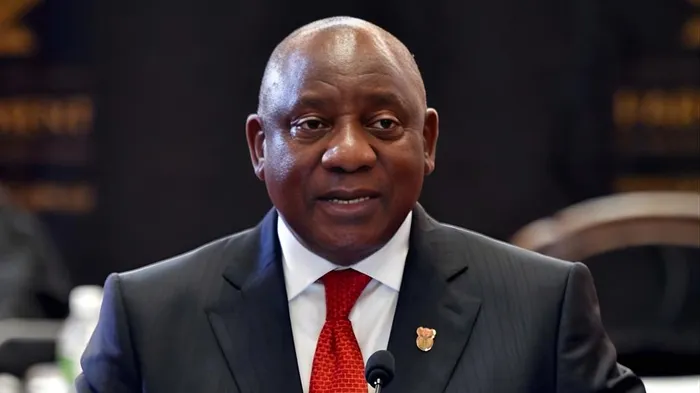
President Cyril Ramaphosa said South Africa's R1 trillion bond placement was the largest in the country's history.
Image: Gov.za
President Cyril Ramaphosa is focusing the Government of National Unity’s (GNU) growth strategy on a historic R1 trillion public infrastructure commitment over the next few years.
Delivering his 2026 State of the Nation Address in Cape Town, the President characterised the allocation – the largest in the country's history – as more than just brick and mortar.
Instead, it is a “transformative” investment aimed at reversing years of declining fixed investment and stagnant growth.
“Through the Infrastructure Fund and new regulations for public-private partnerships, we are using innovative funding models, reducing risk and attracting investors to fast-track projects in energy, water, transport and digital infrastructure,” he said.
A cornerstone of this infrastructure drive was the successful launch of the nation’s first-ever infrastructure bond.
Highlighting robust investor appetite for South African debt, the President revealed that the bond was more than two times oversubscribed.
This surge in confidence suggests that the private sector is increasingly willing to back the state’s long-term development projects, particularly as the government moves toward innovative funding models and new regulations for public-private partnerships.
This comes as Ramaphosa noted that the economic climate has shifted significantly over the past year, citing four consecutive quarters of gross domestic product growth and two consecutive primary budget surpluses.
Ramaphosa credited the strengthening of the rand and the stellar performance of the JSE as evidence of a maturing democratic system that is winning back the trust of both local and international markets.
The local currency recently hit levels last seen in the middle of 2022.
While the currency has been strengthened through positive domestic factors such as South Africa’s removal from the Financial Action Task Force greylist, much has come due to dollar weakness.
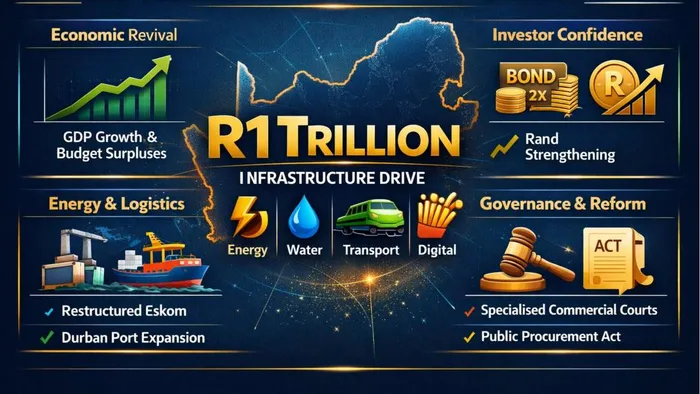
South African President Cyril Ramaphosa has bold ambitions with the R1 trillion infrastructure fund.
Image: Manus
With inflation at its lowest level in two decades and interest rates on a downward trend, Ramaphosa argued that the country has “a unique window of opportunity to translate these gains into sustained growth”.
Yet, Ramaphosa warned of the “cancer” of corruption, and made reference to disputes arising from the implementation of tenders that often delay projects.
“To prevent undue delays in critical projects, we will establish specialised courts for commercial matters with dedicated judges and dedicated court rolls to ensure faster outcomes in matters that have a bearing on the economy and development,” the President said.
Ramaphosa also said that new Public Procurement Act regulations would be finalised by mid-2026.
The energy and logistics sectors remain the primary beneficiaries of this investment push, much of which will be undertaken in conjunction with the private sector.
With load shedding officially declared a thing of the past, the focus has shifted to wrapping up restructuring Eskom and the creation of an independent transmission entity.
In the transport sector, the introduction of private rail operators and the conclusion of a partnership for the Durban Pier 2 Container Terminal mark a decisive move toward a concession-based model.
Ramaphosa emphasised that while the state will retain ownership of key assets, private expertise and capital are now essential to returning South Africa’s ports and rail lines to world-class standards.
“The transformation of our economy is necessary to drive sustained growth, reduce inequality and correct the injustices of the past,” said Ramaphosa.
IOL BUSINESS