Ramaphosa deploys SANDF to combat gang violence and illegal mining
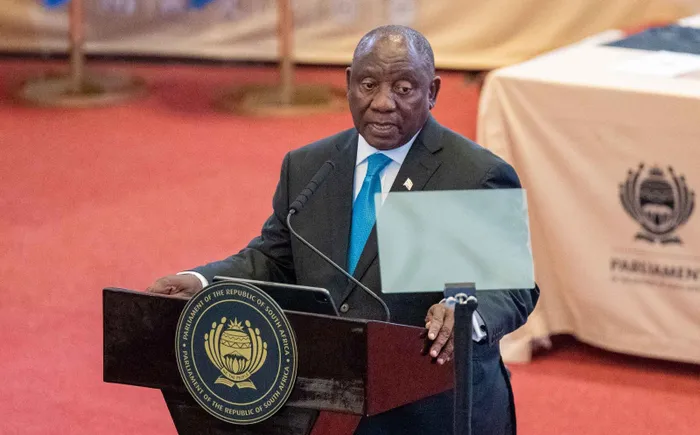
President Cyril Ramaphosa delivered the 2026 State of the Nation Address at the Cape Town City Hall on Thursday night.
Image: Image: Henk Kruger / Independent Newspapers
‘Organised crime the most immediate threat to democracy’
PRESIDENT Cyril Ramaphosa last night said that the fight against organised crime and corruption will be stepped up as he announced the deployment of the South African National Defence Force (SANDF) to deal with gang violence and illegal mining in the Western Cape and Gauteng respectively.
In his 2026 State of the Nation Address (SONA), Ramaphosa declared organised crime as the most immediate threat to the country's democracy and outlined comprehensive plans to strengthen the fight against criminal networks.
“Our primary focus this year is on stepping up the fight against organised crime and corruption, and we will do so using technology, intelligence and integrated law enforcement.
“We will tackle organised crime by consolidating intelligence at national level, identifying priority syndicates and deploying handpicked multidisciplinary intervention teams focused on dismantling criminal networks,” he said.
Ramaphosa also said in strengthening the fight against gang violence and illegal mining, he will be deploying the SANDF to support the police.
“I have directed the Minister of Police and the SANDF to develop a technical plan on where our security forces should be deployed within the next few days, in the Western Cape and in Gauteng to deal with gang violence and illegal mining.”
Parliament will be informed about the deployment and related costs.
“We have to act to rid our country of gang violence,” said Ramaphosa.
Ramaphosa also told the nation that the government was implementing an integrated strategy to address the root causes of crime through coordinated interventions across society.
“We are going to tackle gun crimes by streamlining legislation and regulations on licensing, possessing and trading and firearms and ammunition. We will increase enforcement of existing gun laws.”
The President promised to put more boots on the ground through the recruitment of 5,500 police officers, in addition to the 20,000 new officers announced in previous SONAs.
He added that they were addressing the threat posed by the infiltration of illegal and counterfeit goods to South African jobs and industry.
“We are establishing a National Illicit Economy Disruption Program that brings together key state agencies and other stakeholders, including the private sector, through the effective use of data analytics and artificial intelligence.
“We will be targeting high risk sectors like tobacco, fuel, alcohol and other counterfeit goods.”
Ramaphosa said the Madlanga Commission of Inquiry and Ad Hoc Committee in Parliament have exposed rampant corruption within SAPS and Metro police departments.
“We can’t tolerate this,” he said, adding that the investigations on matters arising from the Madlanga Commission will be conducted swiftly by the newly appointed task team.
The State Security Agency will re-vet the top brass of SAPS and Metro police officers.
“The vetting process will include lifestyle audits as well as we have successfully done with previous commissions. We will use the recommendations of the Madlanga Commission to make far-reaching changes,” he said.
Ramaphosa said they were determined that the commission's findings and recommendations will lay the basis for a fundamental reform of the criminal justice system.
“We are confident that these efforts will succeed, because the great majority of police officers are dedicated to upholding the law and diligently serving the people of South Africa.”
Earlier Ramaphosa urged the nation to draw its strength from the values as articulated in the Constitution.
“Our strength comes from our determination and resolve. It comes from our creativity and inspiration as we navigate this new world,” he said.
According to Ramaphosa, South Africa was stronger than it was a year ago.
“Our economy is growing again. While we have experienced four consecutive quarters of GDP growth, we know that it has to grow much higher and much faster to meet our social and economic challenges.”
Ramaphosa also said the government has brought an end to loadshedding and was building a more dynamic and resilient energy system.
“We have made achievements in improving the performance of our ports and freight rail lines, steadily increasing the volume of goods that we move in and out of our country.”
The president added that the work done to rebuild key institutions from state capture is showing results.
“The South African Revenue Service is once again a world class tax authority. The Investigating Directorate continues with this work and is making progress in the prosecution of those who need to be prosecuted,” he said.
However, Ramaphosa said despite the progress being made, there were still challenges to be faced.
“Although we are moving forward, we must not claim any easy victories. We are still far from where we need to be.”
He noted that for too many people, life remained hard, that jobs were scarce and opportunity was out of reach.
“South Africans are worried about violent crime and corruption. They are concerned at the state of local government and its inability to deliver basic services in many parts of the country.”
But Ramaphosa said the Constitution calls on the government to work towards a society in which every South African has a fair chance to make a better life for themselves.