Geordin Hill-Lewis ‘always the heir’ to DA leadership, claims former party insider
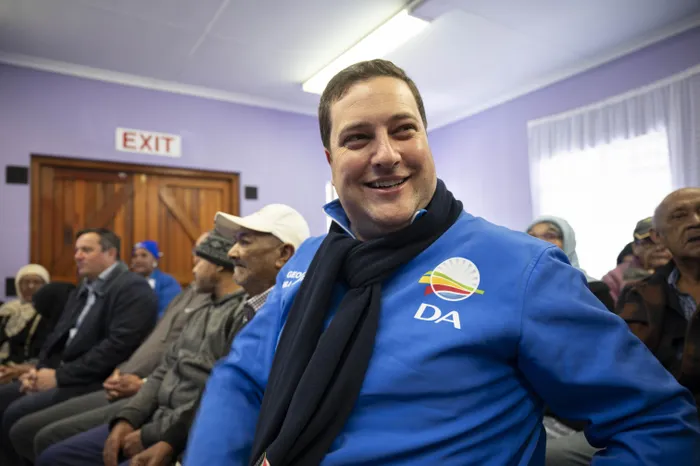
Cape Town Mayor Geordin Hill-Lewis.
Image: Armand Hough / Independent Newspapers
Cape Town Mayor Geordin Hill-Lewis’s emergence as the frontrunner to replace John Steenhuisen at the Democratic Alliance’s April federal conference is no accident, according to a former senior party leader, who says the transition has been years in the making.
Speaking on condition of anonymity, the former DA leader said that Steenhuisen’s decision not to contest the upcoming elective congress came as no surprise internally. In his view, the groundwork for Hill-Lewis’s rise was laid as far back as the period following the departure of former leader Mmusi Maimane.
The source further alleged that Steenhuisen's withdrawal from the race might be linked to an internal party process that cleared him of wrongdoing concerning allegations of misappropriating party funds.
“They had to stabilise his image and that of the organisation,” the former leader said. “The understanding was that he would not contest the conference, and in return, he would retain his ministerial position and benefits.”
The DA has not confirmed any such arrangement.
The allegations against Steenhuisen were initially raised by former DA member Dion George, who accused him of misusing his party-issued credit card. A preliminary investigation conducted by the DA’s Federal Legal Commission (FLC) found no prima facie evidence of misappropriation. The party’s Federal Council later adopted the report.
The investigation was led by FLC Chairperson Glynnis Breytenbach. At the time, Federal Council Chairperson Helen Zille said the expenditure had been fully reconciled and that any limited personal expenses had been adequately explained and reimbursed.
“The report found that the expenditure on the card had been fully reconciled, that there was no prima facie evidence of misappropriation, and that the limited number of personal expenses had been adequately explained and reimbursed,” Zille said when the findings were announced.
The DA has maintained that its internal governance processes are independent and follow established procedures.
Steenhuisen became party leader in 2020 after Maimane’s resignation, taking over during a period of significant internal strain. He had led the organisation on a caretaker basis after Maimane’s departure. The party was grappling with high-profile resignations, particularly among black leaders, and renewed debate about its ideological direction and electoral strategy.
The former senior leader described Steenhuisen’s tenure as transitional.
“He stepped in at a crisis moment. After Maimane left and several prominent black leaders exited, the party needed stability. He provided that. But the long-term project was always Geordin Hill-Lewis,” the source said. “He was groomed for national leadership and positioned carefully over time.”
Hill-Lewis has built a strong profile within the DA, first as a Member of Parliament and later as mayor of Cape Town. He previously served as chief of staff to Zille during her time as Western Cape premier, a relationship that has fuelled speculation about his standing within the party’s upper ranks.
Zille, now chairperson of the Federal Council, has denied orchestrating Hill-Lewis’s rise. She has repeatedly said his trajectory reflects his own competence and record. However, her public praise of the Cape Town mayor has strengthened perceptions that he is the preferred candidate of the party’s dominant faction.
The former leader was blunt in his assessment.
“Geordin Hill-Lewis has always been the heir to the throne and was groomed for this by Helen. Anyone who contests him is going to lose badly. The position already has his name on it,” he said.
The narrative also aligns with Hill-Lewis’s own previous remarks. Last year, he made it clear that he would not challenge Steenhuisen while he remained in the race, stating: “I have absolutely no intention of standing against him as long as he wants to stand.”
karabo.ngoepe@inl.co.za