Sweatshop shock: Parliament wants answers from big SA retailers over Newcastle factory scandal
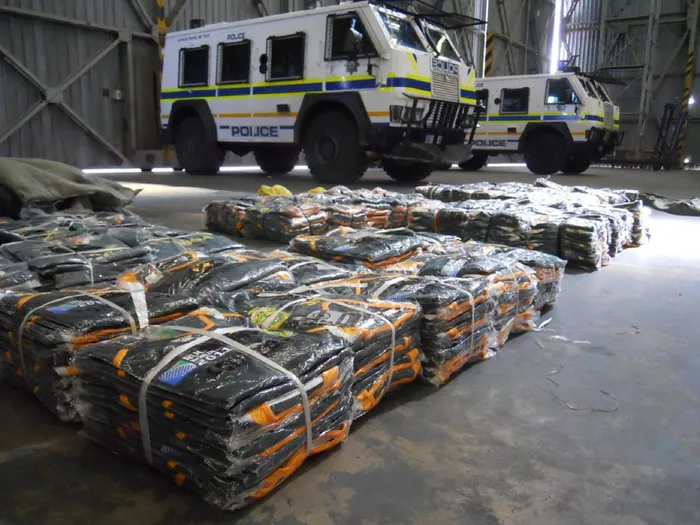
The Department of Employment and Labour, Parliament's Employment and Labour Portfolio Committee, and Department of Home Affairs with the assistance of the police found that factories in Newcastle had been breaking the country’s laws.
Image: SAPS Media Centre
Some of the country’s largest retailers will be called to account for allegedly selling clothes that were being produced by sweatshops in Newcastle, with Parliament’s Employment and Labour Portfolio Committee (ELPC) saying these factories had been breaking the country’s laws, including the municipality’s bylaws and violating human rights.
The retailers, including Pick n Pay, Edgars, the Mr Price Group and Pepkor said the conditions in which clothing was being manufactured contradicted their values that are core to their established supply chain compliance processes.
The ELPC, which led an oversight visit to the Newcastle Industrial Zone last week, vowed to call the large retailers to appear before parliament for ‘supporting manufacturers who are breaking the country’s laws’.
According to a source, who was part of the oversight visit, the factories were subjecting their workers to health-hazardous working and living conditions.
After visiting the industrial zone, the Department of Employment and Labour (DEL) released a statement on February 6, saying some employers were arrested during the joint inter-departmental inspection blitz for abusing immigration laws by hiring 34 illegal foreigners who were working in South Africa without valid documents.
The inspection was conducted by the DEL, ELPC, and Department of Home Affairs with the assistance of the police.
The DEL also said in a statement that major retailers would be called to appear before Parliament.
“During the inspection the joint inter-department operation once again found dozens of illegal workers who reside in premises of the clothing/textile factories.
“The exploitative factories where basic labour laws and other laws of the country are disregarded with impunity are a ‘fatal’ hazard waiting to happen,” the DEL said.
The government officials and MPs found evidence that the factories were producing clothes for, Ackermans, Mr Price, Pick and Pay and other big retailers.
ELPC chairperson Boyce Makhosonke Maneli said, “There was merchandise produced and packaged for delivery to the big retailers as confirmed by the factories.”
The source said: “Most of the time these people are forced to work 24 hours without breaks and without being paid for overtime.
Maneli said almost all companies were found to be non-compliant with the Occupational Health and Safety Act and the National Minimum Wage payment.
“All those who were found to be non-compliant were served with contravention notices and prohibition notices where applicable.
“Indeed the Portfolio Committee will work with other Portfolio Committees on the best way forward in holding everyone accountable,” said Maneli.
Patriotic Alliance MP Juliet Basson took a video of clothing with price tags belonging to some of the big retailers and posted it on social media.
““We have just busted four more sweatshops.
“These sweatshops have a market and are in high demand because our retailers are buying from them.
“These sweatshops have a market due to South Africans,” she said,
She said workers of the sweatshops were treated “less than human”.
Cosatu provincial secretary Edwin Mkhize, who was also part of the oversight visit, said some sweatshops employees were illegal immigrants from Zimbabwe, Lesotho and Swaziland and they complained about not being paid.
“We then told the employers to pay them immediately.
“To our shock those workers were paid in cash an amount of R750 per week while others were paid as little as R350 per week,” said Mkhize.
This is how the retailers responded:
-Pick n Pay said there has been an extremely concerning video circulating about conditions at a production facility that was manufacturing clothing for some of South Africa’s largest clothing retailers, including unfortunately Pick n Pay.
“The factory shown in the video was not approved to produce Pick n Pay Clothing, and has been stopped with immediate effect. In our business, we rely on manufacturers and have strict protocols governing all suppliers, including the contracts they hold with factories. These hold our suppliers accountable for meeting our high ethical standards, and this supplier simply didn’t follow them.”
Pick n Pay added they outsource production but never their integrity or responsibility.
“We are investigating the matter in full, and decisive action will be taken against the supplier based on the outcome.”
-Matthew Warriner Director of Investor Relations and Stakeholder Engagement at Mr Price Group said that Mr Price supports the inspections by Parliament’s Portfolio Committee on Employment and Labour and other authorities into working conditions at clothing factories in the Newcastle area last week.
“Legitimate initiatives to successfully expose and prosecute clothing manufacturers who abuse their workers and undermine South African labour, health and safety laws are welcomed.”
Warriner added that in a disturbing video shared on social media, Mr Price label tags were found at one of the non-compliant factories, along with merchandise produced for other retailers. “Being a value champion does not mean we cut corners on compliance and Mr Price does not condone the production of merchandise in factories with unsanitary and unsafe working conditions. We are therefore treating this matter with the seriousness that it deserves.”
Warriner said that the Mr Price values are core to their established supply chain compliance processes. “Factories selected by our suppliers are independently audited, and our Code of Conduct and our commercial agreement with suppliers make it clear that we do not tolerate the practices exposed in the recent Newcastle inspections.
"Should our enquiries into this matter reveal any breach of our Code of Conduct or supply agreement, we will take decisive steps to address this and hold the responsible parties accountable.”
Edgars said they are aware of a video currently circulating on social media in which one of its brands is referenced.
Norman Drieselmann, Chief Executive Officer of Retailability said that Edgars does not operate or make use of sweatshops. “All suppliers appointed by Retailability, the owner of Edgars, are required to comply with strict ethical, labour and compliance standards as part of our supplier onboarding and review processes."
Edgars added that they remained committed to responsible sourcing and ethical business practices and continued to engage with its suppliers to ensure alignment with these standards.
-Pepkor said that they have become aware of compliance concerns identified during inspections conducted on 5 and 6 February 2026 by the Department of Employment and Labour at certain clothing manufacturing facilities in Newcastle. "Pepkor and its retail brands do not condone any form of unlawful or unethical conduct and require suppliers to comply with the group’s supplier code of conduct. An investigation into the matter has been launched."
Pepkor added that they remain firmly committed to supporting fair and responsible local sourcing. "We are a supporter of the Retail, Clothing, Textile, Footwear and Leather (RCTFL) Masterplan and continue to prioritise local and regional manufacturing as part of our broader commitment to economic inclusion, job creation and the development of a sustainable and responsible local manufacturing industry."