Paul O’Sullivan reveals Ramaphosa's adviser consulted him on SAPS commissioner appointment
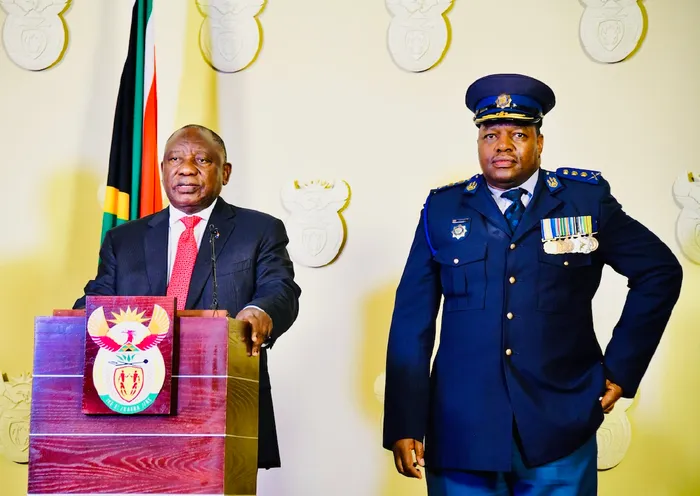
President Cyril Ramaphosa announcing the appointment of General Fannie Masemola as national commissioner of SAPS in March 2022 — a process that forensic investigator Paul O’Sullivan told Parliament he was informally consulted on.
Image: Picture: Siyabulela Duda/GCIS
Forensic investigator Paul O’Sullivan has told Parliament’s ad hoc committee that he was approached by then presidential adviser Bejani Chauke for informal advice during the process to appoint a permanent national police commissioner following the departure of General Khehla Sitole in 2022.
O’Sullivan made the disclosure while responding to questions from ANC Member of Parliament Khusela Diko about whether he had played any role in the appointment process.
“What role did you play in the appointment of the national (police) commissioner, because in media interviews you seemed to be very vocal about the process. What role did you play?” Diko asked.
“I was approached,” O’Sullivan replied.
“By who?” Diko asked.
O'Sullivan responded: “I was approached by Bejani Chauke. I have to tell the truth because I swore to tell the truth, and I don't think I could say anything different to that. I was approached by Bejani Chauke who at the time was special advisor to President Ramaphosa. He informed me that they were looking to appoint a permanent appointee. This is now after Khehla Sitole had been relieved of his duties. They asked for informal advice.”
Sitole’s tenure as national commissioner effectively ended in February 2022 after a legal dispute with President Cyril Ramaphosa over his suspension and fitness to hold office. The Presidency and Sitole reached a settlement agreement, bringing his term to an early conclusion.
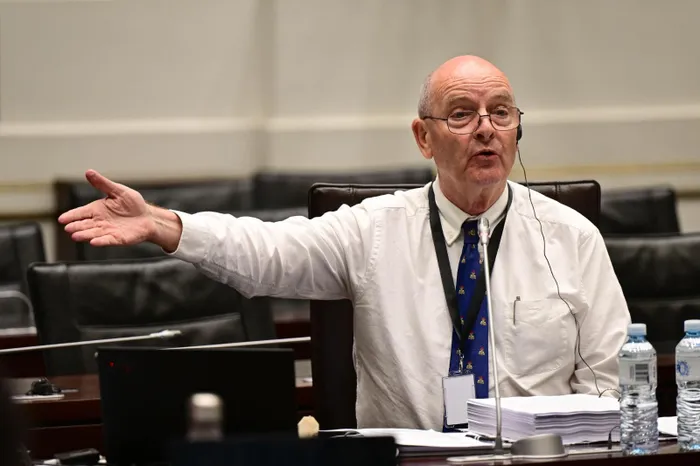
Private investigator Paul O’Sullivan testifying before Parliament’s ad hoc committee in the Good Hope Chambers on Day 2 of hearings into alleged corruption and political interference in the criminal justice system.
Image: Picture Henk Kruger / Independent Newspapers
Sitole was subsequently replaced by General Fannie Masemola, who was appointed by Ramaphosa on 31 March 2022 as national commissioner of the South African Police Service. Masemola had previously served as deputy national commissioner for policing.
O’Sullivan told the committee that he asked Chauke to provide his a list of names of the people on the shortlist for appointment, and the list of names of potential candidates was provided.
“I asked that if you give me the names of the people, which they did. I said we would carry out a lifestyle audit on these people, which we did. We as Forensics for Justice. We carried out a lifestyle audit and I then sent out a report to Bejani.”
O'Sullivan said there were about eight names on the list sent to him by Chauke. Some of the candidates included Masemola and KwaZulu-Natal police commissioner Lieutenant-General Nhlanhla Mkhwanazi, among others he did not name.
“My recommendation was that there were six names on the list that would have been unsuitable for appointment because of their lifestyles.”
Earlier in the session, Diko asked O’Sullivan to explain his claim that former police minister Bheki Cele had “pushed” for Masemola’s appointment, noting that the decision to appoint a national commissioner rests with the president.
“The reason I said that, you could say that is probably speculation, but curious enough I met him again the day before yesterday - the honourable minister of finance (Enoch Godongwana). In 2022 I sat with him on a plane from Durban to Johannesburg. We had a long discussion because at that moment in time there was no permanent commissioner of police. I think it was January or February 2022.
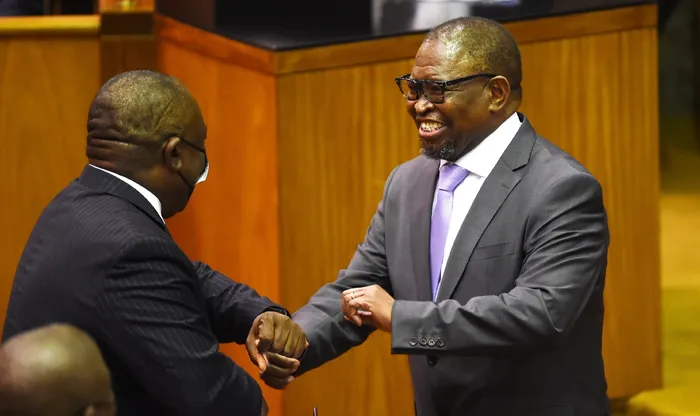
President Cyril Ramaphosa with Finance Minister Enoch Godongwana, referenced during testimony before Parliament’s ad hoc committee where Paul O’Sullivan said he discussed the shortlist for national police commissioner with Godongwana in early 2022.
Image: Phando Jikelo/ Independent Media
“I had a long discussion with him on the plane, and he told me that they had a shortlist and these are the people and what what."
O’Sullivan has previously described himself before the committee as a former British Army intelligence officer who relocated to South Africa and later became involved in policing matters. He founded Forensics for Justice, an organisation focused on investigating alleged corruption within law enforcement structures.
On Tuesday, O'Sullivan told MPs that at one point, he trained Ramaphosa as a police reservist in the late 1990s while lecturing at a SAPS training centre.
“In 1997 one of our students was Cyril Ramaphosa who is today the president of South Africa but then he wasn’t even a politician, he was a businessman,” O’Sullivan said during previous testimony.
He told the committee he lectured in criminal law, police administration and investigation techniques, including modules on constitutional principles and the Bill of Rights.
The ad hoc committee continues to examine allegations of political interference and factional battles within SAPS and the broader law enforcement apparatus, with O’Sullivan’s testimony raising fresh questions about informal consultations surrounding the appointment of the country’s top police official.
jonisayi.maromo@iol.co.za
IOL News