Parliament defends Speaker Didiza against accusations of shielding witnesses
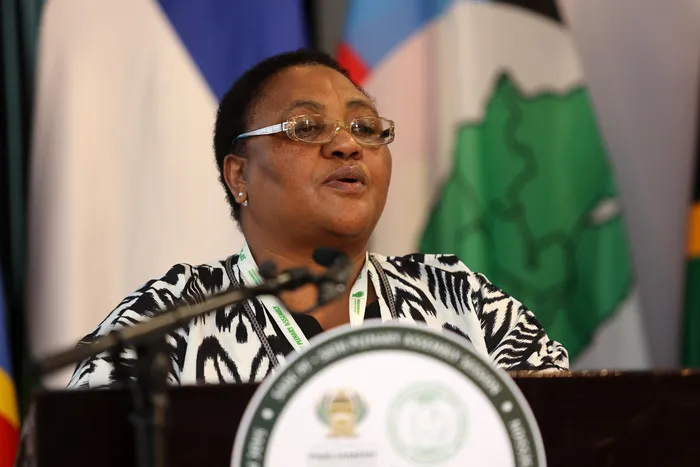
Parliament defends Speaker Thoko Didiza against claims of shielding witnesses Paul O’Sullivan and Brown Mogotsi, asserting her decisions uphold legal standards.
Image: Tumi Pakkies/ Independent Newspapers
PARLIAMENT has rejected accusations that National Assembly Speaker Thoko Didiza is protecting forensic investigator Paul O’Sullivan and North West businessman Brown Mogotsi from appearing before the ad hoc committee.
The allegations, Parliament asserts, "mischaracterise both her role and the legal basis for her decisions."
Didiza's refusal to approve subpoenas for O’Sullivan and Mogotsi has led to a divide within the ad hoc committee investigating allegations of police corruption. The African National Congress (ANC) has supported her stance, while opposition parties, including the Economic Freedom Fighters (EFF) and the MK Party, have accused her of shielding the two individuals from accountability.
In defence of Didiza, Parliament insists that her actions were in accordance with relevant legislation when she declined the committee's request to compel O’Sullivan, who is currently abroad, and Mogotsi to appear in person. Both witnesses have cited security concerns that they claim Parliament has not adequately addressed.
“The assertions that the Speaker is protecting these individuals are incorrect and mischaracterise both the Speaker’s role and the legal basis upon which the decisions were taken,” stated Parliament spokesperson Moloto Mothapo.
The ad hoc committee was established to investigate allegations made by KwaZulu-Natal police commissioner Lieutenant General Nhlanhla Mkhwanazi. Mothapo explained that Didiza’s decisions were based on a “careful and considered assessment” of the committee’s requests and were not made arbitrarily.
“They are firmly grounded in the constitutional and legal framework governing Parliament’s powers,” he added, referencing the Powers, Privileges and Immunities of Parliament and Provincial Legislatures Act, National Assembly rules, and the principle that Parliament must act lawfully and rationally to avoid unnecessary judicial review.
Regarding O’Sullivan, Mothapo noted that records before the Speaker indicate he has not refused to appear. Instead, he has requested to testify virtually, a provision allowed under the committee’s terms of reference.
“O’Sullivan is currently outside the Republic and has raised concerns relating to his personal safety,” Mothapo said.
He further mentioned that O’Sullivan offered to testify from a South African embassy abroad, provided the specific location remained undisclosed for security reasons.
Mothapo highlighted a significant issue with issuing a summons, stating that the committee’s records do not show it adequately considered O’Sullivan’s reasons for requesting a virtual appearance.
“There is no indication that the committee applied its mind to whether his circumstances amounted to exceptional circumstances under its own terms of reference, or to sufficient cause as contemplated in law,” he explained.
Under the Powers and Privileges Act, a summons may only be issued if a witness fails or refuses to appear without sufficient cause.
“On the information placed before the Speaker, that legal threshold has not been met,” Mothapo warned, cautioning that proceeding regardless could weaken Parliament’s position if challenged in court.
He added that O’Sullivan has cooperated by engaging virtually with the committee’s evidence leaders and submitting a written statement. A similar situation arises with Mogotsi, Mothapo noted, as records indicate that the committee did not adequately engage with the personal security concerns he raised about appearing in person.
Mogotsi has expressed a willingness to cooperate and has participated in virtual consultations with evidence leaders. He has requested that appropriate security measures be considered, given the sensitivity of the evidence he intends to present.
“In the absence of proof that the committee properly applied its mind to these concerns - including whether any threat or risk assessment was conducted - the Speaker could not be satisfied that a refusal to appear without sufficient cause had been established,” Mothapo stated.
Didiza has urged the committee to thoroughly engage with the reasons provided by both witnesses and to demonstrate, through minutes and formal resolutions, how those concerns were considered and addressed.
In O’Sullivan’s case, this includes showing that his request to testify virtually was formally tabled, his reasons were considered, alternatives were assessed, and a reasoned, legally justifiable decision was recorded.
For Mogotsi, Didiza requires evidence that his security concerns were formally considered, the credibility of the risks assessed, proposed security measures evaluated, and a reasoned conclusion reached.
“The issuing of a summons is a serious legal measure and must remain an act of last resort,” Mothapo emphasised.
“The Speaker’s actions do not protect individuals from accountability; they protect the integrity, lawfulness and credibility of Parliament and its committees.”