Floyd Shivambu reveals why he left the EFF over alleged corruption and tenders
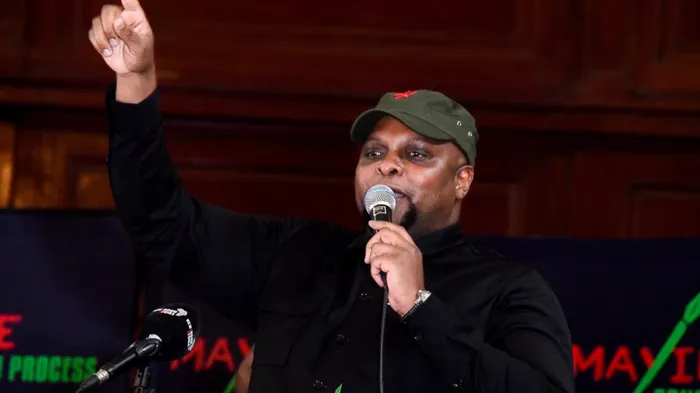
Afrika Mayibuye Movement leader Floyd Shivambu has stated that his disillusionment with the Economic Freedom Fighters (EFF) began when he witnessed the party’s leadership entangled in corruption, particularly within the tender system.
Image: X
Afrika Mayibuye Movement leader Floyd Shivambu has revealed that his disconnection from the Economic Freedom Fighters (EFF) came when he realised the party’s leadership was complicit in the corrupt tendering system that has plagued South African municipalities.
Shivambu, who served as chairperson of the Governor’s Task Unit, disclosed his frustrations in a recent interview on the King David Studio podcast.
In an interview on the King David Studio Podcast, Shivambu described how, after taking on a leadership role within the EFF, he became disillusioned with the party's direction.
He said that, during his time as chairperson, he saw senior party leaders eager to continue the corrupt practices associated with the tender system.
Shivambu said he recounted specific instances where he attempted to confront the issue, notably when he gave verbal instructions and followed them up in writing, urging municipalities to insource workers and abolish tenders for services like security and cleaning.
''As the chairperson of the Governor’s Task Unit, I gave instructions to all municipalities, even those in government, to insource workers. Let’s abolish the tenders on security, cleaners, and everything else.”
However, despite these efforts, Shivambu said he was disheartened to discover that the tendering system remained entrenched, with those working in tendered security contracts often linked to the same people who held power within local governments.
“The people working with our tendering for security in the municipalities were themselves part of the same corrupt network,” he said. “That’s the most tragic thing.”
He expressed his frustration, noting that some of the systemic issues of corruption, especially linked to tenders, cannot be solved through mere speeches or attempts at reform.
"There are certain things you cannot cure no matter what you say, no matter what you preach," he added.
"The corruption, which we identified as a critical issue in our founding documents of Mayibuye, must be eradicated. And the best way to do that is to abolish tenders."
Shivambu highlighted that this position is fundamental to the Mayibuye movement, which advocates for the state to build internal capacity to manage and deliver public services.
"The state must build capacity to perform its own functions. The state should be capable of building schools, managing its own facilities, and employing security guards internally," he stated. "Instead of relying on tenders, the state must have its own capacity to take on far more sophisticated tasks."
He further pointed out that South Africa’s government already possesses the potential to handle far more advanced projects but lacks the will and internal structure to do so effectively.
“During COVID, South Africa manufactured ventilators to assist people in breathing more easily. Some European countries even bought our manufactured products,” he said.
“South Africa has far more advanced capacity to perform its own functions. The problem is we have people going into government with the mindset of getting rich quickly.”
Shivambu also alluded to a deeper issue within the political landscape, where corruption has become normalised.
He argued that the entrenched nature of corruption, particularly linked to the tender system, has resulted in political killings, as politicians and businesspeople vie for lucrative contracts. “Corruption has cost lives. Political killings happen because of tenders,” he said.
Reflecting on the state of local government, Shivambu recalled feedback from consultations in rural areas where elders highlighted the failure of current municipalities.
He noted that many older South Africans, particularly in rural regions, had witnessed more effective governance under the old Bantustan system, which had better internal capacity to meet local needs.
“The people mostly raising concerns were elders, and they spoke about how the Bantustan governments had better internal capacity to respond to the needs of local people,” he said.
He also stressed that local municipalities now operate on a tender-based model that hinders effective governance.
"These local municipalities are tendering governments, existing solely to award tenders for functions that should be performed by the state," he said. "That is the root of corruption in South Africa’s public service, and the tendering system must change."
Shivambu reiterated the need for state institutions to build their own capacity to serve the people and perform essential functions.
"If the state is empowered to perform its own duties at all levels, it will eliminate corruption and also empower many more people," he said.
hope.ntanzi@iol.co.za
IOL Politics