
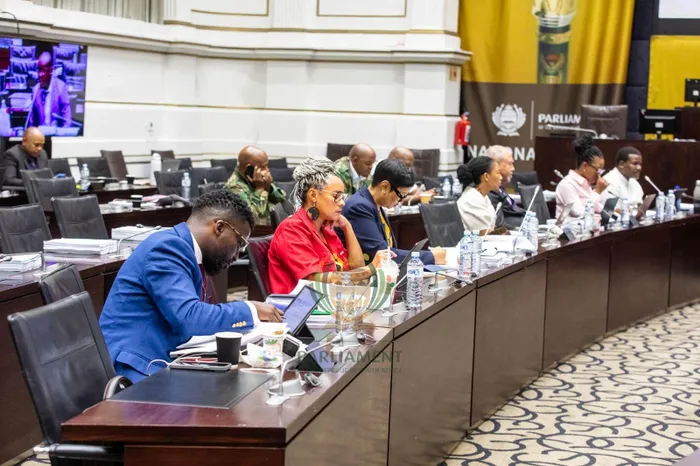
Members of Parliament spar over Paul O’Sullivan and Brown Mogotsi’s testimony, debating security, virtual participation, and legal risks, as time pressures mount ahead of the 20 February committee report deadline.
Image: Parliament of SA
Members of Parliament of the ad hoc committee descended into a heated debate over witness appearances, security demands and Parliament’s authority, as sharp disagreements emerged over whether Paul O’Sullivan and Brown Mogotsi should be compelled to testify physically before the committee.
The dispute arose as the committee considered its programme for the week and correspondence from the Office of the Speaker advising that Parliament pay particular attention to how it responds to security concerns raised by the two witnesses.
The chairperson urged members to focus on appearances scheduled for the current week, noting that later dates could only be shaped once further deliberations had taken place.
ANC MP Khusela Diko said her party had no objection to the programme as presented, noting that the public submissions listed were ones the committee had already approved.
She raised concern about a late request for anonymity by a witness, but accepted that it was within the individual’s rights.
Chairperson Soviet Lekganyane clarified that the witness would introduce themselves publicly on Tuesday, having requested anonymity only for travel and security arrangements.
Diko questioned the absence of a senior SAPS general, a female general who had written to the committee seeking to respond to issues raised by Advocate Andrea Johnson, from the programme. “It’s not a new name. It had been agreed that we would afford her that opportunity,” she said, suggesting the omission may have been an error.
She warned that the committee was under severe time pressure, reminding members that it had agreed to submit its report by 20 February.
“As the African National Congress, we are operating on the understanding that this committee ideally should be wrapping up its work this week or maybe early next week,” Diko said.
On the Speaker’s correspondence regarding O’Sullivan and Mogotsi, Diko said it was “quite disappointing” that Parliament’s legal advisers had not provided clear guidance.
She said the Speaker was correct that Parliament had to formally respond to concerns raised by witnesses, even if those concerns were rejected. “We would be anticipating litigation and we would want to protect Parliament as much as is possible,” she said.
However, Diko said the ANC’s position remained unchanged. “The decision stands that these two witnesses must present themselves before the committee, physically,” she said, arguing that neither had demonstrated extraordinary circumstances.
She said Parliament should spell out what security it could provide and warn that failure to appear would result in a request to the Speaker to concur with issuing summonses.
ANC MP Xola Nqola supported this position, saying the committee had already considered the merits of O’Sullivan’s application.
“There is no less evasive way that we think can be applied to secure the attendance,” he said, accusing the witnesses of deliberately frustrating the committee’s work. “If they say it’s security, we can provide for them appearing. So how are they living now?” he asked.
MK Party MP Sibonelo Nomvalo said the committee could not use a previously adopted witness list to block further names triggered by new testimony.
On O’Sullivan, Nomvalo said the committee should not “nurse people who want to come to Parliament to receive a standing ovation”, adding that O’Sullivan’s demand to appear virtually while refusing to engage with certain parties was unacceptable and would undermine the authority of the chair.
MK Party MP David Skosana said virtual testimony would be “very problematic”, recalling remarks O’Sullivan had previously made about members of the committee.
He raised concerns about consistency and fairness, warning that other witnesses who had already appeared or were still expected to appear should not be treated differently.
Meanwhile, DA MP Ian Cameron said that while physical appearances were preferable, Parliament needed to consider whether a summons would withstand scrutiny if a witness had indicated willingness to testify virtually, including from a South African embassy. Cameron said this created a narrative that the witness was cooperating, making it difficult to justify compelling a physical appearance.
DA MP Damien Klopper said that if any witness appeared virtually, all parties had to be allowed to participate fully. “They cannot be selective answering just to certain parties,” he said.
EFF leader Julius Malema launched a blistering attack on both the witnesses and the Speaker, accusing Parliament of being pressured into granting special treatment. He said O’Sullivan and Mogotsi had shown “no regard for Parliament” and were attempting to dictate terms to the legislature.
“They want private chefs, they want houses and not hotels, they want this and that,” Malema said, adding that such demands amounted to intimidation.
Malema openly rejected the position advanced by the Democratic Alliance, saying Parliament should not accommodate virtual appearances or special security demands. He warned that doing so would amount to capitulating to intimidation and privilege.
“I don’t agree with the DA,” Malema said, appealing to members of the committee “to completely reject this privilege that is being proposed by the DA and the Speaker”.
Malema said accepting these demands would create a dangerous precedent. “You’re going to create a situation where anyone who doesn’t want to come before Parliament simply says, ‘I’ve got security concerns,’” he warned.
He questioned the absence of any security assessment backing the claims. “Where is the security report that confirms this guy has got security threats?” he asked.
He accused Parliament’s legal team of protecting O’Sullivan and Mogotsi, saying, “The protection of Paul O’Sullivan is continuing - now it’s happening in Parliament.” Malema rejected the notion of exceptional circumstances, saying none had been demonstrated, and warned that Parliament should not “succumb to being intimidated”.
EFF MP Leigh-Ann Mathys questioned why the Speaker had only responded at the end of January, despite the committee raising the issue months earlier. She asked whether the Speaker would provide a written explanation for the delay.
Patriotic Alliance MP Ashley Sauls aligned with this position, rejecting any suggestion that Mogotsi’s demands be accommodated.
Sauls said Mogotsi’s demand that Parliament pay for private security was “disrespectful and unreasonable”.
He said witnesses should accept the security Parliament provides to everyone. On O’Sullivan, Sauls said, “It’s no longer a request. It’s now a legal mandate,” arguing that virtual testimony would not serve the interests of justice because the witness could disengage at will.
He warned that O’Sullivan would effectively control his own appearance, saying that if he did not like the questions, “all he can do to leave the meeting is just press a button”.
Freedom Front Plus' MP Wouter Wessels cautioned that while the frustration with O’Sullivan was understandable, the committee had to decide whether it wanted his testimony before the deadline.
He warned that if O’Sullivan was overseas, a summons would likely result in litigation that could delay proceedings beyond 20 February.
“If we summon, we should accept the fact that he’s not going to appear before the 20th of February,” Wessels said, warning that taxpayers could ultimately bear the cost of a legal battle.
He said members needed to weigh whether making a point was worth excluding the testimony from the final report.
hope.ntanzi@iol.co.za
IOL Politics