Rising crime in South Africa: experts warn of organised crime's growing influence
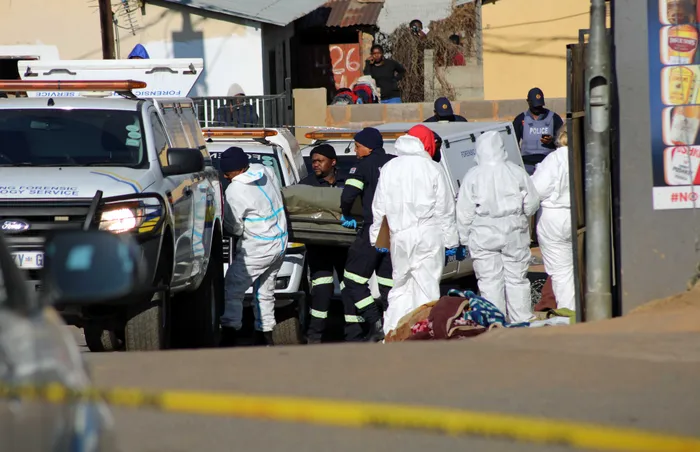
Crime experts give their views on which crimes will be on the rise this year with mass shootings as part of the mix.
Image: Timothy Bernard African News Agency (ANA)
As South Africa gets deeper into 2026, crime experts said a slew of crimes are on the rise, with crime syndicates and cyber criminals gaining the upper hand over a crippling and buckling criminal justice system.
From gang-related mass shootings to sophisticated cyber-enabled fraud, organised crime is becoming more entrenched, complex, and difficult to combat. Experts warn that without decisive action, the country risks a deepening cycle of violence and criminal control that will be increasingly difficult to reverse.
Independent crime researcher Calvin Rafadi has warned that organised crime in South Africa is becoming more deeply entrenched and far harder to eradicate, particularly in communities already plagued by gang activity and economic marginalisation.
Rafadi pointed to persistent gang-related violence in the Western Cape and other parts of the country, citing mass shootings at taverns and entertainment venues spaces traditionally meant for social gatherings that have increasingly become scenes of fear and bloodshed.
“These attacks are not random,” Rafadi noted. “They are often linked to organised criminal activity, turf wars and the consolidation of power by violent gangs.”
According to Rafadi, SAPS detectives are overwhelmed by the sheer volume of serious and violent crime cases, leaving limited capacity for thorough investigations. He stressed that Crime Intelligence must play a far more proactive role, shifting from reactive responses to intelligence-driven interventions aimed at dismantling organised crime networks before violence erupts.
He further advocated for the deployment of the South African National Defence Force (SANDF) as a force multiplier in already identified crime hotspots. Such deployments, Rafadi argued, could assist in removing illegal firearms and ammunition from gangs that continue to terrorise communities with near impunity.
Beyond enforcement, Rafadi emphasised the need for a whole-of-society approach to crime prevention. He called on government departments particularly Social Development to work closely with civil society organisations, NGOs, NPCs, business leaders and faith-based groups to expand access to drug rehabilitation programmes.
“Drug abuse among the youth remains a major driver of violent crime, social decay and gang recruitment,” he said. He warned that failure to address substance abuse will undermine any long-term crime prevention strategy.
Acting Minister of Police Firoz Cachalia has already admitted that the South African Police Service (SAPS) are not adequately equipped to deal with crisis. Speaking during a crime-focused media briefing at Gqeberha City Hall in Nelson Mandela Bay, Cachalia said,“I do not believe we are currently in a position to defeat gang violence in the Western Cape.the scale and intensity of organised crime here has outpaced the resources and capacity available to SAPS.”
City of Cape Town Mayor Geordin Hill-Lewis said the minister’s comments confirmed what communities in gang-affected areas have long experienced: an overstretched and under-resourced police service. He called for greater resourcing of SAPS and improved coordination with municipal law enforcement to respond effectively to rising levels of organised crime.
Dr. Simon Howell, a criminology researcher at the University of Cape Town, welcomed the acting minister’s honesty. “For the first time, the minister’s response was really good. It’s an honest acknowledgement, and honesty is, frankly, the best policy here. It’s the basis for starting to do something useful,” he said.
Howell cautioned, however, that policing and military intervention alone cannot solve gangsterism.
“They have a place in our response, but they can’t be the only solution, they can’t be the main solution, and they certainly can’t be the long-term solution. What we need is to develop communities and people so that gangsterism is no longer a viable alternative lifestyle,” he explained.
Meanwhile, crime expert Chad Thomas believes 2026 will see a dramatic rise in cyber-enabled crime, particularly scams linked to fake investment opportunities.
“I foresee a massive increase in cybercrime involving fraudulent crypto and forex investments,” Thomas said.
“There is also a marked rise in deep-fake technology being used to impersonate family members and friends to extort cash.”
Thomas warned that policymakers and civil society must urgently prioritise public education around targeted online scams, especially those involving non-existent investment platforms and digital currencies. On violent crime, Thomas noted a sharp increase in mass shootings, largely emanating from protection rackets, turf wars and illicit organised crime activities. He further predicted an increase in express kidnappings and a surge in gang conflict, driven by leadership vacuums within competing gangs vying for territorial control.
Commenting on the acting minister’s remarks and the broader state of policing, Thomas said organised crime appears to have the upper hand, though there are signs of renewed appetite within SAPS and the Directorate for Priority Crime Investigation (DPCI) to push back.
“2026 will be a defining year,” he said. “It will determine who truly controls communities, the police or the criminals. This is the moment for the State to win back public confidence.”
Thomas called for a fundamental overhaul of policing structures, including delegating investigations of less serious crimes to local and provincial law enforcement agencies. He stressed the need for expanded detective training, capacitation of Crime Intelligence, and stronger oversight of secret service accounts through independent accounting mechanisms.
Looking back over the past five years, Thomas identified significant increases in cyber and commercial crime, kidnappings, murder-for-hire cases and illicit mining, all forms of organised crime that require intelligence-led operations to infiltrate syndicates.
“These crimes can only be countered through coordinated intelligence operations, prosecutorially guided investigations by SAPS and the DPCI, and the establishment of more specialised courts,” he said.
“Crime in South Africa is not simply about emerging trends it has always been present, but it has evolved, much like a growing infant that matures into an adult,” said Mike Bolhuis, prominent South African private investigator and head of Specialised Security Services (SSS).
“Over time, it has developed into a fully organised system of racketeering that affects nearly every aspect of our communities and livelihoods.”
Bolhuis stressed that addressing the crisis requires drastic intervention. “Everything must be redone - a clean sweep. We need a new president, a new government, and a new police force. There is no other way. You cannot cut away pieces of a rotten apple and expect it to recover; the system is rotten to the core.”
He argued that meaningful reform depends on rebuilding public trust through firm leadership and a zero-tolerance security infrastructure.
“The public mindset can only change when people are guided by a respected authority. Without that, you risk a lawless society where individuals act without consequence.”
Bolhuis warned that while crime has deep roots, its sophistication has increased significantly. Cybercrime, once relatively isolated, is now intertwined with economic and violent offences.
Weekend Argus reached out to the National Acting Minister of police Firoz Cachalia for comment, but he advised that he will outline his priorities and plans for 2026 shortly after convening a strategic session with the Ministry and SAPS Top Management.