Cabinet Lekgotla: Steenhuisen's call for economic focus and job creation
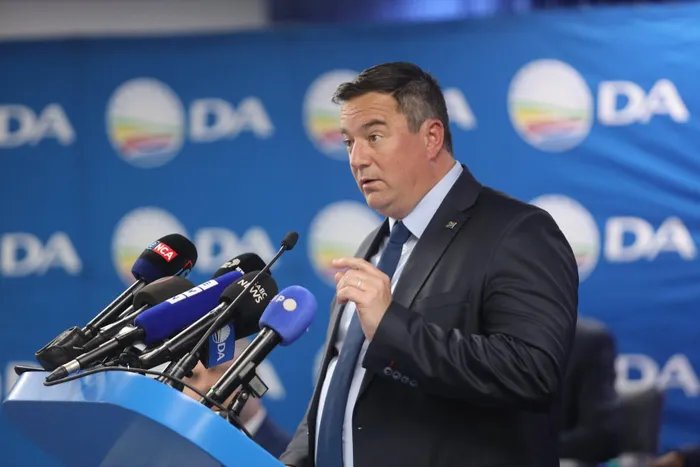
DA leader John Steenhuisen says job creation shouldn’t rest solely with President Cyril Ramaphosa or the National Treasury but rather with ministers in their portfolios.
Image: Timothy Bernard / Independent Newspapers
Ahead of the Cabinet Lekgotla scheduled for next week, Democratic Alliance (DA) leader John Steenhuisen has articulated his expectations regarding critical discussions that could significantly shape the forthcoming State of the Nation Address and the 2026 budget.
Steenhuisen emphasised that a focus on the economy and job creation is paramount, stating, “nothing else makes sense unless we're setting out very clearly how we intend to grow the economy and create jobs”.
He noted that job creation shouldn’t rest solely with President Cyril Ramaphosa or the Treasury; rather, it is the responsibility of every minister in government to demonstrate progress in their respective sectors.
“I think we all need to be held accountable for how many jobs we're creating in our programs and in our sectors,” he said, emphasising a collaborative effort amidst challenging economic circumstances.
“We have to get South Africans working and South Africa to work.”
Praising recent economic indicators, including the nation’s exit from the Financial Action Task Force (FATF) grey list, the lowest inflation in 21 years, and a robust rally of the rand, Steenhuisen acknowledged that while these are positive signs, the country must “turbo charge” its efforts to accelerate economic growth.
“We need to solidify the gains we've made through our partnerships with the private sector through projects like Operation Vulindlela that have really yielded fruit in the energy, logistics and transport spaces. And we need to build on those successes now going forward.”
As attention turns toward the budget to be tabled by Finance Minister Enoch Godongwana on February 25, Steenhuisen offered insight into the workings of the Government of National Unity (GNU).
Last year, Godongwana was forced to re-table the budget after the DA was in the forefront in rejecting VAT increase and making some demands, among other things, before the budget was passed.
This led to some compromises and consensus being reached on the budget and this transcended to passing of the Adjustment Budget with ease earlier this month.
Steenhuisen underscored the importance of a learning curve approach after negotiations led to significant compromises during last year’s budget discussions.
“I think that the collaborative approach we've seen on the Medium Term Budget Policy Statement is the consensus that I think we'll see going into budgets going forward,” he stated.
The inherent challenges of coalition governance, as outlined by Steenhuisen, hinge on the ability to negotiate and find middle ground.
With an awareness that coalitions demand adaptation, he affirmed, “It doesn't matter whether you’re in Germany, Brazil, or any other part of the world, that’s how coalitions work, and without that consensus, coalitions will fall.”
Attributing the sustained operation of the GNU to strong leadership, he reasoned that mature, country-first behaviours were essential for progress.
Steenhuisen noted that despite many critics saying the GNU wouldn't last more three months, it was still standing.
“The economy is moving in the right direction. The indicators are moving in the right direction. There's a wind in our sails again and I think we've got to build on that now going forward,” he said.
“That requires strong, stable leadership that ensures that we are behaving in a mature way and in a country-first way. We have to put South Africa first, and put people of South Africa first, ahead of petty posturing,” said Steenhuisen.
As the DA continues to assert its influence, the DA leader warned that no legislation would pass Parliament without their support, noting the unsuccessful VAT increase last year as a key example.
“We've developed, through the Chief Whips Forum, a mechanism to deal with upcoming legislation to try and iron out problematic legislation and clauses within legislation before it even gets to the parliamentary arena, so that we can try and avoid some of the things we've seen in the past,” he said.
The DA leader conveyed that the approach to new legislation necessitates cooperation in the GNU— a marked contrast to previous parliamentary interactions.
“It requires legislative cooperation and collaboration to get bills through. That's certainly, I think, the way coalitions should handle it all over the world, and I don't think it's unique to us,” said Steenhuisen.
mayibongwe.maqhina@inl.co.za