WATCH | Malema back in court, legal expert warns prison is a 'real possibility'
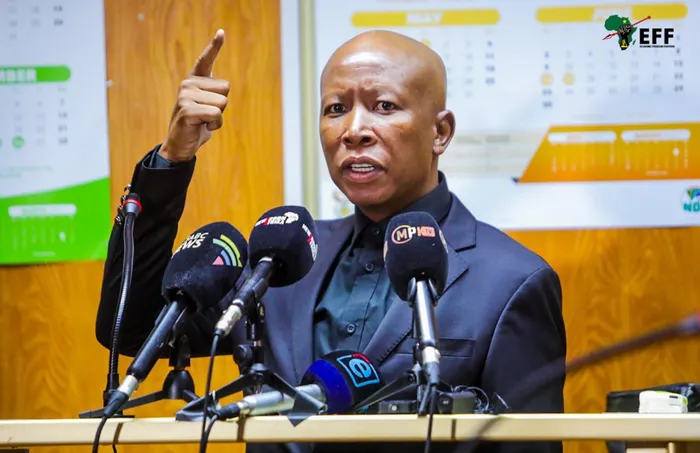
EFF leader Julius Malema
Image: FFILE
Julius Malema returns to the East London Magistrate’s Court on Friday for pre-sentencing proceedings in his firearm case.
The EFF leader was convicted on multiple firearm charges, including unlawfully possessing a firearm and ammunition, and discharging a firearm in a public place.
This followed footage showing Malema firing a rifle during the party’s fifth birthday celebrations at Sisa Dukashe Stadium in Mdantsane in 2018.
In delivering the guilty verdict in October, magistrate Twanet Olivier said the court had rejected Malema’s version of events and found the state had proved its case beyond a reasonable doubt.
Malema, who pleaded not guilty, maintained the eight-year-old case against him was politically motivated and indicated he would appeal any sentence imposed.
His co-accused and former bodyguard, Adriaan Snyman, was acquitted.
Snyman had been accused of supplying the firearm to Malema, but the court found there was insufficient evidence to link him to any crime.
Meanwhile, East London has been awash with EFF supporters who have travelled from across the country to attend the proceedings.
A night vigil was held at the Orient Theatre on Thursday night ahead of the pre-sentencing hearing.
EFF national spokesperson Sinawo Thambo said it was a political attack.
"We are not expecting anything from this racist [magistrate]," she said.
"The [magistrate] has nothing on Julius Malema.
"As we know this is an old political motivated case ... they want to make [US President Donald] Trump happy by putting [Malema] behind bars."
Top defence lawyer and legal expert William Booth said the proceedings will involve the defence presenting evidence in mitigation of sentence.
“In other words, this will deal with the accused’s personal circumstances and any issues relevant to sentencing,” Booth explained to IOL.
“During the pre-sentencing stage, the defence may submit pre-sentence reports from social workers or other professionals, as well as character references and other evidence aimed at persuading the court to impose a lighter sentence.
“This could include information about Malema’s background, his role in the community, and his position as a Member of Parliament and leader of a political party.”
Booth said the state was expected to present evidence in aggravation of sentence.
“This may include arguments that unlawful possession of firearms is a serious offence, particularly given the number of illegal weapons in circulation and the harm they can cause,” he said.
“The magistrate will then weigh the mitigating and aggravating factors before deciding on an appropriate sentence.
“In doing so, the court will consider three key aspects: the personal circumstances of the accused, the seriousness of the offence, and the interests of the broader community.”
Booth said after the pre-sentencing proceedings, Olivier was expected to hand down a sentence.
He said direct imprisonment was a sentencing option available to the court and could be imposed for up to 15 years.
“In cases involving the unlawful possession of an automatic or semi-automatic firearm, the prescribed sentence is 15 years’ imprisonment,” Booth said.
“However, the court may impose a lesser sentence if the accused can show what the law describes as substantial and compelling circumstances.”
Booth said that while commonly referred to as “minimum sentences”, the term can be misleading.
“The law does not mean a fixed sentence must automatically be imposed, but rather sets a benchmark from which the court may depart under specific conditions,” he said.
“Firearm offences are generally treated as serious, given the prevalence of illegal weapons and the danger they pose to the public.
“As a result, direct imprisonment remains a strong possibility, though each case is ultimately decided on its own facts and merits.”
Political analyst Prof André Duvenhage, of North West University, said that should a jail sentence be imposed on Malema, he would effectively lose his position as an MP and within legislative institutions.
"In that sense, his political career would be at stake," Duvenhage said.
"He is expected to organize and mobilize political support to signal that he still enjoys grassroots backing and maintains his innocence.
"However, it is unlikely that such mobilisation would influence the court’s decision."
Another political analyst Zweli Ndevu said a prison sentence for Malema will have serious consequences to his political career and the continued existence of the EFF.
"This will mean that he loses his seat in Parliament and cannot run the party from prison which means the leadership vacuum may lead internal fighting," he said.
"This scenario may not be something that would happen anytime soon, we know that whatever happens today, he is going to appeal and that maybe mean that there is a long way before the matter is resolved."
IOL