Godongwana plays down G20 snub, says Africa’s voice is intact despite SA exclusion
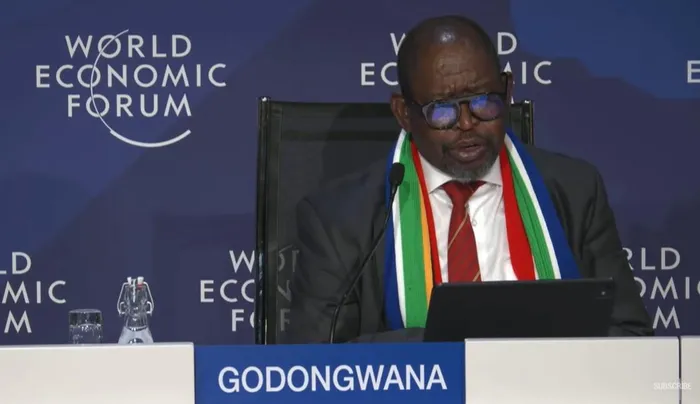
Finance Minister Enoch Godongwana speaking at the World Economic Forum in Davos on Thursday during a media briefing on South Africa's successful hosting of the G20 Summit.
Image: YouTube screengrab
Finance Minister Enoch Godongwana has sought to reassure investors that Africa’s voice in global affairs will not be silenced despite South Africa’s absence from the G20 process in 2026 in the United States amid growing geopolitical tensions and uncertainty in global relations.
Responding to concerns about South Africa being blocked from participating in the G20 in 2026, alongside reports of some African countries facing restrictions on travel to the US, Godongwana on Thursday described the development as a “temporary setback” rather than a structural exclusion from global decision-making.
Godongwana was speaking at the World Economic Forum in Davos on Thursday during a media briefing on South Africa's successful hosting of the G20 Summit in 2025.
"The structure of the G20 for now is that the founding member on the African continent is South Africa. Subsequent to that, the AU (African Union) has been accepted as a permanent member," Godongwana said.
"There have been two countries which have been permanent invitees because we've been trying to increase the voice of Africa, the permanent invitees, Nigeria and Egypt."
South Africa held the G20 Presidency in 2025 and held a successful Leaders' Summit in Johannesburg in November.
However, the US delegation did not partake after US President Donald Trump decided not to travel to Johannesburg due to his misconstrued perspective of South Africa's empowerment laws and foreign policy direction.
Meanwhile, Godongwana said he was not aware of Nigeria or Egypt being blocked from participation, but confirmed that South Africa would not take part in the G20 in 2026 in Miami, Florida, due to an accreditation issue, not because it had been formally expelled from the grouping.
"What we do know is that South Africa is on leave in 2026. [We] have taken leave not because the Americans can chase us out of the G20, but they hold an important instrument, the accreditation," he said.
"If you don't have the accreditation, you can't get into the ring, even if you're around. So they won't accredit us. But the African Union, in terms of African voice, is still in as a member. We must take this purely as a temporary setback for 2026."
Looking ahead, Godongwana expressed confidence that the situation would not extend beyond a single year, noting that the G20 presidency in 2027 is unlikely to adopt a similar stance.
"2027, the president is going to be the UK. I doubt if the UK will take a similar posture. So it's a temporary setback for 2026 only."
The comments come at a time of heightened global fragmentation, with shifting alliances and growing questions about multilateralism and the role of emerging economies.
Meanwhile, the G20 last year endorsed reports on the framework for effective planning and preparatory practices, on blended finance de-risking measures, the cross-border infrastructure toolkit.
These are expected to provide practical solutions to developing a credible pipeline of projects.
The G20 also made recommendations on addressing low-income country debt and the cost of capital for the low and middle income countries primarily through a common framework for debt restructuring, though implementation has been slow.
At the briefing on Thursday, Minister of International Relations and Cooperation, Ronald Lamola, also said the G20 leaders had agreed that critical minerals that the world needs should benefit those countries and communities where those minerals are found and extracted.
"Beneficiation at source also spoke on issues of artificial intelligence, the role of the African continent, particularly in research and innovation. Also a report by Professor Joseph Stiglitz on inequality, which recommended a high-leve panel which we also look forward to take through various multilateral platforms," he said.
BUSINESS REPORT