Funding challenges hinder Mozambique-South Africa border wall construction
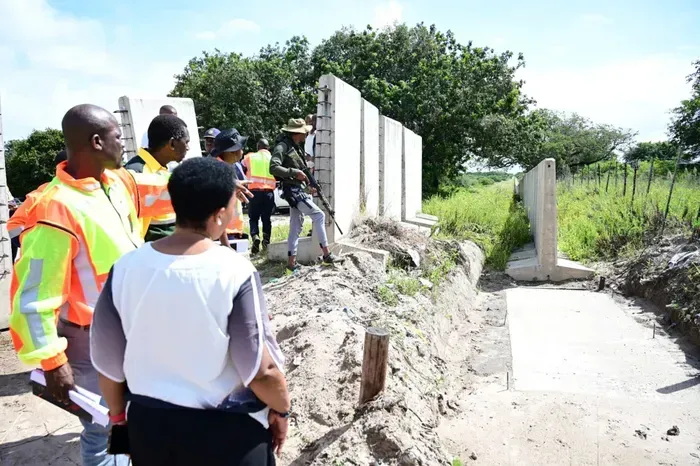
Then KwaZulu-Natal Premier Nomusa Dube Ncube, when she was inspecting the progress in the construction of the concrete wall along the South Africa/Mozambique borderline in uMkhanyakude.
Image: Independent Media archive
Although a Northern KwaZulu-Natal community is breathing a sigh of relief now that there is a part of a Jersey Barrier Wall along the Mozambique/South Africa borderline to impede cross-border criminal activities, it wants this barrier to be extended all the way to the Indian Ocean.
This was revealed by Mayor Sphile Mdaka of Umkhanyakude district municipality, where the concrete barrier is being constructed, who said the project has run out of funds.
The aim of the wall, which was planned to cover 25 km of the border line for R85.7 million, was to stop the smuggling of vehicles hijacked or stolen from KwaZulu-Natal urban areas such as Durban, to Mozambique through Maguzi town.
Mdaka stated that the wall should extend all the way to the Indian Ocean to prevent criminals from finding alternative crossing routes.
The project was launched in 2018 after then-President Jacob Zuma visited the area in 2017 to engage with the communities of uMkhanyakude, Hlabisa, and Jozini municipalities, as well as local police, who expressed concerns about rising crime levels.
The communities had attributed the high level of crime to the weak borders of Swaziland and Mozambique.
It has been reported in the past that hundreds of SUVs, bakkies, minibuses, and sedans were being smuggled to Mozambique.
Some of them had been stolen from Durban Central, Durban North, Westville, Chatsworth, Pinetown and Umhlali.
During Zuma's visit, members of the South African National Defence Force (SANDF) were using huge rocks to block vehicle smuggling routes.
The ANC Youth League in the region suggested the construction of a big wall.
Mdaka said that where the wall has already been constructed, there has been a noticeable decrease in cross-border criminal activities.
Although borders are the responsibility of the Department of Home Affairs’ Border Management Authority, Mdaka said the construction of the wall was initially funded by the KwaZulu-Natal Department of Transport.
“We engaged Sihle Zikalala about the matter when he was the minister of Public Works, as the issues of construction should be under Public Works.
“But there is no budget to continue with the wall now,” said Mdaka.
He said the district was engaging the provincial transport department for further funding.
“I heard that they (provincial transport) are engaging the new minister of Public Works (Dean Macpherson) about the issue of the border, which is a national issue,” he said.
He said the wall was bearing positive results.
“Already there is an impact in terms of stopping the smuggling of vehicles, and now they (criminals) need to look elsewhere to find another crossing route.
“But until you seal the whole area, you will still have a problem because they (criminals) still find another route, as there are still lots of other areas which have not been covered by the wall,” he said.
He could not say when the construction stopped, how much had been contributed by the provincial transport department, and how much further money was required to complete the project.
Mdaka said the already constructed wall starts from Elephant Park to Kosi Bay, and suggested that it should end at the shore of the Indian Ocean.
He said where the wall started was the major spot for vehicle smuggling.
Mdaka’s spokesperson, Vukile Mathabela, later responded in writing, directing further questions to the provincial Transport and Human Settlements.
“From a district perspective, we believe that the wall will assist the district in its efforts to combat crime,” said Mathabela.
Public Works spokesperson James de Villiers said the department does not budget for such projects.
“The border wall is the property of Home Affairs, which should allocate the budget to us as the implementing agency to issue a tender for the procurement of the wall.
“We are unable to procure without money being allocated to us,” he said.
He said there are instances where government departments would construct infrastructure without involving Public Works.
“Transport, for example, would build roads without us being involved at all.
“Departments (education and health) would build schools and hospitals without us being involved,” he said.
However, the Portfolio Committee on Public Works and Infrastructure Department embarked on an oversight visit to assess the progress of the construction in October 2020.
The committee said in a statement dated October 9, 2020, that the project is spearheaded by the Department of Public Works and Infrastructure in conjunction with the KwaZulu-Natal Provincial Government’s Department of Transport in response to complaints raised by communities in the area in 2016.
Home Affairs has not responded to questions sent to its spokesperson, Carli van Wyk, on Tuesday morning.
During her visit to the area in March 2024 to inspect the progress in the construction, then Premier Nomusa Dube-Ncube said initiatives to fight cross-border crime were yielding positive results, “as several high-profile criminals have been arrested and are facing prosecution”.
She called on the provincial transport to fast-track the completion of the wall.
“The concrete slab foundation to conclude this phase has been laid, and we are confident that the construction will move quicker.
“We have directed the Department of Transport to fast-track the raising of the walls,” the SAnews.gov.za quoted Dube-Ncube.
Provincial Transport spokesperson Ndabezinhle Sibiya had not responded to questions sent to him on Tuesday morning.
The issue of constructing a concrete fence along borders made headlines when United States President Donald Trump constructed one along the border of his country and Mexico to prevent illegal immigration.
According to the World Population Review website, there are about 20 other countries around the world that installed strong barriers between them and their neighbours. Many other countries were also planning to apply the same system to fight cross-border crime.
bongani.hans@inl.co.za