‘Cruel Hoax’: AI-generated image falsely linked to Vaal taxi crash victims
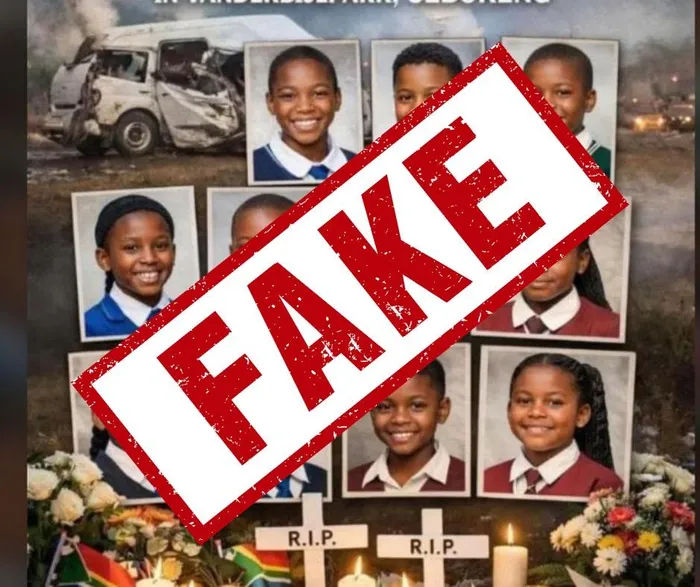
A viral image showing smiling schoolchildren in uniform, alongside white doves, crosses and the words “RIP”, was widely shared online as the young victims of the Vaal taxi crash.
Image: Supplied
A viral image showing smiling schoolchildren in uniform, alongside white doves and crosses marked “RIP”, was widely shared online as depicting the young victims of the Vaal taxi crash.
But the Gauteng education department said it was a cruel hoax and that the picture had been digitally manipulated using artificial intelligence.
Spokesperson Steve Mabona said it was completely “unnecessary” for anyone to create fake images of dead schoolchildren.
“How must families feel when pictures of children who are not theirs are shared, and people pretend to grieve with them?” Mabona said on Tuesday, a day after the driver — who was ferrying pupils to school — allegedly tried to overtake about four vehicles before crashing head-on into an oncoming truck.
The horror R553 smash left at least 12 pupils dead.
The driver, 22, has since been arrested.
He is facing 12 counts of culpable homicide, as well as reckless and negligent driving
Three of the pupils who died attended Hoërskool Vanderbijlpark.
One pupil each was from Vaal High, Oakwood Primary, Vaal Triangle Primary, Oliver Lodge Primary and Noordhoek Primary, while four pupils were at El Shaddai, an independent school.
Mabona said three learners remain in hospital, with one having been airlifted to a private medical facility due to the severity of injuries, while another learner has since been discharged.
“In hospital, we have three learners, one was airlifted to a private facility because the situation there was quite dire, so the family decided to lift that child to a private hospital,” he said.
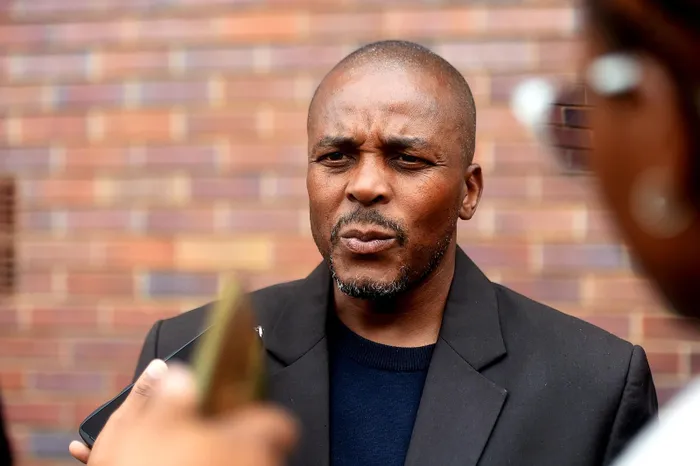
Gauteng education spokesperson Steve Mabona
Image: Itumeleng English/IOL
The fake picture is laid out as a memorial-style collage made up of individual portraits of schoolchildren in uniform.
Each child appears in a separate, neatly framed photo, arranged in rows.
All the children are smiling.
Above the collage are the words “in loving memory of the 13 learners who died in the taxi crash in Vanderbijlpark, Sebokeng”.
White doves are shown flying across the image, a symbol often used to suggest peace or death.
Behind the portraits is a dramatic background showing a damaged taxi, meant to resemble a crash scene.
At the bottom of the image are candles, flowers and small white crosses marked “RIP”, along with the words “gone but never forgotten”.
Speaking at Hoërskool Vanderbijlpark, Mabona said: “It is unnecessary for people to create graphics and circulate them while families are mourning."
He also urged members of the public to refrain from circulating unverified content on social media, especially AI-generated images.
Gauteng police spokesperson Lieutenant Colonel Mavela Masondo said the driver was expected to appear before the Vanderbijlpark Magistrates’ Court within 48 hours.
Arthur Goldstuck, World Wide Worx CEO, said the quickest way to spot a deepfake was to look for things the human face doesn’t get wrong.
"Watch the eyes, because deepfakes often blink strangely or not at all," Goldstuck said.
"Check the mouth: the lips may not sync perfectly with the sound, or the teeth look like a blurred block.
"Look for skin that’s too smooth, lighting that doesn’t match the room, or hair and earrings that flicker or seem to float.
"LIsten for a voice that sounds a bit too perfect or slightly disconnected from the space."
Most importantly, he said, if a video makes you angry or excited immediately, pause and reconsider its authenticity.
"Deepfakes rely on emotional reaction before verification, and are intended to shock."
IOL News