New Year drowning incidents raise alarm on South Africa's beaches
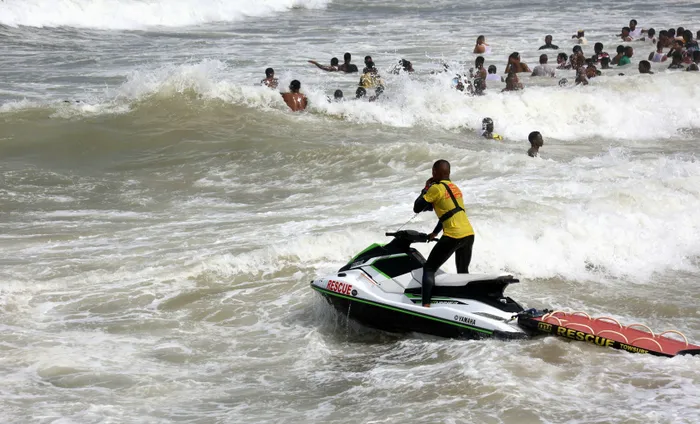
Lifeguards actively worked to stop swimmers from venturing too far from the shore.
Image: Tumi Pakkies / Independent Newspapers
As the New Year of 2026 dawns, South Africa is mourning a series of drowning incidents that have struck families and communities along the coastline.
Lifesaving South Africa (LSA) board member and media liaison officer, Dhaya Sewduth, said the particularly devastating first two days of January included the widely reported mass drowning at Pennington Beach.
A group of five swimmers had gotten into difficulty on New Year’s Day. Two bodies were recovered, two remained missing, and one person was successfully rescued.
Then reports of missing bathers were logged across several beaches, including Ballito, Wedge Beach, South Beach, Country Club Beach in Durban, Blue Water Bay in Gqeberha, and Jabula Beach (St Lucia). Most recently, a fisherman was reported missing at Banana Beach on the South Coast.
Sewduth said search and rescue operations are still under way for several missing persons. Despite this, recoveries were made in two Durban incidents and one in Pennington on January 6, 2026.
“Lifesaving South Africa extends its deepest condolences to the families who have lost loved ones. Our thoughts and prayers are also with those families who continue to maintain vigils, hoping for the safe return of those still missing,” Sewduth said.
He noted that, despite the large crowds on beaches nationwide during the holidays, few drownings occurred when official lifeguards were on duty.
“This underscores the critical importance of only swimming at patrolled, lifeguarded beaches, and strictly within designated swimming zones,” Sewduth said.
“Members of the public are strongly cautioned against entering the water at non-patrolled beaches or outside of lifesavers’ duty hours.”
In contrast, LSA said that during December 25 to 28, 2025, long weekend lifesavers ensured no drownings occurred during official duty hours.
Regarding the Pennington incident, on Tuesday, IPSS Medical Rescue spokesperson Samantha Meyrick said some remains were discovered on the beach.
“At this time, we can only speculate that it is likely one of the drowning victims. They will have to wait for identification to confirm,” Meyrick said.
Meanwhile, the National Sea Rescue Institute (NSRI) Shelly Beach station commander Glen Preston reported that on Tuesday, January 6, at 6.39pm, Nkazimulo Nyawose, a member of the NSRI drowning prevention team on the KZN South Coast, raised the alarm after observing a drowning in progress at Uvongo main beach.
Nyawose was in the area inspecting the NSRI pink rescue buoys deployed along the KZN South Coast coastline when the incident occurred.
Preston said it seemed two females, aged 20, were caught in rip currents while swimming. A young adult male attempted to rescue them, but also got into difficulty in the water.
He said the NSRI Shelly Beach duty crew got ready to respond. Simultaneously, Nyawose notified Uvongo lifeguards.
Although the lifeguards were officially off duty, having finished their scheduled shift at 6pm, some were still in the vicinity getting ready to leave for home. The lifeguards responded immediately, using the NSRI pink rescue buoy, stationed at Uvongo Beach, to go after the three casualties.
“Lifeguards assisted one female casualty and the male casualty to get out of the water along rocks; they were not injured, while a lifeguard, utilising the NSRI pink rescue buoy, rescued a 20-year-old female to the beach,” Preston said.
He said Netcare 911 and Ugu private ambulance services were activated. On their arrival, they medically treated the female, suffering non-fatal drowning symptoms, and she was transported to the hospital by Ugu ambulance in a stable condition. She is expected to fully recover.
“The swift actions of NSRI’s Nkazimulo and the Uvongo lifeguards, with the contribution of the NSRI pink rescue buoy, are commended,” added Preston.
thobeka.ngema@inl.co.za