
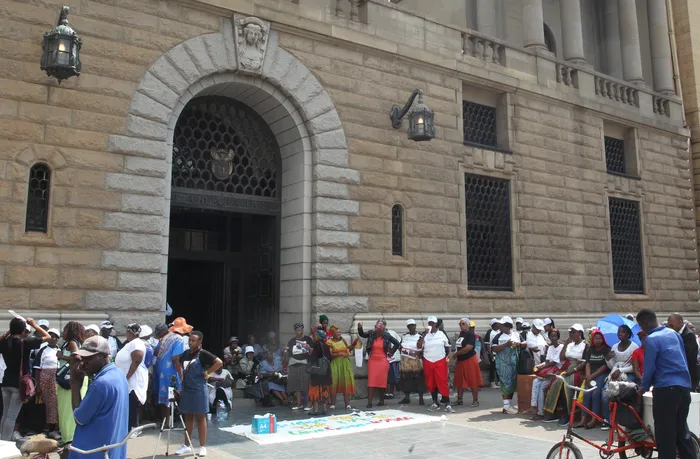
The National Treasury will focus on provinces unable to pay supplier invoices on time.
Image: Jacques Naude / Independent Newspapers
The National Treasury intends to concentrate its efforts on six provinces that are the largest contributors to the government's late or non-payment of billions of rands owed to suppliers.
In its latest report on national and provincial government departments’ failure to pay invoices submitted by suppliers, Treasury identified the Eastern Cape, KwaZulu-Natal, Gauteng, Free State, North West and the Northern Cape as the biggest contributors.
“Provinces continue to be the highest contributors to the statistics of late payments and unpaid invoices, and interventions must be prioritised at the provincial level,” it reads.
According to the report for the second quarter of the 2025/26 financial year (July to September 2025, provincial departments were responsible for 75% of late payments and 97% of unpaid invoices at the end of the second quarter, highlighting the urgent need for targeted interventions at the provincial level.
National departments accounted for 25% of late payments and only 3% of unpaid invoices during this period.
Treasury also stated that the report reveals persistent challenges in the timely payment of supplier invoices. It shows that a total of 112,442 invoices amounting to R10 billion were paid after 30 days while 95,399 invoices remained unpaid at the end of September with a value of R12.4bn.
About R8.06bn was paid late by provincial departments while national departments were responsible for just under R2bn. Provincial departments had not paid nearly R12bn by the end of September and nationally the figure was R279.1 million.
KwaZulu-Natal paid after 30 days nearly R3.32bn while Gauteng stood at over R1.385bn and the North West had paid R1.384bn and the Eastern Cape settled late an amount of R1.034bn. Gauteng had not paid R4.31bn and R3.78bn in the Eastern Cape, R1.48bn in KwaZulu-Natal and R1.02bn in the Northern Cape.
Nationally, the departments that contributed most invoices towards the late or non-payment of invoices were defence, water and sanitation (trading account), public works and infrastructure (trading account), correctional services, justice and constitutional development, forestry, fisheries and environment, land reform and rural development and police.
The report also reveals that the common reasons cited by national and provincial departments for late or non-payment of invoices ranged from cash blocking, financial and budget constraints, financial system and Central Supplier Database challenges, disputed invoices with suppliers to outstanding source documents.
Unresolved supply chain management-related challenges, internal control deficiencies, inadequate internal capacity, late processing and authorisation of invoices and misfiled, misplaced or unrecorded invoices were among other reasons.
The report also highlighted the important role of executive authorities (ministers and MECs) in holding accounting officers (directors-general and heads of departments) accountable for the continued improvement in the culture and payment internal control environment of their respective departments.
It warned about the continued impact of the late or non-payment of invoices on the sustainability of the small, medium and micro enterprises in contributing to unemployment, job creation and inequality issues.
“The efforts by the National Treasury, Public Service Commission, Department of Small Business Development, Department of Planning, Monitoring and Evaluation and the Presidency can only be impactful if there is a willingness of leadership at the departmental level to make a difference,” the report noted.
loyiso.sidimba@inl.co.za