Kaapse Klopse Karnival Association defends changes to 2026 carnival route
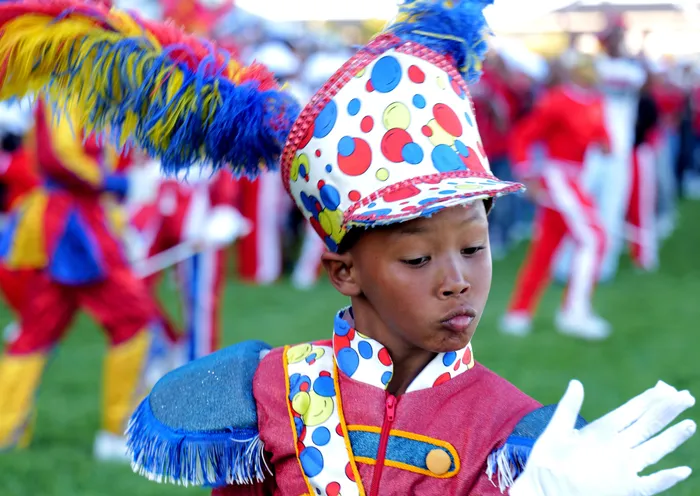
Members of minstrel troupes like the District Six, Mitchells Plain Young Tycoons and the Carnival Boys performing at the Voorsmakie event held at the Kenilworth Racecourse ahead of the annual Minstrel Carnival on January 5, 2026.
Image: Ian Landsberg/ Independent Newspapers
The Kaapse Klopse Karnival Association (KKKA) has defended changes to the 2026 Kaapse Klopse Karnival, saying the revised route and format are aimed at protecting the cultural integrity of the event while responding to rising costs and relief. It said safety responsibilities and long-term sustainability pressures, participating troupes face.
The response was issued in a statement posted on the social media platforms of the Cape Town Street Parade, amid growing public debate over the updated carnival route and the decision to combine key elements of the event.
KKKA director Muneeb Gambino said the association’s board largely made up of troupe owners, carefully weighed cultural, logistical and financial considerations before confirming that the street parade and the first day of competition would take place on January 5, 2026.
He said the decision was informed by the dynamics of the Islamic calendar, the escalating cost of staging the carnival, and the need to ensure the event remains financially viable and culturally relevant.
“The carnival has grown significantly in terms of the quality of delivery by competing troupes and the overall experience for patrons,” Gambino said, adding that this growth has increased costs across both free public events and ticketed competitions.
Under the revised format, the public will still be able to enjoy a free street parade along the route, while those who wish to experience the competitive element can access the stadium, with tickets available via Computicket. Gambino said the aim was to preserve public access while ensuring the competitive component remains sustainable.
The City of Cape Town said it is currently finalising logistical arrangements related to the event.
“The City is currently finalising the logistical arrangements, which are expected to be completed by tomorrow (24 December). Once the arrangements are confirmed, we will communicate on those,” the City said in response to media enquiries.
Responding to criticism of the route change, Gambino said the KKKA’s analysis showed that much of the negative reaction stemmed from individuals linked to the organisation that previously managed the carnival.
He rejected claims that the revised route represents a break from tradition, describing it as historically authentic. According to Gambino, the route was used for decades as troupes paraded “en route” to Green Point, where annual competitions were traditionally held on Tweede Nuwe Jaar.
“This route passes through highly significant areas, including what were known as District One and District Seven,” he said, referring to communities whose residents were forcibly removed under apartheid-era segregation. He said returning to these areas allows the carnival to highlight overlooked aspects of Klopse history, broadening the narrative beyond the more familiar focus on District Six and the Bo-Kaap.
Gambino also noted that the same Somerset Road-to-stadium route was last used in 2014 by the previous organiser, the Cape Town Minstrel Carnival Association, without triggering similar public opposition.
A central motivation behind the revised format, he said, is financial relief for troupes. By compressing what would traditionally have been two carnival days into a single event, large troupes could save several hundred thousand rand, with even greater relative benefits for smaller, under-resourced troupes.
“These savings are particularly important for smaller troupes and allow us to better support them throughout the carnival season,” Gambino said.
He said the KKKA bears responsibility to ensure that the carnival takes place every year and that troupes are able to participate in a full season of competition, requiring a balance between multiple stakeholder interests.
Addressing what he described as inaccurate portrayals of Klopse history circulating online, Gambino called for direct and constructive engagement rather than debate on what he termed “petty forums” that fuel anger and deepen divisions within an already fragmented community.
He said the return to areas linked to District One and District Seven should be understood not only as a practical response to compressing the carnival as religious months move closer to the festive season, but also as an acknowledgement of Green Point as a place of historical return for many families.
While affirming the right to freedom of expression, Gambino challenged critics to reflect on their contributions to sustaining the carnival, including financial support, creative input, sustaining troupes, and managing safety at city scale.
“This is about real, embedded memory, not just 30 years, but 150 years and beyond,” he said, adding that adaptation is essential if the carnival is to survive.
He also defended hosting competitions at the DHL Stadium, arguing that participants deserve access to world-class facilities to showcase their craft and talent.
“Our youth deserve access to excellence,” Gambino said, adding that the KKKA views the revised format as an evolution of the carnival rather than a departure from its traditions — one aimed at securing its future while honouring its past.
Get your news on the go, click here to join the Cape Argus News WhatsApp channel.
Cape Argus