Cape Town faces scrutiny over untreated sewage discharge into oceans
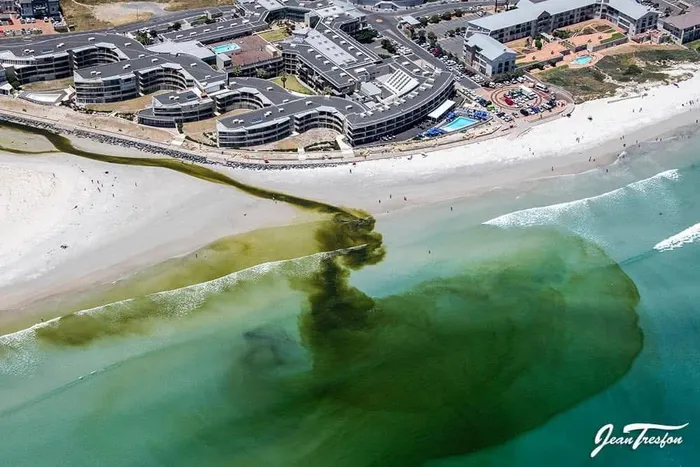
Dirty water, believed to be from an outfall pump, is pouring into the sea in Milnerton Beach, Cape Town.
Image: Supplied
The City of Cape Town has estimated that it would need R12 billion to achieve its long-term plan to improve its sewage discharge at the ocean outfalls to protect the marine environment and ensure the health and safety of the users of its beaches.
ActionSA and Freedom Front Plus (FF+) have accused the Democratic Alliance (DA)-run municipality of disposing of untreated raw sewage into the sea, creating a health hazard, including E. coli.
The municipality’s Mayoral Committee Member for Water and Sanitation, Councillor Zahid Badroodien, said the city is committed to implementing practical alternatives for better management of its sewage discharge at the marine outfalls.
“It is estimated that the total cost of these projects will amount to R12 billion by early estimations,” he said.
He said for short-term measures, the city had in November awarded a R200 million refurbishment tender, which is currently in the appeal period. This tender would, among other things, replace or refurbish washwater, drainage, jockey, and outfall pumps.
“These upgrades will enhance reliability, reduce odours and improve solids removal before discharge,” said Badroodien.
On Tuesday, the Pietermaritzburg High Court ruled in favour of ActionSA and DA that the eThekwini Municipality violated the Constitution by not swiftly attending to raw sewage spills into the rivers and ocean.
The ActionSA had, on December 15, released a statement alleging that Cape Town was pumping an estimated 27 million litres of raw, untreated sewage into its coastline every day through marine outfalls in Camps Bay, Green Point, and Hout Bay.
The party’s national chairperson, Michael Beaumont, said information on the amount of sewage pumped into the ocean was contained in a document pack handed over by the City of Cape Town through ActionSA’s PAIA application. He said the information was with the party’s lawyers, whose officers were closed on Saturday.
He alleged that the pumping of sewage has created floating islands of sewage.
“Beaches are increasingly being closed when winds blow these floating islands of sewage ashore.
“These outfalls discharge sewage into a marine protected area, despite environmental legislation in our country making this a criminal offence, and ocean life is being destroyed by harmful chemicals and pharmaceuticals,” read Beaumont’s statement.
Beaumont alleged that Cape Town has claimed that it does not need to comply with environmental legislation in applying laws that were adopted in 2004, and the marine outfalls predate them by over 100 years.
“What it fails to mention is that Cape Town’s population, and its sewage outflows, have doubled since 2004,” he said.
Beaumont alleged that the city had in 2023 obtained new licences to continue pumping raw sewage into the ocean.
“ActionSA has made submissions to an appeals body established by the Department of Forestry, Fisheries, and the Environment (DFFE) against the issuing of new licences in 2023 for the City of Cape Town to continue pumping raw, untreated sewage into the ocean.
“We made these submissions alongside scientists, civil society organisations, and research institutions that have presented compelling evidence that something has to change.
“This application (for new licence) showed that the city exceeded its daily discharge limits on the Hout Bay outfall pipeline on 107 days out of a 180-day review period, with some days recording double the legal limit.”
He mentioned that there were reports of beachgoers becoming ill.
However, Badroodien said city beaches remain safe for public use.
“The outfalls do not impact recreational areas or blue flag beaches and are positioned far from the shoreline where effluent is dispersed within what is termed an allowable mixing zone,” he said.
He accused ActionSA of misleading the public by claiming that the city has applied for new licences.
“The city was working with DFFE to review licence conditions that are inconsistent across the three marine outfalls.
“It is incorrect to claim that the city is discharging an uncontrolled volume of screened sewage into the ocean through the marine outfall.
“Independent scientists monitor ocean conditions, and the city reports to the regulating authority on all necessary parameters in line with the original licensing conditions,” said Badroodien.
City of Cape Town’s Freedom Front Plus Councillor Paul Jacobson described swimming at local beaches as “like swimming in a toilet”.
He said one of the affected beaches is in Maidens Cove, where residents of the Cape Flats swim.
“When we have an onshore coming in, this water with its pollutants gets taken straight onto the beach.
“We have images from above, which have been documented, of sewage plumes getting blown into our bays, and bathers may get a smell, but they are oblivious to the fact that this is actually raw sewage. We also see condoms, sanitary wear, and everything that is from our toilets,” said Jacobson.
He accused the city of shifting the blame for the pollution of the ocean.
“We dispose of 50 million litres of raw sewage per day into our bays, from Hout Bay to Green Point, and these city officials blame the vessel docked in the area.
“If you say to somebody, ‘Would you swim in the toilet?’, they would ‘say no way’, but the reality is on certain days, that is what we are swimming in. We have seen from the top a body of mass raw sewage,” he said.
He mentioned that professors of chemistry, recreational divers, marine biologists, and aerial photographers have confirmed both the appearance and odour of the sewage in the sea.
“We have been swimming in this for 30 to 40 years, and the smell is human waste, which has not been treated.
“It is a disgrace and shame, and the blue flag status should never have been applied and given,” said Jacobson.
Mark Jackson, from the Bay of Sewage, an anti-sea pollution group, described Cape Town as the worst of the worst worldwide when it comes to dumping sewage directly into the marine environment.
“Our city knows we have a serious problem, which is why they commissioned engineering firm Zutari to design viable treatment plants to actually treat the effluent first.
“The finished plans were presented in early 2024. Our city must stop its delaying tactics and build them,” he said.
Caroline Marx, from Rethink The Skink, an NPO and action group focused on responsible management of water and wastewater, said: “The Camps Bay marine sewage outfall lies about 800m offshore and has an estimated 500m-wide exclusion (“no-go”) zone where bacterial levels may be dangerously high.
“Yet, there are no warning signs or markers for kayakers, open-water swimmers, or divers, who can unknowingly stray into this zone and be exposed to contaminated water.
“The other outfalls are slightly further offshore, but the same applies,” she said.
bongani.hans@inl.co.za