Inside South Africa’s billion-Rand building hijack economy being linked to DJ Warras's death
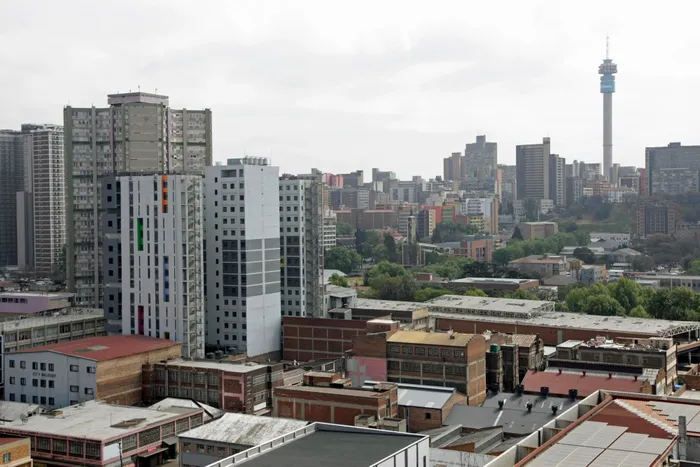
Joburg... city of hijacked syndicates.
Image: Timothy Bernard/Independent Newspapers
At first glance, the building looks merely neglected: broken windows patched with cardboard, a security gate welded shut, a tangle of illegal electricity cables draped across the façade like vines.
But behind the locked doors of many inner-city buildings in Johannesburg, a highly organised criminal economy is at work, one that property owners, investigators and housing advocates say is generating billions of rand a year while hollowing out South Africa’s cities.
This is the business of hijacked buildings.

DJ Warras was shot and killed in Johannesburg in what some say was allegedly a hit directly linked to building hijack syndicates.
Image: Instagram
The death of DJ Warras, gunned down in broad daylight outside the Carlton Hotel in Johannesburg earlier this week, is alleged to almost certainly be a hit believed to be linked to building hijackers.
His death brought into focus the issue of hijacked buildings throughout South Africa, and in Joburg especially. Joburg Transport MEC Kenny Kunene said "we are at war with hijackers of buildings" adding that the death of Warrick "DJ Warras" Stock signals the battle for control of inner-city properties which had escalated into a full-blown war. "They have made the lives of South Africans intolerable" he said of the hijackers adding that the City of Joburg was also losing billions in unpaid bills.
Across South Africa’s major metros such as Johannesburg, Pretoria, Durban, Gqeberha, East London and parts of Cape Town, criminal syndicates have seized control of thousands of residential and commercial properties.
Estimates from property owners and urban researchers put the number at around 5,000 buildings nationwide, with roughly 1,100 in Johannesburg’s central business district alone of both government and privately owned properties.
These are not spontaneous occupations driven by desperation, owners say. They are coordinated takeovers run like shadow property companies: rent is collected in cash, enforced through intimidation; utilities are illegally connected; and anyone who resists is threatened into silence.
“It’s a business model,” said one property owner. “They take the building, they take the income, and they carry none of the costs. We, the owners, carry all the risk."
How hijackings work
The pattern is strikingly consistent. A building becomes vulnerable, perhaps because an owner falls into arrears, a managing agent withdraws after repeated threats, or a property stands temporarily empty during renovations or a legal dispute. A group moves in, often posing initially as security guards or caretakers.
Within weeks, the legitimate owner is locked out. "When you do try fight back the the law works in their favour as you as the ousted owner have to find alternate accommodation for occupants, and the hijackers often turn the tables on you, saying you are the criminal, that the building is not yours," says another owner.
Access points are welded shut. Armed “bouncers” are stationed at entrances. Tenants are told they must now pay rent to a new authority and it is usually in cash, sometimes via mobile transfers to untraceable accounts. Those who refuse are evicted violently or threatened. Owners who attempt to enter are warned they will be killed. The threats and intimidation are real and tormenting.
Once control is established, the syndicate extracts value relentlessly.
Dozens, sometimes hundreds, of people are crammed into buildings never designed for such density. Rooms are subdivided with plywood; fire escapes are blocked; water and sanitation systems collapse under the strain. Maintenance stops entirely.
Yet the money flows.
In the South African Podcast, DJ Warras explained how sometimes a tiny space is occupied by seven people, meant for one person.
Meanwhile a single hijacked building can generate hundreds of thousands of rand a month in rent. Multiply that across hundreds of properties in a single city, and the sums quickly climb into the billions annually... all of it untaxed, unregulated and largely invisible.
“These are cash businesses,” said another owner involved in a multi-year legal battle to reclaim a property. “No maintenance, no taxes, no compliance. Pure profit.”
Owners trapped in a legal maze
Under South African law, evicting unlawful occupants is governed by the Prevention of Illegal Eviction Act (PIE), which requires court processes and, crucially, alternative accommodation for displaced residents. In practice, owners say, this has made it almost impossible to reclaim hijacked buildings.
Court cases drag on for years. Sheriffs refuse to act without police protection. Municipalities, citing a lack of emergency housing, often decline to assist. Meanwhile, owners remain liable for rates, taxes and service charges, even when they have no access to their properties and no income from them.
“The hijackers enjoy the building with zero costs,” said another owner. “The owners pay everything and earn nothing.”
Several owners described being driven into hiding after receiving repeated death threats. Others have abandoned properties altogether, not because they are negligent “slumlords”, they say, but because the personal risk became intolerable. And this is what the syndicates wish to achieve - to put so much fear into the owners so that they never return, leaving the hijackers to run the buildings with impunity and raking in the millions.
This dynamic has created a vicious cycle: buildings deteriorate further, municipalities label them unsafe, and neighbourhood decline accelerates, all while criminal groups entrench their control.
The human cost
For residents living inside hijacked buildings, conditions are often dire. Fires are a constant risk, exacerbated by illegal electrical connections and blocked exits. Basic sanitation is frequently absent; water is siphoned from neighbouring buildings or municipal pipes. Public health experts warn that such conditions are ideal for outbreaks of waterborne diseases such as cholera and typhoid.
Communities around hijacked buildings report increased crime, drug trafficking and a sharp decline in property values. Legitimate businesses leave. Streets empty. Entire blocks slide into neglect.
“These buildings don’t just collapse physically,” said an urban planner. “They collapse trust, safety and any sense of order.”
A crime hidden in plain sight
Despite its scale, building hijacking has rarely been treated as a priority organised crime issue. Cases are fragmented across civil courts, housing departments and under-resourced police units. Syndicate leaders are seldom prosecuted; when arrests occur, they tend to target foot soldiers rather than those directing operations.
Owners argue that the state already has the tools to dismantle the system such as policing, asset forfeiture, coordinated prosecutions, but has failed to deploy them effectively.
“If the authorities can’t remove criminals from buildings now,” one owner asked, “what changes when ownership changes? The hijackers don’t disappear. They just adapt.”
As South Africa grapples with urban decay, housing shortages and deep inequality, hijacked buildings sit at the intersection of all three and serve as a stark example of how criminal economies flourish where governance falters.
In the shadows of Johannesburg’s skyline, the lights are still on. The rent is still being collected. And for the syndicates running this underground empire, the business has never been better.