Gangs demand R10,000 to let Cape Town municipal workers fix sewage spills
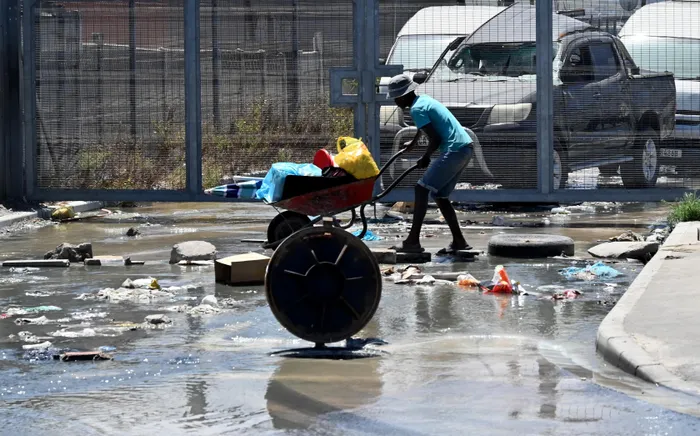
Residents in Khayelitsha’s Makhaza area navigate their way through streams of raw sewage
Image: Ayanda Ndamane/IOL
Gangsters are demanding up to R10,000 from Cape Town municipal workers before they are allowed to enter certain areas to fix burst pipes and sewage overflows.
But with the city rightfully refusing to bow the knee to gang extortion, poor residents are left paying the ultimate price as poo and water leakages continue to flow through their communities — and have done so for far too long.
Cape Town’s water and sanitation political head Dr Zahid Badroodien said the problem, which brings a stomach-churning smell so bad that families keep their windows and doors shut even in the blazing summer heat, was a big headache keeping him awake at night.
“And the headache will only go away,” he said, “if the areas are safe enough for my team to go in to fix what needs to be fixed.”
He said the city has identified “red zones” where crime is at its absolute worst.
"Red zones" are areas municipal officials avoid because they are too dangerous.
“Our staff cannot carry out essential repairs in these areas without putting their lives at risk,” Badroodien told IOL on Monday.
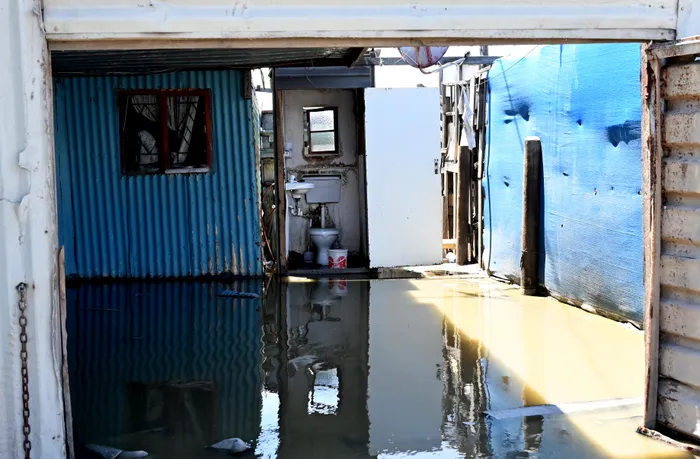
Shacks are drowning in sewage
Image: Ayanda Ndamane/IOL
The crisis is playing out against the backdrop of ongoing sewage overflows and low water pressure in the metro's informal settlements.
Residents said in these areas, taps often run dry for hours on end.
When an IOL news team visited Makhaza, Khayelitsha, earlier this month, residents were forced to wade through knee-deep rivers of what looked like raw sewage.
A strong, unbearable stench clung to the air as blocked drains flooded streets and spilled into homes.
For residents like Aphiwe Mhlungu, the situation has become unbearable.
“We can’t open our windows, the smell is everywhere, and the kids can’t even play outside,” the 45-year-old said.
“We’re just left to live in this filth because no one can come in to help.”
Mhlungu said some days he and his little family can’t eat because the "stench is too strong".
Another resident Sibongile Dlamini said: "We are tired of living like this.
"We call the city, but repairs take too long ... it is humiliating to live like this while waiting for someone to help us."
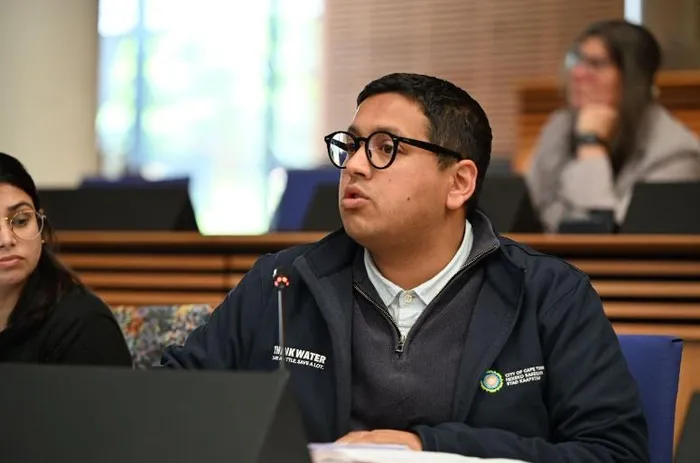
Water and sanitation political head, Dr Zahid Badroodien
Image: City of Cape Town
Badroodien said though he sympathised with residents, crime, extortion and sabotage were increasingly preventing teams from doing their work.
"People come up to our workers and say, ‘If you want to fix the sewer pipe, you need to pay R10,000 before you can do anything.’”
He said city workers are also targeted for the equipment they carry.
“They also get hijacked sometimes, and in certain communities like Manenberg, they get caught in between gang gunfire.
"It’s sadly very common.”
Asked if he will pay protection money, Badroodien was quick to say "no".
“We will never do such a thing,” he said.
“When extortion happens, it must be reported.
"The city then assigns its own law-enforcement teams to support the operational teams.”
However, this often leads to delays, he said.
In some cases, work has to stop entirely when security support runs out.
“Teams sometimes have to leave and come back another day, which means residents go without water or sanitation for longer,” Badroodien said.
He said staff safety comes first.
“There is no way that an operational team member should put their own life at risk for doing their job,” he said.
“I will never push teams into an area that has been declared a red zone without the necessary support.”
Badroodien said that, on top of the thuggery and extortion attempts, residents in Makhaza had built homes on top of a three-metre sewer servitude.
He said the process of moving them was being led by the human settlements directorate.
But the MMC in charge, Carl Pophaim, said his officials were also threatened when they wanted to engage with the residents.
"The city has assembled a transversal team with sister departments to ensure a seamless relocation for residents currently occupying the servitude in Makhaza which has since collapsed," he told IOL.
"Human settlements is taking the lead at this stage due to the relocation demand, so that the contractor can repair and replace the existing pipeline and restore basic service delivery.
"Since Friday, I have been in negotiations with a taxi association to address concerns.
"Our contractor, who needed to prepare the site for relocation, was ready and geared up to do so on Friday but faced threatening action from what appear to be affiliates of the taxi industry.
"Up until about 12pm or 1pm [Monday], we concluded negotiations, taking into consideration the association’s concerns, as the relocation site is in close proximity to the taxi rank."
He said they were now coordinating an emergency meeting with their contractor to formally request that work commence Tuesday morning.
He said the intention was for undisturbed work to continue over the ensuing 72 hours, ensuring the relocation is concluded by Sunday.
"If this is successfully undertaken, the pipeline can then be repaired by colleagues in the water and sanitation directorate, who will assume the leadership role in phase two of the process."
According to the Global Initiative Against Transnational Organized Crime's latest Western Cape gang monitor report, extortion was the "largest income stream after drugs".
It said extortion was ruthlessly enforced, contributing to the increase in gang-related violence.
"The practice of extortion is most deeply embedded in township areas such as Khayelitsha," the report said.
"Extortionists, including the notorious Gupta and Boko Haram, seek to illegally 'tax' all economic activity, demanding protection fees from a threat they themselves create."
The report further said the gangs often act through local proxies and sub-groups that collect extortion rents on their behalf.
"The 28s street gang is deeply involved in the extortion of construction sites and township areas," it said.
"The 27s also have a powerful street gang presence."
Beyond extortion attempts, Badroodien said vandalism and deliberate sabotage of infrastructure are worsening the problem.
“You’re always going to find standpipes that have been vandalised, illegal connections that lower pressure, or toilets that have been broken or removed,” he said.
He described incidents where water pipes were damaged so taxis could access water, toilet doors were stolen to be used as front doors, and plastic pipes were removed and sold on the roadside.
“There’s no single person or group behind this,” he said.
“It is a community responsibility at large to look after the infrastructure.
“In Mitchells Plain, we found construction rubble, mattresses, TVs and even car bumpers dumped into sewer manholes.
“Every time we cleared it, a few days later the same thing would happen.”
He said such sabotage often resurfaces during politically tense periods.
“I’m already predicting that as we move closer to the next elections, those same bulk sewer pipelines will start overflowing again,” he said.
A City of Cape Town report, seen by IOL, has confirmed that toilets installed in informal settlements are being vandalised or removed after installation.
The admission appears in the September 2025 Water and Sanitation Performance Monitoring Report.
The report tracks service delivery across the metro, including the rollout of taps, toilets and sewer infrastructure.
In informal settlements, the city reports that 161 new taps and 1,157 toilets were provided in the first quarter of the financial year, exceeding its own targets.
It said some of these taps and toilets may already have been vandalised or removed, which means the headline numbers do not necessarily reflect what residents still have access to on the ground.
Western Cape legislature police oversight, community safety, cultural affairs and sport chair Benedicta van Minnen said extortion and gangsterism were alive and well in Cape Town.
She said more than 75% of the province's crime happens in Cape Town.
"The police's plans are under-resourced," she told IOL in an in-person interview.
"Police staffing is 8,000 below what it should be.
"They should have 20,000 officers; at the moment, they are at about 12,500.
"This means there are fewer police officers and detectives in police stations, and that makes a real difference."
She said conviction rates for gun crimes are sitting at about 5%.
From the Western Cape government’s point of view, she said, a lot of the problem comes down to oversight.
"We do not have enough boots on the ground," Van Minnen said.
"That responsibility lies with the police, who are, of course, supported by what happens in the City of Cape Town through law enforcement, the Metro Police, and traffic police.
"Our job is monitoring and oversight, which we have carried out extensively this year.
"It is also because of our monitoring and oversight that we support the call to supplement the work of law enforcement and the metro police by giving them some investigative powers."
Sandra Dickson, from STOP COCT, said not everything can be blamed on the thugs.
Though the Water and Sanitation Performance Monitoring Report shows that Cape Town's tap water is largely safe to drink, with more than 99% of drinking water samples meeting national safety standards, only 57.5% of river and vlei water samples met the minimum E. coli safety standard.
This is below the city's own target of 60%.
It means that more than four out of every 10 samples contained unsafe levels of faecal pollution.
This water is not safe for recreation, animals or human contact.
In Mitchells Plain, which includes the Khayelitsha stormwater system, none of the water samples met the E. coli safety standard.
The report openly states that sewage is being conveyed through the stormwater drainage system in this area.
This effectively means sewage is flowing through open canals and ponds instead of proper sewer infrastructure.
ActionSA this week claimed that the city pumped an estimated 27 litres of raw, untreated sewage into its coastline every day through marine outfalls in Camps Bay, Green Point and Hout Bay.
"Beaches are increasingly being closed when winds blow these floating islands of sewage ashore, and reports of beachgoers getting sick are increasing in frequency," the party's national chair Michael Beaumont said, adding that they have filed criminal charges against the metro.
"These outfalls discharge sewage into a marine protected area, despite environmental legislation in our country making this a criminal offence, and ocean life is being destroyed by harmful chemicals and pharmaceuticals."
The city, however, rebutted the claims, saying it only discharges 5% screened sewage into the ocean.
"[The remaining] 95% of our city’s sewage makes its way through existing wastewater treatment works," it said.
IOL News