Malema slams GNU for failing to address unemployment and economic stagnation
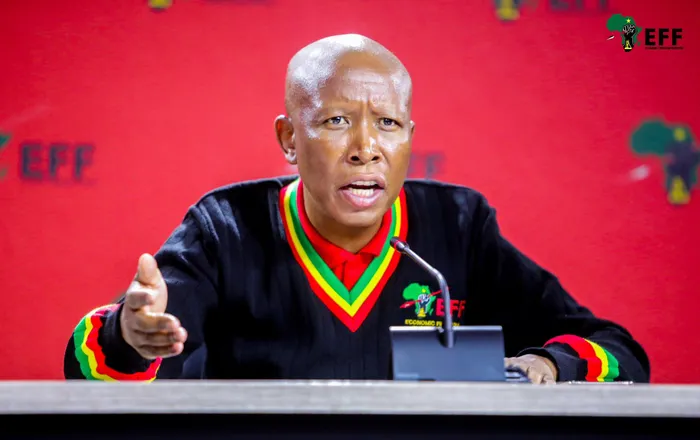
EFF's Julius Malema criticises the Government of National Unity for its failed policies, claiming neoliberal austerity is suffocating the economy, deepening inequality, and excluding the black majority from meaningful participation.
Image: EFF / X
Economic Freedom Fighters (EFF) leader Julius Malema says the Government of National Unity (GNU) has failed the poor, the workers, the youth, and the nation.
Speaking at a media briefing in Johannesburg on Thursday, Malema accused the GNU of failing to drive economic growth and create jobs, while continuing to uphold a colonial economic structure that excludes the black majority from meaningful participation.
"This is underlined by stagnant economic activity, the collapse of industrial capacity, and the entrenchment of mass unemployment."
“This is not a statistical anomaly. It is a deliberate outcome of a political arrangement designed to protect a colonial economic architecture while shutting out the black majority from meaningful participation
"The GNU has failed to grow the economy and create jobs in successive quarters," Malema said.
According to Malema, the 0.5% economic growth across all three quarters of 2025 is a clear indicator of the government's failure to deliver on its promises.
With more than 11 million South Africans still jobless, Malema described this situation not as a historical accident but as the "deliberate outcome of a political arrangement whose purpose is to protect a colonial economic architecture."
Malema argued that the current economic model is a continuation of past policies, which he believes were designed to benefit the few rather than the majority.
"The GNU exists to prevent this redistribution. The GNU is not a break from the past; it is a continuation of an agenda that predates the 2024 elections," he said.
"Under the illusion of renewal, the GNU reaffirms the same neoliberal commitments that have suffocated our country for a decade."
Malema said GNU has chosen austerity over industrialisation, outsourcing over state capacity, privatisation over developmental governance, and foreign dependency over domestic resilience.
"The result is predictable: stagnant growth, crumbling infrastructure, collapsing state-owned entities, and an economy defined by extraction without production."
Malema also emphasised that the government’s disregard for the working class has led to the erosion of hard-won labor rights.
"The GNU governs as though the working class is disposable," he said.
He further warned that workers now face a cruel binary to accept wages that guarantee poverty, or remain unemployed indefinitely.
"In either case, capital triumphs while communities suffocate," he said.
"This is not development; it is structural exclusion."
He also criticised the lack of industrial policy and state-driven initiatives that could stimulate growth.
"There is no industrial policy, no serious programme for localisation, no commitment to build productive capacity, and no vision to mobilise domestic capital towards manufacturing, agro-processing, pharmaceuticals, energy or rail," Malema said.
Instead, he claimed the government passively waits for foreign investors who have little interest in truly industrialising the country.
He criticised the Public Investment Corporation, which he said props up sectors controlled by the white establishment, instead of investing in transformative economic initiatives that could benefit the majority of South Africans.
"The Public Investment Corporation, the largest allocator of capital on the continent, props up sectors owned by the white establishment," Malema said,
Malema also highlighted the government’s failure to manage essential state-owned enterprises. "Municipalities are collapsing because they are treated as trading companies rather than developmental institutions," he said.
He pointed to the deterioration of Transnet, Eskom, Denel, and South African Airways (SAA) as key indicators of government mismanagement.
''The GNU has tabled budgets that reproduce inequality, deepen unemployment, and suppress social mobility," he said.
"Every opportunity to stimulate growth, expand public capacity, and ignite job creation has been ignored."
Malema’s critique was not limited to economic policy but extended to what he described as an ideological crisis.
"What we confront is not a governance crisis alone; it is an ideological crisis rooted in a refusal to abandon a colonial economic logic that protects the powerful at the expense of the dispossessed," he said.
"The GNU cannot grow the economy it has no developmental imagination, no structural capability and no commitment to transforming ownership patterns,'' said Malema.
"South Africa deserves leadership capable of building, not outsourcing; industrialising, not privatising; empowering, not excluding," he said.
"Only a developmental agenda anchored by the state can reverse this decline and restore dignity to our people."
hope.ntanzi@iol.co.za
IOL Politics