Political parties call for immediate whistleblower protection measures to combat corruption
Witness Protection
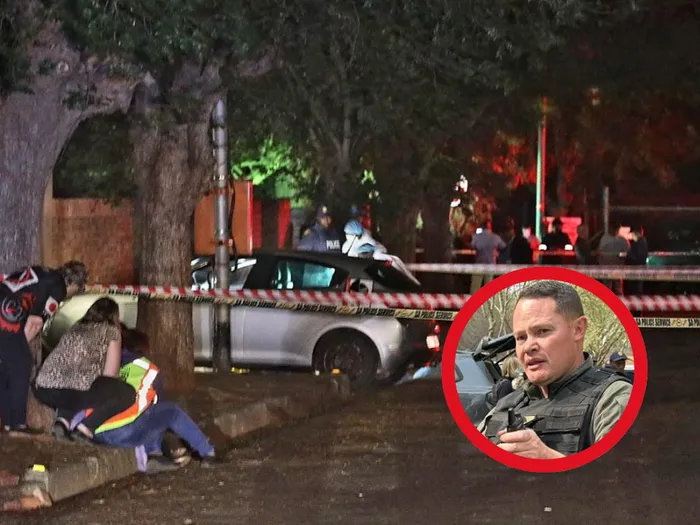
The scene of the shooting in Brakpan where Marius 'Vlam' van der Merwe (inset) was shot dead a couple of weeks after testifying in the Madlanga Commission of Inquiry.
Image: Timothy Bernard / Independent Newspapers / IOL Graphics
IN the wake of the assassination of Marius van der Merwe, the whistleblower known as “Witness D” at the Madlanga Commission of Inquiry, political and civil society voices have issued fierce condemnations and urgent demands for decisive action to protect those who risk their lives to expose corruption and organised crime.
Van der Merwe, a Brakpan-based member of the security industry and former official of the Ekurhuleni Metropolitan Police Department (EMPD), had recently given testimony before the Madlanga Commission — the Judicial Commission of Inquiry into Criminality, Political Interference, and Corruption in the Criminal Justice System.
He was murdered in what many, including Build One South Africa (Bosa), have described as a targeted killing. His death, they said, was a brutal reminder that South Africa was failing the very people who stood up against wrongdoing.
Former ACDP MP and founder of Voice to Parliament (VTP), Marie Sukers, made a powerful call for immediate legislative and executive action. In a statement this week, she condemned the state’s failure to safeguard van der Merwe, whose identity, she argued, was “inadequately protected” and who “becomes another in the long list of whistleblowers outed to criminals, who was not hidden well enough nor received sufficient state safeguarding”.
“We have to urgently take the necessary actions to strengthen and protect the lives of people who are coming forward to testify against the crime networks that undermine the rule of law, and the efforts to rebuild our institutions,” Sukers said. “The courageous actions of professionals, law enforcement officers, and ordinary men and women whistleblowers must be honoured by deliberate actions, not mere talk.”
VTP is demanding that Parliament fast-track legislative reforms to establish independent safehousing mechanisms and ensure dedicated funding for secure support systems for whistleblowers.
Sukers further called on the Presidency to take “extraordinary urgent action” by issuing a presidential proclamation mandating all commissions of inquiry to provide “secure, safe housing and protection protocols for whistleblowers”.
She urged President Cyril Ramaphosa to convene the SA Police Service (SAPS), the State Security Agency (SSA), and the Department of Justice “to coordinate rapid response units for whistleblower protection” and to “fund and establish secure, undisclosed safehouses managed independently from local police structures to prevent leaks and intimidation”.
With Parliament set to adjourn for the Christmas recess, Sukers stressed that legislators must act before breaking for the holidays. She called on MPs to “urgently domesticate the UN Convention Against Corruption (UNCAC) provisions on whistleblower protection, ensuring compliance with global norms”.
This, she said, should include the creation of a statutory body “with powers to provide safe housing, legal aid, and psychosocial support to whistleblowers”, as well as mandatory scrutiny of government departments and law enforcement agencies on their handling of whistleblower cases to “ensure accountability”.
In a pointed call for financial commitment, Sukers insisted that “funds must be ringfenced within parliamentary appropriations for whistleblower protection, including emergency relocation and security measures”. She also advocated for financial rewards aligned with “international best practice” to encourage disclosures and “reduce fear”.
Sukers invoked the names of several courageous individuals who have paid a heavy price for their integrity: “Marius van der Merwe and Babita Doekeran, knowing the possibility of assassination, chose to be brave. Coen and Thomas Murray chose to be brave.” Then, turning the question back on the nation’s leaders and citizens alike, she asked: “What choices are we making to honour their memory?”
Expressing deep sorrow, she extended condolences to van der Merwe’s family, describing him as someone who “provided a compelling account of the challenges faced by ordinary law enforcement officers at the coal face for the battle of the soul of this nation. We honour his memory and thank God for his service. Hamba Kahle, son of the soil. May your memory be a blessing.”
Sukers concluded with a resolute appeal to the Presidency: “Show commitment to the fight and prove, through deeds not words, that it prioritises justice, accountability, and protection of those who stand up against wrongdoing — and by giving the necessary acknowledgement and support to the families who have lost breadwinners, and loved ones in this fight.”
Her message was clear: In moments that “shape a nation irrevocably”, silence and inaction are complicity. The time for decisive action to protect truth-tellers is now.
Bosa, in a statement this week, said it was “outraged and deeply saddened” by the death of the young father, whose only “crime” was his courage to stand up against wrongdoing. Van der Merwe, the party noted, was murdered in what it calls a targeted killing — one that “underscores, in the harshest possible terms, the urgent need to fast-track comprehensive whistleblower protection legislation.”
“South Africa is failing the very people who risk their lives to expose corruption,” Bosa declared in a forceful statement. The party blamed long-standing governmental delay for the peril faced by whistleblowers: “For years, brave public servants and ordinary citizens have come forward… only to be left exposed, vulnerable, and alone. The government has dragged its feet while whistleblowers are assassinated, intimidated, or forced into hiding.”
Bosa also condemned recent remarks by the Minister of Justice, who suggested live broadcasts of inquiries could compromise witness safety. “This is an outrageous deflection,” the party said. “It is not ordinary South Africans who are murdering witnesses to state corruption. It is powerful criminal networks, often with links to state institutions, who kill those who threaten their interests.”
Reiterating its call for Parliament to “immediately fast-track the Whistleblower Protection Bill,” Bosa warned: “South Africa cannot win the fight against corruption while allowing those who expose it to be hunted down in cold blood.”
The SA Communist Party (SACP) likewise issued a strong condemnation following the assassination. In a statement this week, the SACP expressed its “deepest condolences” to van der Merwe’s family, friends, and colleagues, wishing them “strength as they endure the immeasurable pain and trauma brought about by this brutal and senseless killing”.
“The SACP condemns, in the strongest possible terms, the targeting of individuals who come forward to assist the Commission,” the party declared. “This attack is not only a crime against an individual but a direct assault on justice, accountability, and the rule of law.”
Reaffirming its commitment to truth and transparency, the SACP stated: “We reiterate our unwavering support for the Madlanga Commission and call on communities across the country to organise against crime and corruption and refuse to be intimidated by criminal elements determined to obstruct the truth.”
The party also issued a clear demand to the state: “We demand justice and closure for the Van der Merwe family. We further call upon the state to strengthen witness protection mechanisms and ensure that the Commission is fully empowered to uncover the truth without fear or favour.”