Not In My Name | Ramaphosa calls on South African men to confront gender-based violence
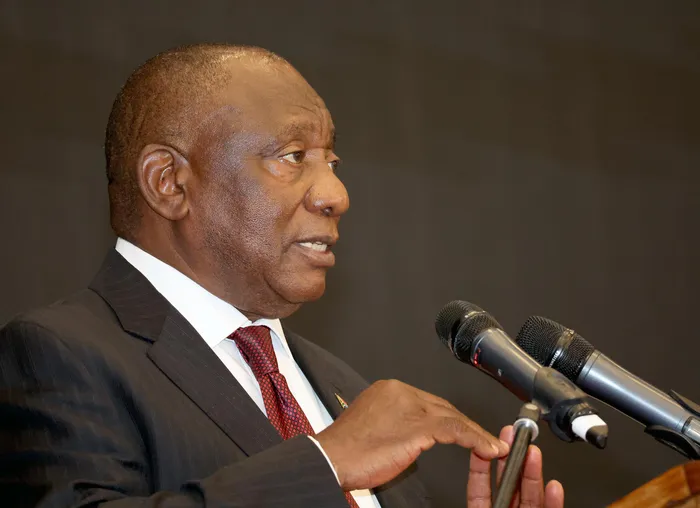
President Cyril Ramaphosa urges men to take responsibility for ending gender-based violence, warning that silence enables abuse. He says GBV will fall “when men rise” with respect, courage and accountability.
Image: GCIS
President Cyril Ramaphosa says South Africa cannot win the fight against gender-based violence (GBV) unless men take responsibility for ending the crisis, warning that the country’s silence and inaction are fuelling an epidemic that continues to destroy families and communities.
Speaking at the 2025 Men’s Indaba at Lemo Green Park in Bloemfontein on Thursday, Ramaphosa told delegates that violence against women and children “is a pandemic, and a crisis that will destroy our nation if we do not stop it,” adding that men must declare, “Not in my Name.”
Ramaphosa said the gathering was taking place as the country observed the 16 Days of Activism against Gender-Based Violence, but noted with concern that recently released crime statistics show increases in contact sexual offences and attempted sexual offences.
He said this means “more women and girls, and even young boys, have been victims of sexual assault, rape and attempted rape,” and warned that “every day across this country, the safety and dignity of women and children is being undermined by the actions of violent men.”
Ramaphosa reiterated that gender-based violence is not a women’s problem, but a crisis rooted in the actions and attitudes of men.
“Gender-based violence is the actions of men, and about the terrible crimes they commit,” he said.
He added that these acts are often justified “in the name of culture and tradition,” or as a way of proving masculinity.
He stressed that while government continues to improve the criminal justice system and support survivors, including the opening of a Sexual Offences Court in Botshabelo, these interventions alone are not enough.
He said no number of police officers, shelters or evidence kits would end the crisis “without directly engaging men,” and warned that if men remain passive while women lead marches and campaigns, “the statistics will not change.”
Ramaphosa said the Men’s Indaba was a clear signal that the country can no longer “outsource the fight against GBV to women who are the victims,” and emphasised that men must stop standing on the sidelines.
“Let us not think that our silence does not mean our complicity,” he said. “Let us not assume that by looking away as another man abuses a woman we are not guilty too – because this crime continues to fester in a culture of silence.”
The President called for open discussion about the pressures facing men, including unemployment, school dropouts, family breakdown, substance abuse and the absence of father figures in many homes.
He said South Africa has a crisis of “broken families,” noting that the majority of children do not live with their biological fathers.
“The presence of a father in the home is important to shaping the attitudes and behaviour of boys,” he said, calling it “heartbreaking” that so many young boys lack male guidance.
Ramaphosa pointed to youth unemployment and rising school dropout rates among boys, saying these factors leave them vulnerable to gangs, violence and substance abuse.
He said men are suffering from depression, isolation, and addictions, and are often socialised in communities and online spaces to believe that dominance and violence make them strong.
“The image is being pushed, that treating women and girls a particular way shows you are ‘a man’ – and that being kind and compassionate makes you weak,” he said.
He condemned predatory behaviour by men of all ages, from older men exploiting young girls to boys pressuring female classmates for intimate images.
He also highlighted abuse within families, where men addicted to alcohol or drugs “terrorise their mothers and grandmothers,” and emphasised that abusers “live among us,” as husbands, fathers, uncles, friends and colleagues, yet “other men look away.”
Ramaphosa urged men to examine their own attitudes toward women, insisting that all forms of abuse, physical, emotional, psychological, and economic, must be recognised and confronted.
He said toxic masculinity is a product of South Africa’s broader culture of violence and stressed that while nothing excuses GBV, the country must understand the conditions causing men to turn to violence so that it can intervene early.
He called for men’s dialogues to take place throughout the year, not only during the 16 Days of Activism, and said these platforms must give men and boys “a safe space to be vulnerable and to be honest,” without being labelled as abusers.
He emphasised the need for psychosocial support for boys in schools, stronger prevention efforts within families and communities, and rehabilitation programmes for offenders to break the cycle of violence.
“South Africa does not need a so-called new generation of men,” Ramaphosa said. “It needs the men and boys of this generation to do better, and to be better.”
He said the country needs men who are “compassionate, accountable, and strong in character,” and who act as protectors, role models, and active challengers of abusive behaviour among other men.
Calling on men across the country to take responsibility, Ramaphosa said: “Let us say resoundingly, Not in our Name. GBV will fall when men rise. Not in violence, but in respect, courage and accountability.''
hope.ntanzi@iol.co.za
IOL News