
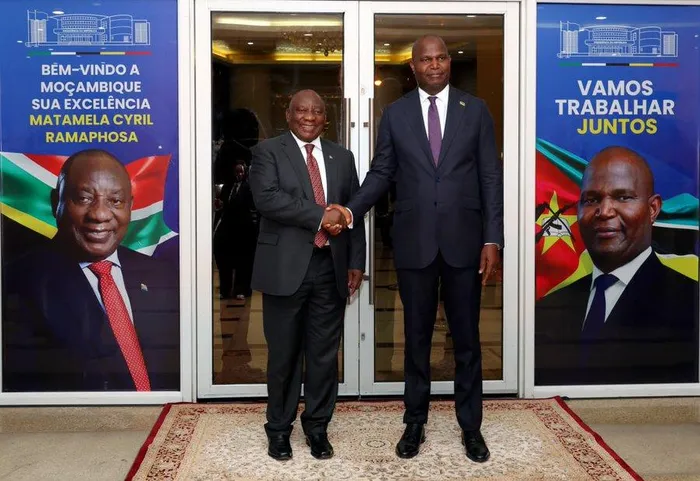
Presidents Cyril Ramaphosa and Daniel Chapo held bilateral discussions at the State House in Maputo ahead of the 4th Bi-National Commission.
Image: South African Government
South African companies operating in Mozambique have invested more than R160 billion and created 43,000 jobs, President Cyril Ramaphosa said on Wednesday, describing the scale of economic activity as a foundation for a new era of strengthened bilateral cooperation between the neighbouring countries.
Ramaphosa was speaking in Vilankulo during the South Africa–Mozambique Business Forum, part of his two-day working visit to the country for the 4th Bi-National Commission (BNC). He praised the launch of the South African Chamber of Business in Mozambique, calling it a milestone that would enhance organised business, advocacy, networking and knowledge-sharing among South African companies operating across the border.
“Through their total investment of R160 billion in Mozambique with a cumulative total of 43,000 employees, the member companies of the Chamber will be able to drive economic development,” Ramaphosa said, commending business leaders for their role in strengthening economic ties.
His visit began on Tuesday, where he led the South African delegation at the State House in Maputo. The Presidency emphasised that relations between the two countries are rooted in history and struggle, with the BNC structure guiding political, economic and social cooperation. This week’s session is the fourth since the inaugural BNC in 2015, followed by meetings in 2017 and 2022.
The BNC aims to assess progress on previous commitments, strengthen bilateral relations, expand trade and investment, and exchange views on regional, continental and global developments. According to the Presidency, more than 70 bilateral agreements and memoranda of understanding already exist, covering agriculture, defence, border management, health, transport, labour, investments and customs administration.

President Cyril Ramaphosa during his engagements in Mozambique
Image: South African Government
Ramaphosa said trade between South Africa and Mozambique had shown “remarkable resilience”, doubling between 2020 and 2024. The Presidency’s statement confirmed that Mozambique remains South Africa’s main trading partner on the African continent, with total trade reaching R119.4 billion in 2024, up from R114 billion the year before. South African exports amounted to R19.4 billion last year.
At the Business Forum, Ramaphosa noted that South Africa’s top export categories to Mozambique are mineral products, machinery and metals, with foodstuffs and vehicles making up smaller but significant shares. While these reflect South Africa’s industrial base, he said they also highlight the need for diversification toward more value-added goods and services. Mozambique’s exports to South Africa remain dominated by energy products — electricity, natural gas and coal — along with aluminium and agricultural goods.
Ramaphosa described Mozambique as being at a pivotal moment in its economic development, endowed with natural gas, coal reserves, and vast solar potential. He also identified opportunities in agro-processing, packaging, wood processing, textiles, building materials, metals and metallurgy. These sectors, he said, align closely with South Africa’s industrial capabilities and present opportunities for deeper collaboration under the African Continental Free Trade Area (AfCFTA).
“For South Africa and Mozambique, the AfCFTA provides a framework to position ourselves as gateways to broader African markets,” he said, noting that South African firms could use Mozambique to reach East Africa, while Mozambican companies could use South Africa’s industrial infrastructure to access Southern Africa.
However, Ramaphosa warned that several constraints still hinder growth, including infrastructure gaps — particularly in transport corridors and energy supply — customs delays, regulatory differences, and limited access to trade finance for small and medium-sized firms. He called for harmonised regulations, simplified border processes and one-stop investment centres to accelerate business activity.
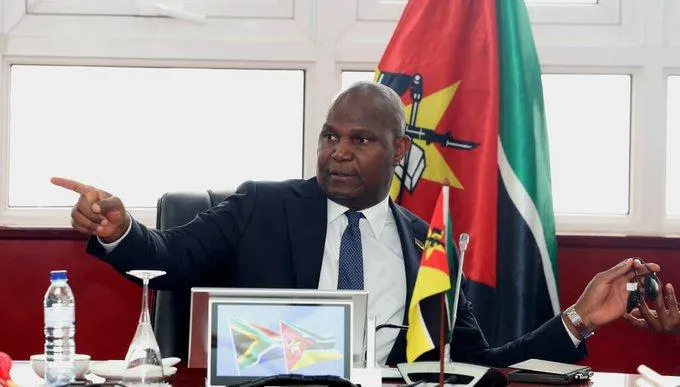
President Daniel Chapo at the State House in Maputo, Republic of Mozambique
Image: South African Government
“These challenges are not insurmountable,” he said. “They require sustained commitment from both governments, working in partnership with the private sector, to implement practical solutions.”
Ramaphosa said South Africa remained committed to supporting cross-border infrastructure projects, strengthening commercial services through its diplomatic missions, and advancing skills development that benefits workers in both countries.
On Wednesday, before travelling to Vilankulo, Ramaphosa addressed the opening of the BNC in Maputo and took part in the signing ceremony and joint press conference. He then travelled to the Inhambane Province to officiate at the launch of the Sasol Hydrocarbons Processing Integrated Infrastructure in Temane — one of the major South African investments contributing to Mozambique’s industrialisation.
Throughout his engagements, Ramaphosa emphasised that the decisions and investments made during this BNC cycle would shape the long-term prosperity of both countries.
“The economic relationship we build today will determine the prosperity of our children tomorrow,” he said, urging businesses to “move beyond cautious exploration toward bold partnership” and commit resources to concrete projects.
He said South African companies bring technical expertise, managerial experience and capital, while Mozambican firms provide local knowledge, community relationships and regulatory insight. Together, he said, they can achieve outcomes that neither could accomplish alone.
jonisayi.maromo@iol.co.za
IOL News