
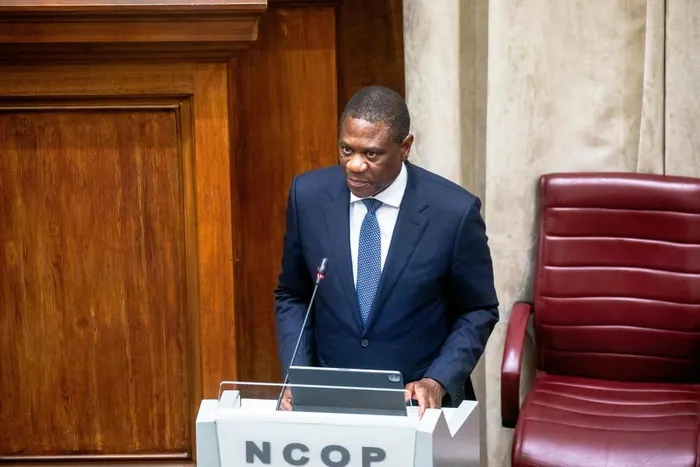
Deputy President Paul Mashatile delivers his annual address to the National Council of Provinces.
Image: Photo : Zwelethemba Kostile / Parliament RSA
Deputy President Paul Mashatile on Thursday warned against sounding the drums of victory for the successful passing of the 2025 Budget earlier this year.
Speaking during his annual address to the National Council of Provinces, Mashatile said the first adoption of the Budget under the Government of National Unity tested and ultimately strengthened their unity as representatives of the people.
“This achievement exemplified our determination to prioritise the nation, advancing crucial legislation aimed at fostering inclusive economic growth, creating jobs and alleviating poverty and the cost of living.
“It underscored the effectiveness of collective efforts in addressing significant challenges and igniting meaningful change for all South Africans. However, it is far too early to sound the drums of victory,” he said.
Mashatile said millions of people still wake up to the harsh realities, including poverty, unemployment, the rising cost of living, corruption and gender-based violence and femicide.
“These are lived experiences that demand our urgent and steadfast intervention.”
Mashatile also said 2025 saw the beginning of the National Dialogue aimed to reaffirm the country’s commitment to inclusive governance and social cohesion.
The first National Convention was held in August.
“This historic event brought together governments, civil society, and communities to address the important topics such as social unity and economic transformation,” he said.
The deputy president said the executive achieved significant milestones in its task of promoting trade and investments.
“Through strategic engagement, partnerships have been cultivated to promote investment, job creation, and innovation.”
He added that South Africa has also established itself as a strong advocate for multilateralism and as a key proponent for a global agenda.
Referring to the hosting of the G20 Leaders’ Summit last month, Mashatile said the event marked a significant achievement for both South Africa and the continent.
He used his address to call for the fight against the scourge of gender-based violence and femicide (GBVF) and urged men to take guidance of their families, homes, children and communities.
Mashatile said the legacy of apartheid continued its horrible stronghold on the majority of South Africans.
“Many of the people still live in the sprawling fragmented cities and towns. This is why we are responding to apartheid spatial planning through the introduction of the Spatial Planning and Land Use Management Act's, among other measures, which requires rigorous applications to foster inclusive growth.”
He said there were efforts to shift investment to create well-located service sites near economic opportunities, reducing travel costs and time for citizens.
“We are also working with provinces and municipalities to facilitate the release of strategically located public land for mixed-income human settlements.”
Steps were being taken to address the housing crisis due to the persistent housing backlog exacerbated by incomplete projects and the rapid growth of informal settlements.
Mashatile also said the government was committed to securing water and sanitation for everyone.
“We are addressing the critical water insecurity crisis caused by aging infrastructure, poor maintenance, high non-revenue water losses, sometimes up to 50% in some areas, and the devastating impact of climate change which caused droughts and floods.”
According to Mashatile, there was acceleration of investments in the refurbishment and expansion of bulk water and wastewater infrastructure.
“We are committed to training and deploying an additional 15,000 skilled water professionals by 2030 to enhance municipal technical capacity and governance.”
Mashatile said the government was also empowering municipalities and improving service delivery amid councils facing acute governance instability, financial distress, and capacity deficits that lead to service delivery failures.
“To address these challenges, government continues to implement targeted support and intervention mechanisms for distressed municipalities.”
mayibongwe.maqhina@inl.co.za