South Africa's GDP growth remains sluggish despite signs of recovery
ECONOMY
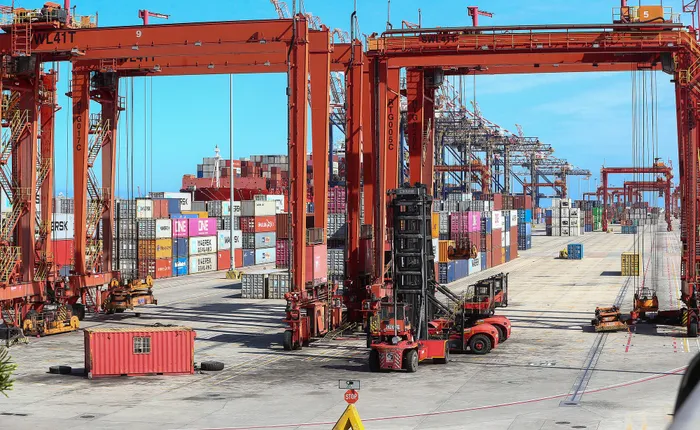
The green shoots in the economy include the improvement in freight passage at Transnet, the end of rolling blackouts and the country’s removal from the grey list and an upgrade by S&P ratings agency, all of which will help boost sentiment and attract investment, while the global economy has proved more resilient than previously anticipated.
Image: Leon Lestrade/Independent Newspapers
South Africa’s economy could still grow less than 1% this year despite optimism for a slight upsurge after gross domestic product (GDP) posted its fourth straight gain in the three months to September.
Data released by Statistics South Africa (Stats SA) shows that real GDP grew by 0.5% in the third quarter, slower than the revised 0.9% growth in the second quarter.
Stats SA’s chief director for national accounts, Dr Bokang Vumbukani-Lepolesa, said the expansion was quite broad-based, with nine over 10 industries growing during this period.
“The trade, mining and finance industries as well as government services were the most significant positive contributors to overall growth. Trade increased by 1% with positive gains in wholesale, retail, motor trade, accommodation and food and beverages,” she said.
“Mining output increased by 2.3% driven predominantly by platinum group metals with support from manganese ore, coal, chromium ore and copper. Electricity, gas and water was the only industry that disappointed in the third quarter, shrinking by 2.5%. This was due to lower electricity production and consumption.”
Dr Elna Moolman, Standard Bank Group head of South Africa macroeconomic research, said the 0.5% growth outcome aligned with expectations, with most sectors performing as anticipated. Household spending continued to grow, albeit slightly slower than in the previous quarter.
“Fixed investment encouragingly recovered in the third quarter, though this was driven almost entirely by the public sector. At least there is then still evidence of ongoing traction with the government's growth-supportive fixed investment drive,” she said.
“The crux is that the economy is performing in line with our expectations in a very difficult year from where we still expect to see an improvement in growth over the medium term.”
The government welcomed the latest GDP results, saying the continued improvement reflects the resilience of the economy and the impact of ongoing structural reforms to support inclusive and sustained growth.
The green shoots in the economy include the improvement in freight passage at Transnet, the end of rolling blackouts and the country’s removal from the grey list and an upgrade by S&P ratings agency, all of which will help boost sentiment and attract investment, while the global economy has proved more resilient than previously anticipated.
“While challenges remain, the economy is on a path of gradual recovery. Government will continue implementing measures to support growth, investment and job creation,” it said.
Investec economist Lara Hodes said the GDP uptick signalled an economy slowly working through long-standing structural barriers that have constrained export potential and job creation.
“While significant progress has been made in a number of key areas of the economy, with Operation Vulindlela Phase 2 launched in May, business confidence remains subdued with growth insufficient to drive sustainable job creation. The hastened implementation of essential reforms is imperative,” Hodes said.
The South African Reserve Bank expects growth to stabilise and has revised its 2025 GDP forecast slightly higher to 1.3%, more than double the estimated pace of 2024, with growth approaching 2% over the medium term.
The National Treasury forecasts growth of 1.2% in 2025 and 1.8% over the medium term, supported by reforms in energy and logistics.
However, Frank Blackmore, lead economist at KPMG South Africa, warned that though the GDP print indicates a broad distribution of growth across the economy, it was still short of impactful growth.
“Overall, growth in the first three quarters stands at 0.1%, 0.9% and 0.5% respectively, averaging around 0.5%, which leaves GDP likely to come in at under 1% for the year as a whole, even with an optimistic fourth quarter,” Blackmore said.
North West University's Business School economist, Prof Raymond Parsons, said the vulnerabilities that remain in the growth outlook stem from the slower GDP growth, the continued poor performance of manufacturing as a key lagging sector, and the expected negative impact of US import tariffs on the SA economy.
“The green shoots of the current economic recovery and investor confidence must still be nurtured by favourable policy responses. The challenge remains to implement robust growth-friendly policies that will further build on the steadier foundation of the incipient economic upturn that has become apparent in 2025,” Parsons said.
BUSINESS REPORT