Are military interventions the answer? Civic groups oppose SANDF deployment amid crime crisis
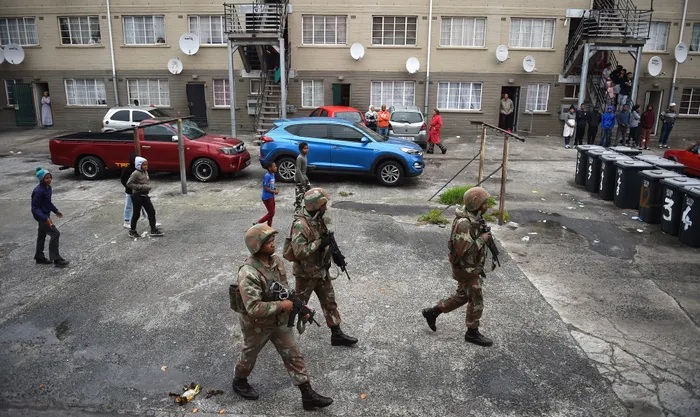
The South African National Defence Force (SANDF) is deployed to combat rising gang violence, sparking debate among civic organisations and government officials.
Image: file
While the Chairperson of the Portfolio Committee on Defence and Military Veterans, Dakota Legoete, has welcomed President Cyril Ramaphosa’s deployment of the South African National Defence Force (SANDF) to combat crime, gang violence, and illegal mining, civic organisations have rejected this move, citing previous failures of similar interventions.
In a statement issued by Parliament on Friday, Legoete said the fight against internal criminal threats is just as critical as protecting the country from external aggression.
“The safety of our citizens is non-negotiable. When organised crime syndicates and illegal mining networks terrorise communities, threaten livelihoods, and undermine the rule of law, the state must respond decisively," he said.
"We fully support the President’s firm commitment to restore order and protect our people.”
Parliament said Legoete emphasised that the Constitution empowers the SANDF to defend and protect the Republic, its territorial integrity, and its people.
“The SANDF has a constitutional duty to defend and protect the Republic and its people. When criminal elements effectively hold communities hostage, particularly through illegal mining operations and violent gang activity, the deployment of the Defence Force becomes both necessary and justified,” he said.
Legoete further stated that he has consistently called for the strategic deployment of the SANDF to support SAPS in stabilising crime hotspots. “I have long warned that the threats we are facing within our own borders have escalated beyond what can be effectively managed through ordinary policing alone.
“The scale and sophistication of organised crime now require a more coordinated and robust intervention, one that includes the disciplined capacity of the SANDF working in support of SAPS. I therefore welcome the President’s decision.”
He said the situation, particularly in the Western Cape, has reached alarming levels.
“Gang violence continues to terrorise communities, and the proliferation of illegal firearms in the hands of gangs and extortionists is completely out of control. Our people deserve urgent and decisive action.”
“This intervention is long overdue,” he added. “Our people deserve to feel safe in their homes and in their communities. The deployment of the SANDF, working in support of SAPS, will strengthen the government’s capacity to decisively confront those who threaten our national security.”
He emphasised that expanding internal security responsibilities must be matched with adequate resources.
“We cannot expect the Defence Force to meet growing internal and external security demands while it remains severely underfunded. Chronic budget constraints weaken operational readiness, delay modernisation, and ultimately compromise our national security," he stated.
According to the Chairperson, strengthening the SANDF is not only about domestic safety but also about the country’s regional obligations. “South Africa’s security is closely linked to the stability of the Southern African region. A capable, properly funded, and modernised SANDF is essential for safeguarding our sovereignty, supporting peace missions, and contributing to regional stability.”
He urged the government to prioritise the implementation of the 2015 Defence Review and ensure sustainable funding for the Defence Force. “The SANDF is more than a military institution. It is a symbol of our sovereignty, resilience, and unity. If we are serious about defeating organised crime and protecting our constitutional democracy, we must equip and fund our Defence Force accordingly. The time for decisive action is now.”
However, the Cape Crime Crisis Coalition (C4) rejects the rationale for the deployment of the SANDF.
C4 spearheaded the call for gang violence to be declared a national state of disaster and sent numerous letters to Premier Alan Winde. “The deployment of the army is not a solution; it is a surrender,” C4 said.
C4 stated that the narrative has been practised before with not much remedy: “We have been here before, and the evidence shows that it does not work. In 2019, Operation Prosper was launched with great fanfare in Mitchell’s Plain, Nyanga, and across the Cape Flats. Cameras rolled. Politicians posed. Soldiers patrolled. Six months later, the army returned to the barracks.
“In a 2020 evaluation of Operation Prosper examining the role and impact of the SANDF, including its impact on the murder rate, the findings show: “That there does appear to have been a reduction in murders in the month when the deployment started but found no evidence that the army presence significantly reduced murders in the affected communities over the deployment period, as compared with similar ones where the army was absent.”
It said gangs today were highly organised criminal syndicates. It stated there was an alternative. “We call on the President and the Provincial Government to declare a Provincial State of Disaster in the Western Cape, in terms of the Disaster Management Act, 2002.
Premier Winde also welcomed the deployment but said it was a short term solution which could not replace the police.
Get your news on the go, click here to join the Cape Argus News WhatsApp channel.
Cape Argus