South Africa's agriculture in crisis as foot-and-mouth disease wreaks havoc
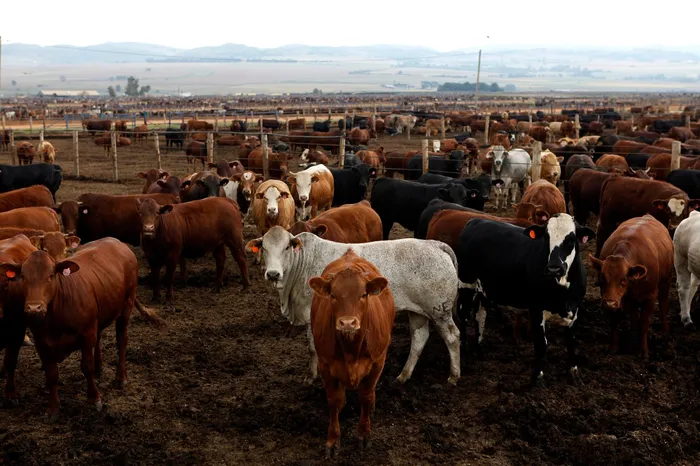
A catastrophic outbreak of foot-and-mouth disease (FMD) continues to devastate farms in SA.
Image: REUTERS/Siphiwe Sibeko
THE foot-and-mouth disease outbreak that has devastated South Africa’s agriculture, has raised urgent concerns for farmers.
Considered the worst outbreak of foot-and-mouth disease (FMD) in recent years, the implications are dire, with prices for red meat and dairy products set to surge.
FMD is a highly contagious disease of all cloven hoofed animals and South Africa lost its FMD freedom status in 2019. The outbreak started in 2021 when animals moved from Phalaborwa to KwaZulu-Natal.
Farmers like Angus Williamson, vice president of the KwaZulu-Natal Agricultural Union (Kwanalu), have blamed government negligence for the crisis.
He said it was a catastrophe which could have been prevented.
"As organised agriculture we engaged with government since 2021 when the outbreak was in Mtubatuba and it took them a year to get vaccinations done in that area. The government is fully to blame because they were warned.
"The losses are into the millions. Some dairy farmers have lost between R6 and 8 million. That is monstrous. With the new wave of foot and mouth disease there's farmers who have lost up to 200 to 250 calves from Tiger heart sydrome which is a secondary infection from foot and mouth. That is a loss of R2.8 million, which a Free State farmer had because of calves he could not sell," said Williamson.
He added that the price of red meat will go up and milk will be more scarce.
"You cannot expect the production to drop by 30 to 40% on the milk side and not expect to have an impact on dairy products. Red meat is going to become more scarce and expensive. We cannot sell animals now because the sales have all closed due to the challenges of foot and mouth disease.
"Until the government have some sort of protocol and legislation changes farmers are going to be financially constrained for the next 12 to 18 months. I have foot and mouth on my farm and I'm under quarantine so I cannot sell any cattle until protocol and legislation changes so I have no outlet for my cattle until a vaccination comes in. There's a lot of scepticism with regards to the vaccine that's coming in. Government have to start listening and reacting to organised agriculture," said Williamson.
In response to the outbreak, Agriculture Minister John Steenhuisen this week unveiled a plan for the country to be disease free by 2036.
Steenhuisen said their strategy was not a temporary patch, but a comprehensive control and eradication programme designed to interrupt virus transmission and protect the national herd.
"We are prioritising high-risk zones, with the goal of reaching at least 80% coverage in targeted cattle populations, especially in the communal areas and up to 100% in feedlots and dairy cows. The objective is to reduce outbreak incidence within 12 months by more than 70% in the high-risk provinces through systematic vaccination and preserve FMD-free provinces through buffer vaccination and strict movement controls.
"High-quality vaccines with high potency will be used during the campaign, especially trivalent vaccines of SAT1, SAT 2, and SAT 3 currently circulating in South Africa. Partnerships with global leaders like Biogénesis Bagó in Argentina will ensure that we have a reliable supply, with one million doses ready to be sent as soon as the necessary permits are issued," said Steenhuisen.
He said they have been procuring vaccines from the Botswana Vaccine Institute (BVI) and will continue sourcing vaccines from this institute.
Laboratory capacity is also being strengthened, with the Agriculture Research Council’s Onderstepoort Veterinary Research (ARC-OVR) facility leading a network of state laboratories to ensure faster testing and turnaround times.
Northern Cape is the only province that has not reported an outbreak - two million animals have been vaccinated.
"KwaZulu-Natal, Gauteng, Free State and North West were identified as the hardest hit provinces. Interventions include the immediate mass vaccination across affected districts which will be repeated within three months - 100% vaccination of feedlots and dairy cows; 90% commercial and 80% of communal animals," said Steenhuisen.
While Kwanalu has welcomed the proposed vaccination strategy, concerns linger regarding the availability of vaccines, rollout logistics, and communication protocols.
The Union has warned that unless these and other operational elements are addressed urgently and equitably, the strategy’s objectives will falter.
“Whilst we note the national strategy and its acknowledgement of long-standing requests from the industry the plan comes four years too late and does not address the real issues affecting our industry,” said Sandy La Marque, CEO of Kwanalu.
"One of our biggest concerns has been the dairies. These are high-producing, stressed animals that need to maintain performance. Dairy herds must be prioritised in the vaccine rollout, followed by commercial, communal farmers and feedlots," said PJ Hassard, President of Kwanalu.
KwaZulu-Natal Premier, Thamsanqa Ntuli, and the Cabinet have pledged to respond decisively, with plans for province-wide vaccinations starting in February.
A cabinet meeting was held this week following reports that the disease has spread to all districts within the province, with recent incidents reported in Ugu and Harry Gwala districts.
Thembeni kaMadlopha-Mthethwa, MEC for Agriculture and Rural Development, emphasised that vaccination remains a critical tool in containing the current outbreak and protecting the province’s livestock sector.
Since the first outbreak was recorded in Mtubatuba in May 2021, the KwaZulu-Natal Department of Agriculture and Rural Development (DARD) has implemented extensive control measures and has vaccinated approximately 800 000 cattle to date.
“Our veterinarians are actively on the ground working closely with farmers to manage and contain this disease. The demand for FMD vaccines is extremely high, and farmers have experienced challenges in accessing vaccines. As provincial government, we are pleased to announce that a province-wide vaccination rollout will commence in February,” said kaMadlopha-Mthethwa.
She added that the rollout plan will cover feedlots, dairy farms, commercial farms and communal farming areas, with further details on dates and locations to be communicated in due course.
KwaZulu-Natal will be the starting point of the national livestock vaccination programme, and all livestock owners are urged to cooperate fully with veterinary officials when the campaign begins next month.
AgriSA acknowledged the efforts by the Department of Agriculture to stabilise the current situation, adding that the updated strategy reflects a more coordinated, risk-based, and science-led approach to vaccination, surveillance, movement control, and zoning, which is essential to containing the disease and restoring confidence in the livestock industry.
“With sustained cooperation between government and industry, adequate resourcing of the national strategy, and strong participation by farmers on the ground, South Africa can progressively stabilise outbreaks, protect disease-free zones and work toward the recovery of internationally recognised FMD-free status,” said Willem de Chavonnes Vrugt, AgriSA president.