
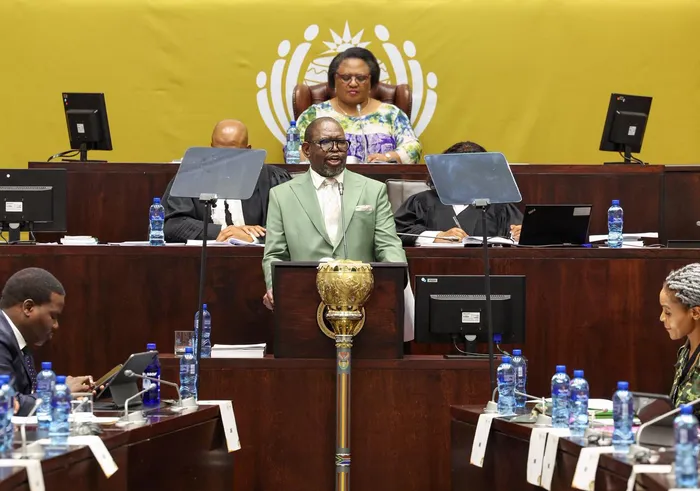
The 2025 revised and proposed fiscal framework garnered a simple majority of 216 votes from parties in the Government of the National Unity, with 78 objections when it was adopted early this year.
Image: GCIS
As 2025 draws to a close, Parliament has been a theatre of unprecedented events and intense scrutiny with a significant impact on the country’s political landscape.
From the gripping postponement of the Budget presentation to intense investigations into police corruption, this parliamentary year has showcased both the challenges and resilience woven into the fabric of South African politics.
Budget postponement
The year began with a notable first as Finance Minister Enoch Godongwana was compelled to present two budgets.
This unprecedented postponement was sparked by proposed increases in VAT and mounting tensions among partners in the Government of National Unity (GNU).
The DA, having pursued legal action alongside the EFF, threatened to withhold its support unless its fiscal proposals were addressed.
The mounting pressure led to frantic last-minute negotiations within GNU to avert a budget deadlock and illustrated unresolved complexities of coalition governance.
Critics accused the DA for using the discussions to push unrelated agendas such as the Basic Education Amendment Bill and the National Health Insurance Act.
Robust portfolio committees
Portfolio committees have been the backbone of Parliament, providing a platform for rigorous scrutiny and accountability of the executive.
This year, they emerged as powerful players, demanding transparency and results from ministers.
Former minister of higher education, Nobuhle Nkabane, faced fierce questioning over her controversial appointments of ANC-aligned chairpersons for Sector Education and Training Authorities.
Nkabane’s defensiveness and refusal to disclose panel members added fuel to an already tense atmosphere, prompting even her ANC colleagues to step back from providing support.
Discontent brewed when Godongwana clashed with the Portfolio Committee on Land Reform when he declined to present on expenditure trends related to land reform funding, further intensifying calls for him to be summonsed.
Moreover, criticism mounted against Public Works and Infrastructure Minister Dean Macpherson for his absence from committee meetings, culminating in a public reprimanding by MK Party MP Des van Rooyen, who called him a “so-called GNU” minister and was in turn called “AKA special weekend”.
In response, Deputy President Paul Mashatile acknowledged the growing frustration surrounding ministers’ engagement in committee meetings.
“This problem has reached us. As a leader of Government Business, I have received this complaint, and I have written to all ministers to urge them to attend the portfolio committees,” Mashatile told a breakfast session with the Press Gallery Association.
Parliamentary inquiries
The Standing Committee on Public Accounts initiated an inquiry into the Road Accident Fund (RAF) amid mounting allegations of financial mismanagement and maladministration.
Despite legal pressures to attend, former RAF CEO Collins Letsoalo’s refusal to cooperate has led the committee to consider pursuing criminal charges against him.
The investigation, which will resume next month, has already heard from numerous witnesses shedding light on significant governance issues within the RAF.
Additionally, an Ad Hoc Committee was initiated to probe allegations from KwaZulu-Natal SAPS Commissioner Lieutenant-General Nhlanhla Mkhwanazi.
While the inquiry faced initial delays, testimonies beginning in October indicated a serious breach of integrity within both the criminal justice system, with certain members of Parliament named in damaging allegations.
The inquiry will resume in January with testimonies of other witnesses after scores of witnesses, including attempted murder accused tenderpreneur Vusimuzi “Cat” Matlala, who gave evidence at Kgosi Mampuru Prison in Pretoria.
Oversight of the Presidency
A long-awaited oversight committee on the Presidency was finally formed this year, marking a significant evolution in parliamentary accountability.
This committee will scrutinise the budget and administration associated with the Presidency.
It will have the power to summon the designated minister appointed by the President.
The President and Deputy President will be required to appear before the committee annually to discuss policy matters of national and international importance.
Policing conduct of MPs
Parliament also saw an increased scrutiny of MPs’ ethical conduct, with the Ethics Committee issuing 10 reports - a considerable increase from previous years.
Even Deputy President Paul Mashatile faced reprimanding for not declaring a diamond gifted to his wife, highlighting the committee's growing assertiveness in maintaining ethical standards within Parliament.
Appointments
The recruitment process to find the new Deputy Public Protector took longer than expected after Parliament recommended Advocate Dinkie Portia Dube last month.
The process, which was restarted in August 2024, stalled in April in the Justice and Constitutional Development Portfolio Committee over the adoption of the report amid calls for exclusion of the EFF, which had not participated in the interviews.
In August, the Constitutional Court ordered the restart of the process to fill position for five commissioners at the Commission for Gender Equality.
The court found that Parliament failed to comply with its constitutional obligation to facilitate reasonable public involvement in recommending persons to be appointed as members of the Commission for Gender Equality.
MK Party musical chairs
Perhaps most striking this year has been the internal chaos enveloping the MK Party caucus, witnessing resignations and leadership shakeups.
A total of 13 members resigned as MPs.
The recent suspension of party deputy president John Hlophe following irregular actions has only intensified the turbulence within the ranks.
In May, Mzwanele Manyi was removed as chief whip and replaced by Colleen Makhubele.
The party’s spokesperson Nhlamulo Ndhlela was also removed from the whippery after Hlophe in a letter to party leader Jacob Zuma expressed his dissatisfaction with his disruptive conduct and later labeling Makhubele as a “political novice and newcomer” to the political landscape”.
Hlophe was suspended last month for removing Makhubele and replacing her with Des van Rooyen without consulting party leaders while Zuma was on a visit to Burkina Faso.
Van Rooyen is now the acting parliamentary leader while the internal inquiry into Hlophe is expected to be finalised by the end of January 2026.
mayibongwe.maqhina@inl.co.za