Seven key issues Madlanga Commission is expected to highlight in report to Ramaphosa
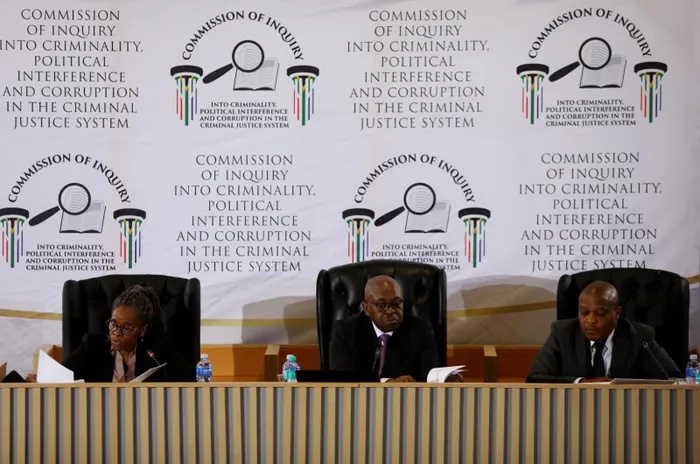
The Madlanga Commission is expected to present its interim report to President Cyril Ramaphosa this week. Pictured are members of the Commission (from left) Adv. Sesi Baloyi SC, Justice Mbuyiseli Madlanga (Chair) and Adv. Sandile Khumalo SC.
Image: Oupa Mokoena / Independent Newspapers
Systemic criminal infiltration, political interference in policing, the implication of senior officials in criminal activities, the unlawful disbandment of the Political Killings Task Team (PKTT), compromised judicial processes, failure of whistle-blower protection and institutional weakness in SAPS are among the key issues expected in the Madlanga Commission’s preliminary report this week.
The Madlanga Commission of Inquiry is investigating allegations of collusion and corruption between politicians, senior police, prosecutors, intelligence operatives, and elements of the judiciary, levelled by KwaZulu-Natal Provincial Police Commissioner Lieutenant General Nhlanhla Mkhwanazi.
It was established by President Cyril Ramaphosa and chaired by retired Justice Mbuyiseli Madlanga, with shocking revelations including claims that senior officials are implicated in receiving money from criminal cartels in exchange for favours.
The Commission is expected to hand over its preliminary report to Ramaphosa on Wednesday.
7 Key Points
1. Systemic criminal infiltration
There is likely going to be a finding that there is prima facie evidence confirming the existence and operation of sophisticated criminal syndicates, such as drug cartels, which have infiltrated and corrupted elements of the SAPS, especially Crime Intelligence, Metro Police, and the National Prosecuting Authority (NPA). WhatsApp messages, CCTV footage, and audio recordings presented as testimony suggest there may be beneficial relationships between senior law enforcement officials and the alleged ‘Big Five’ criminal cartel members.
2. Political interference in policing
It is likely to include substantive findings on the undue interference by current or former members of the National Executive or senior government officials in operational police matters and sensitive investigations.
3. Unlawful disbandment of the PKTT
A specific finding is expected regarding the executive decision to disband the PKTT, determining whether it was a legitimate administrative move or an act of political interference to suppress investigations. Senzo Mchunu, the suspended Police Minister, has been accused of issuing an instruction to disband the PKTT immediately without consulting the national police commissioner and the KZN provincial Commissioner.
4. Compromised judicial processes
Findings on allegations of impropriety within parts of the judiciary and magistracy, specifically concerning the alleged manipulation of bail processes for high-level organised crime suspects, are expected to form part of the commission’s preliminary report. Witness B’s testimony detailed a judge’s alleged bias in granting bail to murder-accused businessman, and purported member of the ‘Big Five’ criminal cartel, Katiso ‘KT’ Molefe.
5. Failure of whistle-blower protection
There is likely going to be a critical assessment and finding on the failures of the state’s witnesses and whistle-blowers protection mechanisms, brought to light by the recent murder of key witness ‘Witness D’ (Marius van der Merwe).
6. Institutional weakness in SAPS
The preliminary report is likely to detail an initial analysis of systemic fragility and operational collapse within core SAPS divisions, including Crime Intelligence, the huge backlog in ballistics and forensic analysis, and its impact on case finalisation. The commission heard that the SAPS Forensic Science Laboratory Services has a 30-day turnaround time for ballistics reports, a stark contrast to the PKTT’s turnaround time of one day.
7. Implication of senior officials
The report may identify specific current or former senior officials, including police generals, political figures, and judiciary members, against whom there may be sufficient prima facie evidence of aiding, abetting, or benefiting from the criminal activity. The testimony has brought to the public’s attention the names of very senior officials allegedly linked to wrongdoing.
Political analyst Professor Bheki Mngomezulu, said there could be tangible recommendations, but very few will be implemented.
“We saw the same with the Zondo Commission and others. The public expects arrests and the sacking of individuals. The President is expected to act swiftly. However, I doubt if that will happen. He is also implicated. He will say that he is still studying the report and allow the dust to settle,” Mngomezulu stated.
Another analyst Professor Ntsikelelo Breakfast, from Nelson Mandela University, said that the report will not paint the whole picture, and it is crucial not to read too much into this.
He said that criminal proceedings cannot be ruled out.
“Since these findings will be laid bare at a time when the elections are around the corner, we might see political expediency at play, where political parties will use these to campaign, not because they care about justice,” Breakfast said.
He highlighted that the public is sick and tired of corruption that happens unabated and they will be moved by the actions taken by the responsible institutions.
gcwalisile.khanyile@in.co.za