Are university admissions compromised by corruption in South Africa?
Higher Learning
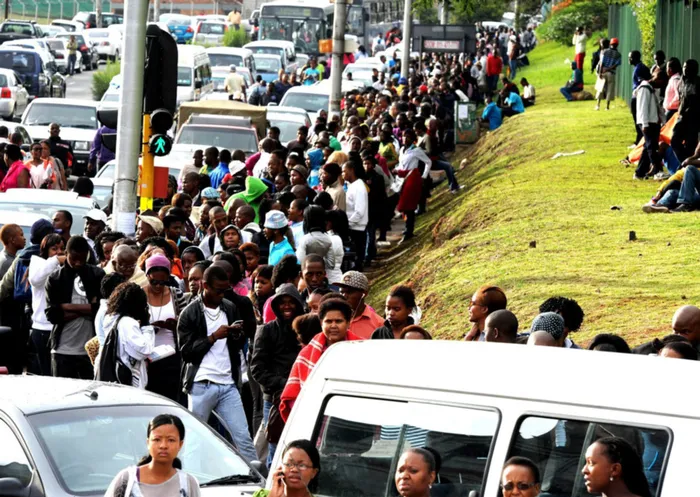
Thousands of students stand outside in a long queue stretching down Annet Street, going into Bunting Road to the entrance of The University of Johannesburg. Across South Africa, there is growing unease about whether spaces at our universities are being bought and sold.
Image: Adrian de Kock
WHISPERS have become rumours. Rumours have become patterns. And patterns, when ignored for too long, harden into truths we pretend not to see.
Across South Africa, there is growing unease about whether spaces at our universities are being bought and sold. I do not write this with the confidence of firsthand experience, but with the weight of repeated allegations, familiar stories, and an uncomfortable sense that something has shifted inside our institutions of higher learning.
When I first attended university, such criminality would have been unthinkable. Admission was competitive, yes, but it was governed by rules that were largely trusted. You applied, you waited, and you accepted the outcome.
Merit mattered. Effort mattered. There was a shared belief that the system, while imperfect, was fundamentally fair. That belief is now under strain.
The allegations are not abstract. They tend to surface around high-demand programmes, medicine, law, engineering and around late registrations when desperation meets administrative discretion. In those moments, where systems are stretched and oversight is weak, intermediaries appear. Someone claims they can “help”. A space is suddenly found. Money quietly changes hands. A market is born.
This is not just a story about individual greed. It is about structural pressure. Demand for university places vastly exceeds supply. Universities are overwhelmed, underfunded, and administratively stretched. Application systems may be centralised, but verification remains fragmented. Where there is scarcity, opacity, and unchecked discretion, corruption finds oxygen.
The most painful question is not whether this is happening. It is who pays the price.
The first casualties are deserving students. Bright learners from poor households who have done everything right are edged out by those with money or connections. Merit is quietly replaced by access. Over time, this does something far more damaging than denying a single student a place. It corrodes trust in the entire education system. When young people stop believing that effort is rewarded, society loses something precious.
There is also a deeper institutional cost. Once admission processes are compromised, everything downstream is suspect. Who graduates. Who drops out? Who is to blame for the failure? The credibility of qualifications themselves comes into question.
Some will argue that this crisis requires a commission of inquiry. It does not.
Commissions are useful when facts are unknown. In this case, the pattern is already clear. What is missing is not information but action. Another commission risks becoming a way to appear serious while postponing accountability.
What is needed instead is practical, immediate reform.
Admissions systems must be tightened. Every manual override, every late admission, every exception should leave a permanent digital trail and trigger independent review. There should be no invisible discretion.
Oversight must be real. The Department of Higher Education and Training already has the authority to demand admissions data. Pattern analysis can quickly identify faculties or institutions where anomalies cluster. Corruption rarely spreads evenly. It leaves fingerprints.
Whistleblowers must be protected. These schemes survive because junior staff fear retaliation. If admissions officers, IT staff, and administrators know they will be protected and supported for speaking out, the market collapses quickly.
And consequences must be visible. Not quite internal disciplinary hearings that fade into silence, but prosecutions. One or two public cases would send a message louder than any policy document.
Finally, we must confront the lie we tell ourselves about access. If demand is allowed to outstrip capacity while alternative pathways are treated as inferior, corruption will continue to be a pressure valve. Technical and vocational education must be restored to dignity, not positioned as consolation prizes for those who “failed” to get into university.
The buying of university spaces, if left unchecked, not only harms individual students but also reshapes the moral logic of education itself. It teaches young people that effort is optional and money is decisive. That is a lesson no society can afford to teach.
The question is not whether we need another inquiry. The question is whether we still have the courage to defend fairness, even when doing so requires uncomfortable action.
Because if we do not, the next generation will learn very quickly that the door to opportunity no longer opens with hard work, but with a price tag.
* Nyaniso Qwesha is a writer with a background in risk management, governance, and sustainability. He explores how power, accountability, and innovation intersect in South Africa’s landscape.
** The views expressed here do not reflect those of the Sunday Independent, IOL, or Independent Media.