America is not angry at South Africa – it is confused by our Constitution
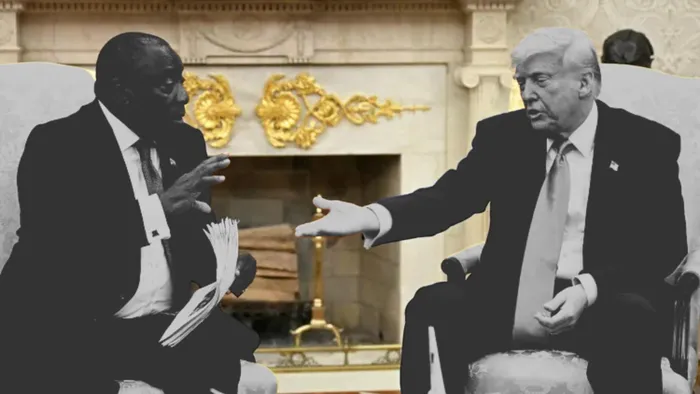
As geopolitical tensions rise, the real issue lies in America's misunderstanding of South Africa's Constitution. What does this mean for both nations?
Image: IOL Graphics
As tensions between South Africa and the United States resurface under Donald Trump’s presidency, the dominant explanation is geopolitical. We are told that it is BRICS, China, Russia or South Africa’s refusal to, “pick a side”. This story is incomplete.
A deeper, quieter problem sits beneath the current rhetoric: The United States does not understand South Africa’s Constitution. More precisely, it does not understand a constitutional system that demands transformation rather than restraint, with its own highest court structured to reject precisely that idea.
The friction that exists is not political first, it is constitutional. The US repeatedly misreads South Africa because it does not understand its Constitution and because its dominant constitutional voice today is deaf to a tradition of American Constitutional thought that once listened to South Africa.
Two Constitutions, with two ideas of justice
South Africa’s post-apartheid Constitution is built on transformative constitutionalism, a legal project explicitly designed to dismantle structural inequality created by Apartheid and colonialism. The law is not neutral. The Constitution assumes inequality is historical, systematic and legally remediable.
As stated by Klare (1998), courts, under transformative constitutionalism, are not passive umpires. They are required, carefully within limits, to advance dignity, equality and substantive freedom. Similarly, Liebenber (2010) explains that courts under transformative constitutionalism are required, within limits, to advance dignity, equality and substantive freedom through judicial enforcement of socio-economic rights and a reasonableness standard that respects separation of powers whilst rejecting state inaction.
The dominant constitutional philosophy currently expressed in the United States and its Supreme Court differs from that of South Africa. The US Supreme Court is liberal-formal, where rights are largely negative. Property is near absolute, redistribution is suspect, and courts are expected to restrain the state, not guide social repair.
Substantive Justice v Formalism
In RSA v Grootboom 2000 (11) BLCR 1169 (CC), the Constitutional Court held that the State has a positive constitutional duty to take reasonable measures to realise the right of access to housing. The court did not order houses to be built overnight; it said that the State must act reasonably, especially where the most vulnerable are concerned. Constitutional rights without enforceable obligation, the court reasoned, are empty.
Convexly, the US Supreme Court took the opposite path in San Antonio Independent School District v Rodriguez 411 U.S 1 (1973), where the court looked at school funding, the court refused to acknowledge and recognise education as a fundamental right and explicitly declined to intervene in, “distribution of funding,” holding that redistribution was a political matter not a judicial one.
As Sunstein (2001), observed in his comparative analysis, South Africa constitutionalised socio-economic rights precisely where the United States treated them as non-justiciable political questions. Simply put, South Africa constitutionalised obligation, whereas the US constitutionalises abstention. What Washington often labels as “Judicial Activism,” South Africa sees as constitutional normality.
Transformation v Absolute Ownership
Nowhere is this misunderstanding sharper than on land.
South Africa’s Constitution deliberately reframes property as a social institution, shaped by history and inequality.
In First National Bank of SA Ltd t/a Wesbank v Commissioner of SARS 2002 (4) SA 768 (CC), the Constitutional Court made it clear that property rights are protected under the law, but they are not absolute. Property rights must be balanced against public interest and the need for redress. This jurisprudence underpins land reform. Expropriation must be lawful, rational and proportionate. Compensation is contextual and not automatically market-based.
Conversely, the US Supreme Court reasons differently, in Cedar Point Nursery v Hassid 594 U.S (2021), even limited, temporary access to private land was treated as a per se taking, thus requiring compensation. Property is treated as pre-political and near inviolable.
What does this mean?
When US political figures describe South African land reform as “confiscation,” they are not identifying the constitutional difference and thus the breakdown in understanding. They are exporting American doctrine into a foreign legal order.
Substantive Justice v Colour-Blind Formalism
The divide goes further when looked at through a racial lens. In Minister of Finance v Van Heerden 2004 (6) SA 121 (CC), South Africa’s Constitutional Court upheld affirmative action grounded on substantive equality. Treating everyone the same in unequal conditions, the court held that treating everyone the same in unequal conditions entrenches injustice rather than cures it.
The US Supreme Court has moved decisively in the opposite direction, in Students for Fair Admissions v Harvard 600 U.S (2003), it struck down race-conscious admissions, reaffirming a commitment to colour blind formalism.
These two judgments are not anomalies but present two conflicting constitutional logics. South Africa asks whether a measure dismantles historical disadvantage, and the US ask whether a measure differentiates at face value. Much of the Trump-era criticism of South Africa’s race-based redress draws authority from the latter logic, whilst ignoring the former entirely.
America once understood Transformative Constitutionalism – Ruth Bader Ginsberg did
It is important to state clearly that this constitutional misunderstanding is not inevitable in American Law. There was a time when South Africa’s constitutional project was praised by the US.
Justice Ruth Bader Ginsburg openly admired South Africa’s Constitution and its jurisprudence. She cited Grootboom approvingly, praising South Africa’s enforcement of socio-economic rights and described South Africa’s Constitution as a model precisely because it recognised dignity without material conditions is hollow.
Ginsberg represented a strand of American constitutionalism that understood substantive equality, comparative learning and transformative adjudication. That strand has now been marginalised with Trump-Era rhetoric not just rejecting South African constitutionalism but American tradition and excellence.
Did the difference exist before Trump?
Trump did not invent misunderstanding; he amplifies it. Trumpism is openly hostile to structural explanations of inequality, judicially enforced redistribution and race-conscious remedies. Transformative constitutionalism rests on exactly these foundations. From within the “Trump-es-sphere,” South Africa’s legal order appears illegitimate due to a lack of understanding. The result is moralised criticism where constitutional analysis is required.
US foreign policy rarely engages with comparative constitutional theory. Countries are assessed through markets, alliances and ideological signalling, not through the logic of their respective apex courts.
The misunderstanding exists where South Africa is viewed as a symbolic proxy in American domestic debates about socialism and race, where accuracy becomes secondary to narrative utility. Power symmetry ensures the misunderstanding carries little cost.
What does this mean for South Africa?
South Africa is not breaching any constitutional norms. It is applying a coherent, globally respected constitutional model, one that even leading American jurists once celebrated.
This does not mean that South Africa’s governance failures are trivial, it means that critiques must distinguish constitutional design from political performance. The real dispute is not between Pretoria and Washington but between two theories of what constitutions are for.
Where do we go from here?
If the US continues to judge South Africa through American constitutional doctrine, friction with persist regardless of who occupies the White House. Donald Trump does not create the misunderstanding, but gives it a louder microphone.
Understanding South Africa requires the current US administration to accept the uncomfortable truth that constitutions can legitimately demand transformation, not merely restraint. Until that lesson is re-learned, America will keep speaking, and South Africa misheard.
If South Africa wants to be heard rather than misread, it must treat foreign policy as an exercise in constitutional translation. Through DIRCO and its ambassadors, South Africa should articulate its positions not as ideological choices but as constitutionally mandated items, anchored in judicially enforceable obligations and the rule of law.
Ambassadors must be equipped to act as constitutional interpreters, able to explain land reform, redress and non-alignment in the language of proportionality, reasonableness and the rule of law, rather than moral assertions alone. This will require disciplined strategic communication, greater legal literacy within missions, and a deliberate shift from reactive defence to pre-emptive explanation. South Africa does not need to apologise for its Constitution; it needs to explain it clearly, consistently and on its own legal terms.
* Sherwyn Sean Cupido-Weaich is a legal and governance professional and researcher with an academic background in law and business. He holds a BA (Hons) in Business and Law (UK) and is completing an Executive MBA in Data Analytics (UK). He has published peer-reviewed research on economic justice and development and is currently engaged in research at the intersection of constitutional governance, data, and public-sector transformation.
** The views expressed do not necessarily reflect the views of IOL or Independent Media.
IOL Opinion