South Africa is ‘safe to a large extent’ – and that’s the problem
OPINION
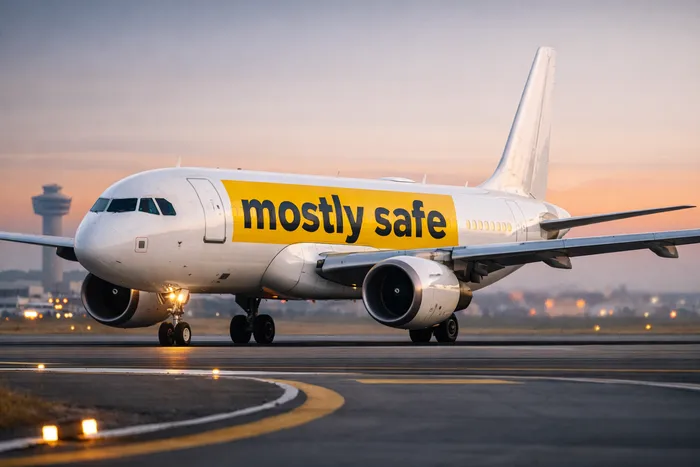
“Mostly safe” isn’t quite the confidence boost travellers are looking for.
Image: Created with DALL-E / DFA
THIS week, as the government outlined its latest multi-pronged measures to heighten the safety of tourists and international travellers heading to South Africa during the festive season, the country’s Tourism Minister, Patricia de Lille, offered the reassurance meant to steady nerves and boost confidence.
South Africa, she said, is “safe to a large extent.”
There are phrases that reassure. There are phrases that inspire confidence. And then there are phrases that sound like the fine print you skim just before something goes horribly wrong.
“South Africa, to a large extent, is safe” belongs firmly in the last category.
It is embarrassing because it sounds like a risk disclaimer, not leadership. Imagine any other context:
“This bridge is safe to a large extent.”
“This plane is mostly safe.”
You wouldn’t get on.
Yet this is the line served up to the world – and to South Africans themselves – as reassurance during the festive season, when crime spikes, vigilance hardens, and survival instincts quietly kick in. It is not confidence-building. It is the verbal equivalent of shrugging while hoping for the best.
“Safe to a large extent” is the language of insurance policies, not ministers. It is the phrase you use when you want to acknowledge danger without owning it, when certainty is inconvenient, and when accountability is just one sentence too far.
The problem is not that South Africa is complex. It is not that crime exists. It is not even that the government wants to protect tourism, a sector that desperately needs stability and trust. The problem is pretending that half-reassurance counts as reassurance at all.
Because “mostly safe” doesn’t land as comfort. It lands as caution.
To tourists, it whispers: Be careful. Something might happen.
To locals, it sounds like: Lower your expectations.
South Africans do not live in theory. We live in routes planned after dark, phones hidden at robots, keys clenched between fingers, WhatsApp warnings shared faster than official alerts. We know which streets to avoid, which times to be home, which instincts to trust. None of this is paranoia. It is adaptation.
So when leadership says the country is “safe to a large extent”, it doesn’t feel like optimism. It feels like distance.
There is also something quietly insulting about the phrasing. It assumes that people don’t hear the caveat. That the public won’t notice the hedge. That “to a large extent” won’t hang in the air like an unanswered question: And the rest?
What about the parts that are not safe?
Who lives there?
Who works there?
Who gets written off by the footnote?
Because crime in South Africa is not evenly distributed, but fear certainly is. It spreads quickly and settles deeply. And no amount of scenic descriptions, wildlife imagery or hospitality slogans can paper over that reality.
This is where the embarrassment sharpens.
Leadership, especially in a country with South Africa’s history and present-day challenges, requires clarity. It requires honesty. It requires the courage to say: This is the problem, this is what we are doing, and this is what still needs fixing.
What it does not require is verbal cushioning.
When officials rely on phrases that sound like legal disclaimers, they do not project control – they project uncertainty. And uncertainty is contagious. Investors feel it. Tourists sense it. Citizens internalise it.
Words matter because they signal priorities. They reveal whether the government is confronting reality or managing optics. Whether it is speaking with people or over them.
“Safe to a large extent” is not just weak phrasing. It is a small window into a bigger problem: a state that often seems more comfortable managing narratives than outcomes.
And that is why the line sticks in the throat.
Because South Africans are not naïve. We do not expect perfection. We do not demand miracles. What we ask for is seriousness – and seriousness begins with language that does not flinch.
You cannot lead a country with footnotes.
You cannot reassure a world with qualifiers.
And you certainly cannot expect people to climb aboard when you’ve already warned them that the bridge might wobble.
If South Africa is safe, say so – and prove it.
If it is not, say that – and fix it.
But please, spare us the disclaimers.
We’ve learned the hard way what those usually mean.