Lipstick, laughter and a R65-billion budget: Imogen Mashazi is everything that is wrong with public service in South Africa
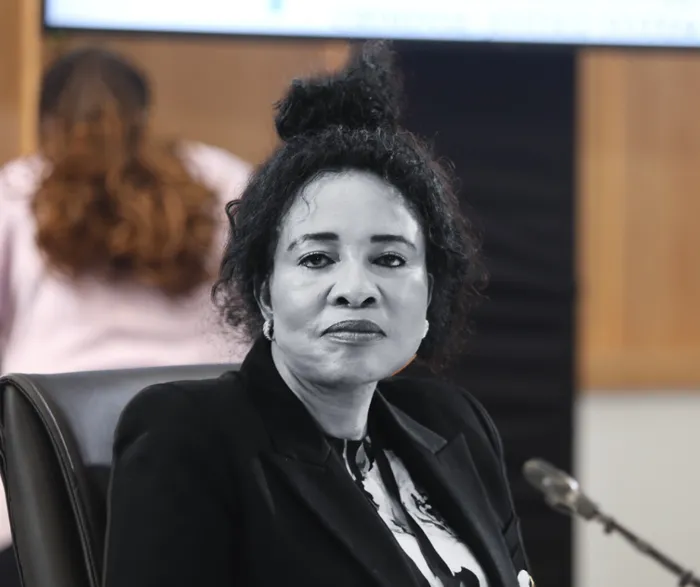
Former Ekurhuleni city manager Imogen Mashazi’s appearance at the Madlanga Commission exposed the deeper failures of South Africa’s public service. Her distracted behaviour, missing evidence and dismissive answers contrasted sharply with the serious allegations before her, including claims of sexual harassment, coercion and rape within the EMPD that she failed to act on for years. Mashazi’s testimony revealed a leader who normalised inaction, avoided accountability and treated oversight with impatience.
Image: Oupa Mokoena
When former Ekurhuleni city manager Dr Imogen Mashazi sat down at the Madlanga Commission, South Africans were entitled to expect the steady hand of a veteran public servant.
Instead, we watched a spectacle. Lipstick applied mid-session. Faces pulled at the evidence leader. Soft laughter under her breath. Eyes fixed on her phone while senior counsel tried to question her.
When pressed for answers, she leaned on stock phrases: “I take your point.” “No comment.” “I’ll talk to my lawyers.”
At one point, she told the commission she would rather submit answers in writing because appearing again might cause her to “get a stroke”.
It may have been theatre for some - the memes were flying on social media - but it revealed something far more serious.
It exposed a culture in public administration that treats accountability as an irritation.
That should worry every ratepayer who funds Ekurhuleni’s more than R65-billion operating budget.
For years, Mashazi held one of the most powerful administrative positions in the country. A city manager is the chief accounting officer, entrusted with how public money is spent and responsible for enforcing discipline. Yet her decades of experience did not translate into seriousness when it mattered most.
The commission is probing allegations of criminality, political interference and corruption inside the criminal justice system, including the Ekurhuleni Metropolitan Police Department (EMPD) and its links to alleged crime boss Vusimuzi “Cat” Matlala. In that context, the city manager had two basic duties, to tell the truth and to back it up. She struggled with both.
The most disturbing part of her evidence involved women. Mashazi told the commission that, from as early as 2016, female EMPD officers reported allegations of sexual harassment, coercion and even rape at the hands of senior officers, including chief Isaac Jabulani Mapiyeye.
Under questioning, she conceded that none of these reports became formal complaints.
She launched no investigation.
She initiated no disciplinary action. Instead, she created an “empowerment programme” for women officers, supposedly to help them avoid becoming “sexual slaves” - her own term. Justice Mbuyiseli Madlanga reminded her that women who come directly to the city manager are not hearsay. When vulnerable employees report abuse, you act.
South Africa lives with some of the highest levels of gender-based violence in the world.
The state has spent years promising action.
Yet here was a municipal manager admitting she sat on allegations of rape inside her own police department and chose not to use the authority she had.
A good public servant knows that policy documents mean nothing if you will not protect the people beneath you.
If you accuse someone of rape, sexual harassment or abuse of power in a public hearing, you owe the country more than vague recollections.
Evidence leader Advocate Mahlape Sello SC repeatedly asked Mashazi for documents, emails or minutes that could support her claims.
None appeared.
At one point Sello had to tell her she could not hear the questions because she was on her phone. Mashazi claimed she was “checking for evidence”, yet produced nothing. When making sweeping claims about misconduct, promotions for favoured “angels” and pregnancies involving officers and their subordinates, she again failed to provide records or formal action.
This is not a small procedural issue. It speaks to a broader problem in public administration.
We live in a WhatsApp Republic where decisions that belong in formal minutes are traded in chat groups.
Allegations are “raised” but never recorded.
Senior managers claim they “knew there was a problem” but cannot produce a file number or instruction to investigate.
When accountability arrives, they hide behind the excuse of “no formal complaint”.
There are basic duties any city manager must meet.
You treat allegations of sexual violence as urgent. You use legal opinions to guide action, you keep proper records. You show respect for oversight forums by arriving prepared and ready to account.
Measured against that standard, Mashazi’s testimony showed an administrator who normalised inaction, shifted responsibility and viewed oversight as an annoyance. It suggested someone detached from the duties of public service, more interested in her appearance and not a leader who ran one of South Africa's biggest metros.
Was she really the best South Africa could offer as the accounting officer of a city with one of the largest municipal budgets in the country?
A metro linked to rogue police units, alleged cartels and collapsing basic services?
I fear this crisis runs deeper than one official. Mashazi is everything that is wrong with public service in South Africa, where senior managers prioritise political survival, hide behind the absence of formal complaints and treat watchdogs as nuisances.
The Madlanga Commission has revealed a criminal justice system hollowed out by interference and intimidation.
Mashazi’s testimony adds a different problem. It shows how everyday incompetence creates the conditions where corruption grows. South Africans should be grateful for this glimpse into the corridors of power, but we must demand accountability and make sure the Mashazis of this world face real consequences instead of returning to office without answering for their actions.
*** Lee Rondganger is the Deputy Editor of IOL
IOL Opinion
Lee Rondganger is the Deputy Editor of IOL.
Image: IOL