Beyond Steenhuisen's exit: The deeper problems facing the DA
Politics
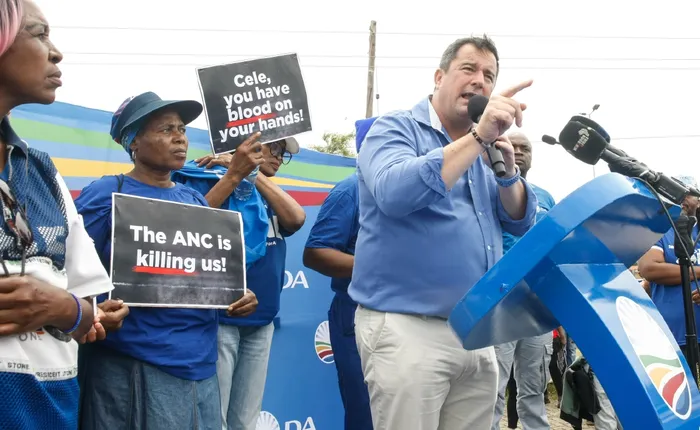
Former provincial campaigns director for the Democratic Alliance in KwaZulu-Natal, Mbali Ntuli, argues that DA leader John Steenhuisen's scandals which led to his exit cannot be reduced to just his poor handling of the foot-and-mouth disease outbreak, misuse of the party's credit card and his gluttonous Uber Eats orders. She argues that the rise Steenhuisen (centre) in the DA reveals a concerning lack of leadership pipeline and a political identity has been built around the untested claim that it is fundamentally better than the African National Congress.
Image: Independent Newspapers Archives
IT is no secret that I have strong personal views about John Steenhuisen. The reasons are publicly well known and, I should add, entirely earned. That aside, I understand why so many people wanted me to weigh in on his expected announcement. South African politics has developed a taste for the salacious.
We like the spectacle. We enjoy watching power unravel. I get that. But since people are expecting me to say something, let me use this moment to say what actually matters.
It was widely anticipated that Steenhuisen would announce that he would not recontest the leadership of the Democratic Alliance (DA). This hardly came as a surprise. Almost his entire tenure has been consumed by drama, scandal, alleged internal financial impropriety, and now, arguably, the final blow: the mishandling of the foot-and-mouth disease outbreak.
That his leadership style, temperament, and emotional intelligence made him a poor choice to lead the country’s national opposition has been apparent to almost everyone except his own party. For that misjudgement, the DA itself must carry responsibility, particularly as it heads into what will be a bruising ten months before the next election.
In truth, the DA would be better served by asking him to resign entirely. His departure will inevitably trigger another round of internal factional battles, with pressure to reshuffle cabinet positions and quietly offload him as political dead weight.
On the one hand, this is deeply disillusioning behaviour from people who claim to offer principled leadership. On the other, it is the coldly rational political move. Removing him would give a new leader, most likely Geordin Hill-Lewis, some runway to stabilise and rehabilitate the party’s image before the election.
But the DA is rarely that strategic. More likely, Steenhuisen would be redeployed to a different ministry, Hill-Lewis would remain both mayor and party leader, and the party will limp forward. There is simply no credible argument for the leader of the second-largest party in the country not being in Parliament, especially in a Government of National Unity (GNU) where the DA is effectively a co-governing partner.
That is the sensational part. Now for the real problem.
The DA’s financial scandal involving Steenhuisen has been reduced, almost farcically, to jokes about credit cards and Uber Eats. Whether someone expensed the cost of a princess wrap or a Kauai smoothie is not the issue. Focusing on the trivialities misses the point entirely.
What we are witnessing is not an isolated lapse in judgement. It is the predictable outcome of a political culture that, for years, looked the other way while certain individuals were allowed to operate above the rules.
These things never begin with scandal. They begin quietly: tithes not paid, donors approached for expenses ordinary members would never be permitted to request, special compensation arrangements, and unexplained “top-ups” that materialise for some and not others. Over time, the message becomes unmistakable: consequences are negotiable. Entitlement follows. Recklessness is inevitable. Once that spiral begins, the ending is rarely surprising.
Much has been made of the argument that DA funds are not public money and therefore not a matter of public concern. This argument is deeply flawed. While the DA receives private donations, it also receives taxpayer funding via the Electoral Commission of South Africa (IEC).
Public representatives’ tithes are derived from state-paid salaries. Constituency and caucus allowances are publicly funded. To pretend these streams exist in sealed-off silos is either naïve or deliberately misleading.
More damning still is the ethical question. Even if the funds in question were entirely private, what does it say about a leader entrusted with responsibility who treats that trust casually? Political parties do not merely manage money. They manage public confidence. Once that confidence is squandered, no technical accounting defence can restore it.
This saga matters because the Democratic Alliance does not operate in isolation. It is the official opposition, a party that has built its entire identity on the claim that it is fundamentally better than the African National Congress. Better governed. More ethical. More competent. More accountable.
That claim carries responsibility.
When the leader of the opposition is embroiled in conduct that mirrors the very failures the DA has spent years condemning, it matters profoundly, not only for party politics but also for the health of the democratic system itself. South Africa’s democracy depends on the presence of a credible, principled opposition capable of holding power to account. When that opposition falters, the entire accountability ecosystem weakens.
This concern is amplified by the current political context. Roughly 72% of parties represented in Parliament now sit within the GNU. While the GNU may have been politically expedient, it has dramatically narrowed the space for robust opposition politics. Parliament now risks becoming a chamber where scrutiny is thin, fragmented, and increasingly performative.
In this environment, the DA’s conduct matters more, not less. A party that is now part of the government cannot demand exemption from scrutiny. If it wishes to be seen as a genuine alternative to ANC-style governance, it must meet the same standards it has long demanded of others. There can be no special pleading, no technical evasions, and no minimisation simply because the misconduct occurred within party structures rather than the state.
Once a party enters government, it forfeits the luxury of moral exceptionalism. It earns scrutiny and must withstand it.
The danger is not only that the DA begins to resemble what it criticises, but that citizens conclude there is no serious opposition at all. When voters decide that “they are all the same,” disengagement follows. And disengagement is the greatest gift any failing democracy can receive.
Yet the deepest crisis facing the DA goes beyond financial impropriety. It is a crisis of the leadership pipeline, or more accurately, the absence of one.
For years, the party marginalised capable leaders who did not fit its narrow conception of leadership, while elevating others despite glaring deficiencies. The arrogance lay in assuming voters would not notice that the DA brand would continue to carry the weight even as the substance beneath it thinned. That assumption has not held.
The result is a leader tolerated largely because of party association rather than genuine confidence in his ability to inspire or lead. This arrangement has suited those with power behind the scenes: a convenient lightning rod for public anger, someone hardened by ruthless internal politics, and therefore someone almost destined to self-destruct.
The real problem is what comes next.
The DA’s bench is alarmingly thin. Competence has too often been subordinated to factional alignment, leaving a vacuum so stark that only one alternative name is floated seriously, not because it is unquestionably the best option, but because there is no real competition.
That this vacuum has reportedly revived conversations about Helen Zille returning to frontline leadership should concern both party members and the electorate. Zille is nearly 80. Politics is mentally and physically punishing work, and age is not an abstract consideration. A party that continues to tether its future to a single individual while failing to plan meaningfully for succession is behaving irresponsibly.
The alternative is scarcely more convincing. Expecting Geordin Hill-Lewis to run one of the country’s most economically significant cities while also leading a national party within a GNU he did not negotiate would stretch even the most capable leader beyond reason. That is not strategy. It is desperation.
Most voters can name only a handful of DA figures: Helen Zille, Geordin Hill-Lewis, Chris Pappas, John Steenhuisen, and perhaps their local councillor. That is not a leadership pipeline. It is a warning sign.
And the DA cannot claim surprise. It knew who it elected. It knew what it rewarded. As the party itself often reminds voters: you get what you vote for.
In this case, the result has been years of uninspiring leadership sustained more by brand loyalty than by genuine confidence.
This crisis was not inevitable. But it was entirely predictable.
* Ntuli is the founder and chief executive of the non-profit company Ground Works Collective and a former member of the provincial legislature and campaigns director for the DA.
** The views expressed here do not reflect those of the Sunday Independent, IOL, or Independent Media.
Get the real story on the go: Follow the Sunday Independent on WhatsApp.

Mbali Ntuli is the founder and chief executive of the non-profit company, Ground Works Collective, and a former member of the provincial legislature in KZN.
Image: Meta