Can toffee apples make Kimberley’s ‘hitsuzen’ bearable
GreyMutter
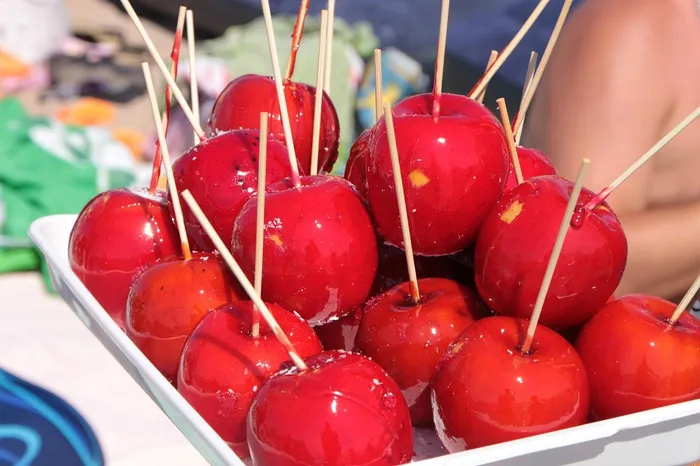
Toffee apples on sports days when we were at school, especially during times when our team were on the receiving end of a drubbing, made the hammering seem less severe. Toffee apples can be a great, sweet distraction.
Image: Emilian Robert Vicol from Pixabay
EVERY year, from the first few days of primary school till your last days as a matriculant at high school, there was a very, very important question that needed addressing: “WHAT house are you in?”
Blue House, Red House, Green and Yellow were the school’s athletics teams, with members seemingly randomly selected from class lists. These teams would compete in the annual Inter-House sports, and for those few weeks that the teams were training, but more so on the day of the competition, battle lines were clear.
Oh, I said that the selections were “seemingly” random, because it’s funny how every year it just so happened that Blue House won and Red House were runners-up! How it was possible that the fastest, most athletic laaities, and the school’s sports coaches ended up in those teams without fail is still beyond me.
And I used to believe in coincidence … that is, until I learned about “hitsuzen”, which in a very porous nutshell refers to a naturally foreordained event – a state in which other outcomes are effectively impossible. Once the deck is stacked a certain way, the fall of the cards becomes predictable.
No matter how hard we pumped our little legs, how much our lungs burned, or how much effort we put in, the Blue and Red House kids – the elites – would surge ahead in most events. Realistically, the rest of us never stood much of a chance.
It might have been miserable if winning was all that mattered. But sports day was never only about results. There was the carnival atmosphere, and the sense that something out of the ordinary was happening. Then, of course, there were the toffee apples.
Look, I’ve long forgiven the elite houses’ recruiters. They saw the opportunity to win and took it. And at least the rest of us got something sweet to take the edge off defeat.
A toffee apple has a way of doing that. Even when you know, deep down, that the PT teachers had “konkelled” their houses to victory, the crunch of sour apple and sweet sticky toffee made it feel almost worthwhile.
Which got me thinking: perhaps that’s what Kimberlites need – toffee apples.
Something sweet enough to distract from the sting of scorching heat paired with dry taps. From the return of nightly water shutdowns. From refuse removal fleets under strain, leaving rubbish uncollected beyond scheduled days. From potholes so widespread that fixing them all feels increasingly unlikely. And from the sense that our leaders are often preoccupied with "bigger issues" far removed from residents’ most basic needs.
For an overview, I'd recommend a column on the DFA website, titled: When governance becomes a guessing game.
So I say “bigger issues” deliberately, because of a growing trend that should concern anyone who believes in open, accountable governance: the exclusion of the public from council meetings.
There are legitimate circumstances where the public should be excluded. That should never be in dispute. But exclusion is meant to be the exception. In September, the public and media were locked out of a special council meeting for roughly four hours.
I’ll bet that the atmosphere in the corridors outside the council chambers must have felt uncomfortably familiar – like the teachers in charge of Blue and Red House quietly konkelling behind closed doors.
Councillors may well be following procedure. They may be acting entirely within the rules. But residents owe it to themselves to understand what those rules are, and when exclusion is justified.
Because once people begin to suspect that decisions are being shaped away from public view, a dangerous feeling sets in: that outcomes are already decided, and participation is largely symbolic.
No one wants residents to conclude that compassion for those struggling with poor service delivery comes from leaders who are insulated from that struggle themselves.
Charles Spurgeon once observed: “None pity the poor like those who have been or are still poor, none have such tenderness for the sick as those who have been long in ill health themselves. We ought to be grateful for occasional griefs if they preserve us from chronic hard-heartedness; for of all afflictions, an unkind heart is the worst, it is a plague to its possessor, and a torment to those around him.”
Perhaps that is the real danger of exclusion and distance: not just secrecy, but hard-heartedness.
Hitsuzen describes a result that feels inevitable, unavoidable, already written. And when residents begin to believe that decisions will be made regardless of their presence, effort or voice, that sense of inevitability takes root.
At that point, even the sweetest toffee apple won’t be enough to take away the bitterness.