Limpopo and Mpumalanga floods: Urgent need for disaster preparedness
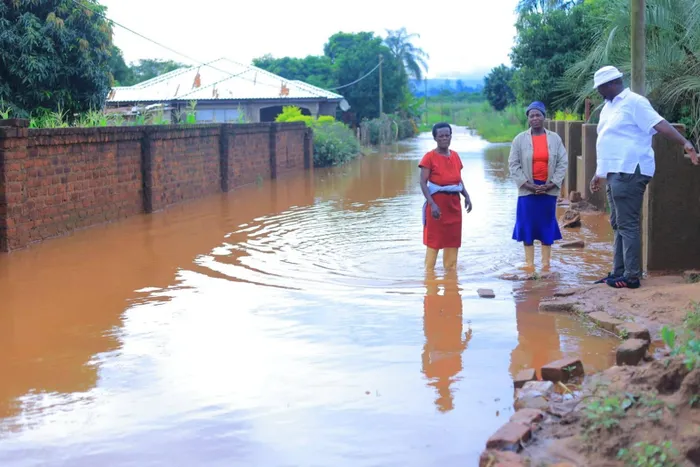
Severe flooding in Limpopo has left communities devastated, highlighting the urgent need for improved disaster response and planning. Meanwhile, neighbouring Mpumalanga faces similar challenges as extreme weather events continue to threaten lives and livelihoods across the region.
Image: Supplied
Despite South Africa boasting a state-of-the-art, impact-based early warning system managed by the South African Weather Service (SAWS), the recent destructive flooding in Limpopo and Mpumalanga serves as a stark and painful reminder that technology alone cannot prevent disaster.
Thirty-one people have lost their lives after torrential rains over the two provinces caused rivers to burst their banks.
The areas include Hlabisa, Hoxane, Kiepersol, Mkhuhlu, and Wales in the Bushbuckridge Local Municipality, as well as the Giyani, Vhembe, Mopani, and Sekhukhune districts.
The Emergency Housing Unit of the National Department of Human Settlements, working together with teams from Mpumalanga and Limpopo provincial departments, is conducting physical verification of all households impacted by the floods.
On Thursday, President Cyril Ramaphosa visited Vhembe and Mopani districts to assess the damage caused by the more than 400mm of rain that fell in the area. Approximately 36 houses were destroyed.
While the Mpumalanga and Limpopo governments take stock of the flood damage and loss of life, residents on the ground stated that movement was limited on Saturday.
Mandla Chauke, a Proportional Representative Councillor in the Giyani area, stated that people were not coping and those in need of medical assistance were affected the most.
He said residents had limited movement and preferred to stay indoors. He said they were watching the devastation unfold on television, following media reports and local social media groups.
“The local clinic is flooded, and most of the roads in the Giyani area are damaged. The majority of the houses are rondavels. People are stranded. Those with vehicles are unable to leave the area. We were warned of the excessive rainfall, but we did not know what the future held for us or what would happen,” he said.
Rodney Mavundza, a PR councillor in the Mbaula area, described the situation as bad. He said that because of accessibility issues, certain government departments could not react rapidly, but from his observation, officials were doing everything they could to assist.
He was also unable to leave his area. He said the Limpopo government's response has been slow, and it may take months to repair the roads.
“Some of the villages have been cut off, while in some of the areas, the water level has subsided. I have seen the police and some local officials near the bridges preventing people from crossing. It is difficult to stop people from moving because they have to buy food. The department maintaining the roads has repaired some of them temporarily,” he said.
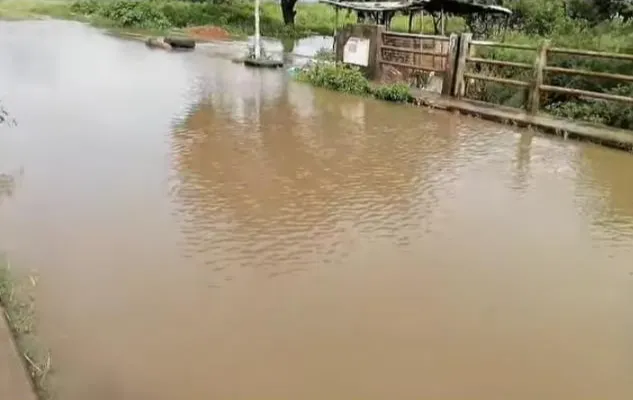
Kheto Bridge was covered in water. It is an access road within Giyani, situated in the north-eastern part of Limpopo.
Image: Rodney Mavundza
Lindy Wilson, the DA Limpopo spokesperson on Disaster Management, explained that rainfall levels exceeded year 2000 levels in certain areas, particularly in the Mopani and Vhembe districts.
Wilson stated that communities in these two districts, in north-eastern Limpopo, have endured widespread flooding and displacement, the destruction of bridges and roads – including critical transport and supply-chain routes, the collapse of municipal infrastructure, and severe disruption of essential services such as water and electricity. Significant damage to homes and government infrastructure has been reported, alongside the loss of livestock and crops.
Wilson said that without urgent emergency repairs to critical infrastructure, including water, electricity, transport, and supply-chain routes, the humanitarian and economic consequences — particularly for the farming sector — will be significantly worsened.
“We call for the establishment of an inter-governmental task team to be put in place so that informed decisions can be taken for the reprioritisation of funds. We will closely monitor how fiscal resources are spent,” she warned.
Once the situation has stabilised, and in light of reports and complaints from affected towns and districts, Wilson stated that they will call for an independent enquiry to assess whether:
- Provincial and local governments had adequate prevention and mitigation measures in place.
- They were sufficiently prepared to provide a coordinated and rapid response.
- They had the capacity to deliver immediate relief and effect a resilient, longer-term recovery.
Following on the heels of the devastating April 2022 floods in KwaZulu-Natal, these new events underscore a recurring, fatal flaw in the national disaster response, which is a critical gap between scientific warning and effective community action.
For experts, the problem extends far beyond meteorology. It’s a systemic failure rooted in inadequate warning dissemination, lack of preparedness for early action, and deep-seated social challenges like poverty and informal settlements. Collectively, these factors are turning extreme weather into large-scale humanitarian crises.
“This is why we need an integrated approach, not just focused on early warning but also building preparedness for early action, community-based warning for better dissemination, and climate-sensitive spatial planning to ensure that people are not in harm’s way,” said Professor Tafadzwa Mabhaudhi, a climate change expert from the University of KwaZulu-Natal.
Mabhaudhi, who is also the director of the London School of Hygiene and Tropical Medicine (LSHTM), noted that social vulnerability is a major accelerator of disaster.
“Poverty, unemployment, and inequality accentuate vulnerabilities,” he explained. “People in these circumstances have low adaptive capacity and often live in poorly constructed homes and low-lying areas, in the case of informal settlements. This exposes them to the risk of floods, while the low adaptive capacity makes them highly vulnerable.”
The crisis on the ground is compounded by a disconnect between planning and physical reality, particularly in rapidly developing provinces like Limpopo.
Experts from the Department of Geography and Environmental Studies at the University of Limpopo weighed in.
Professor Marubini Ramudzuli from the University of Limpopo highlighted how human activity disrupts natural defences.
“Based on our observations, the natural drainage systems are impacted and altered by the introduction of unplanned land use, the use of low-lying areas and streams as illegal dumping grounds, and the location of infrastructure like bridges in the wrong places,” she said.
Ramudzuli pointed out the direct consequence of this negligence: “The illegal dumping of refuse in stream channels leads to the clogging of drainage pipes that make stream channels shallow and easily swell when there is excess water entering the streams.”
Further analysis by Professor Hector Chikoore confirmed that the physical environment is unforgiving when combined with poor planning.
His research identified slope and soil type as the primary physical factors driving flood intensity in the affected Limpopo districts.
“Our research confirmed that 'slope' is the number one physical factor determining flood intensity in this region, followed closely by soil type,” Chikoore stated.
He explained that low elevation areas with gentle slopes are often more prone to severe flooding than steeper terrain because the water pools and stagnates.
Furthermore, large parts of the Mopani and Vhembe districts are dominated by fine-textured clay soils with low infiltration rates.
“When heavy rains from a tropical low hit, this soil seals up almost immediately, creating massive surface runoff instead of absorbing the water,” he said.
Chikoore was unequivocal in his assessment of the current approach: “The land-use and infrastructure planning strategies in Limpopo are not currently adequate because they are often based on broad, regional-scale data that misses critical local details.”
The result is development in high-risk zones. According to Professors Marius Marais and Izelque Botha, also from the University of Limpopo, rapid and often unplanned commercial and residential development has occurred “within flood zones – a red flag that would usually be picked up if proper spatial planning, land use planning, hydrological analysis, and EIA authorisation processes (including public consultation) had been followed”.
For many experts, the scientific consensus on climate change and its risks has been clear for years, but political will and implementation have lagged.
Professor Danitza Klopper agreed that planning for flooding is considered, but often the extreme rainfall amounts are underestimated in municipal plans.
“In order to be properly prepared for severe flooding events and other climate extremes, planning needs to move beyond assessment to action. Infrastructure such as stormwater drains need to be built and maintained, and institutional and financial support should be mobilised for climate-resilient development in the province,” Klopper advised.
Professor Mabhaudhi echoed the urgency, stressing that climate change is not a future threat.
“We are living through it now, and facing its devastating impacts now,” he said.
He emphasised that the national response needs to be holistic, integrated, and, most importantly, human-centred.
“The greatest of these impacts are on human health, physical and mental, and nature… Our response to climate change should place human health at the forefront,” Mabhaudhi advised, noting the “silent impacts” of mental health struggles following repeated exposure to disasters.
The way forward, according to the experts, is a robust, integrated approach combining technical solutions with community empowerment.
Chikoore suggested low-cost, community-based geographical solutions, such as simple SMS/radio early warning systems for remote villages and revegetating buffer zones around settlements to slow down runoff before it hits homes.
Ezekiel Sebego, Disaster Risk Reduction Manager at SAWS, explained that the Weather Service works closely with partners to support an integrated and multi-sectoral approach aligned with the global Early Warnings for All (EW4ALL) initiative.
He noted that effective early warning systems require coordinated action across four key pillars: disaster risk knowledge, Pillar 1, led by the National Disaster Management Centre; detection, monitoring and forecasting, Pillar 2, led by SAWS; dissemination and communication Pillar 3, led by the Department of Communications and Digital Technologies, and preparedness and response Pillar 4, led by the South African Red Cross and others.
“In areas such as Limpopo and Mpumalanga, the SAWS provides timely impact-based warnings to disaster management centres and other stakeholders, who then contextualise this information, communicate it through appropriate channels, and activate preparedness and response measures to protect lives and livelihoods,” Sebego said.
He stressed that the EW4ALL initiative reinforces that “early warnings alone are not sufficient to prevent disaster losses”. It requires “clear institutional roles, strong coordination, and investment in preparedness, early action and community-level response capacity,” he added.
Sebego also pointed out that “through basic education and common sense interventions”, SAWS and the NDMC could save more lives “if the reckless practices of some motorists could be prevented”.
He specifically highlighted “motorists who try to forge their way through clearly flooded bridges, risking their lives as well as those of first responders who would inevitably have to try to save them, should they be swept off bridges/causeways.”
On Friday, Amnesty International South Africa Executive Director Shenilla Mohamed said the floods in Limpopo and Mpumalanga highlight the impact of extreme weather events on people’s rights to life, shelter, water, food, and livelihoods.
“The persistent incidents of severe flooding in many parts of the country underscore the government’s obligation to urgently implement a human-rights based approach to climate change and extreme weather events,” she said.
Mohamed said the government must mobilise all necessary human, financial, and technical resources to ensure that disaster risk reduction is fully integrated into urban planning processes, to protect people from the devastating impact of flooding.
“The failure of the government to adequately and thoroughly realise these obligations comes at a huge cost to the human rights, lives, and livelihoods of millions of people,” she warned.
Amnesty International South Africa noted the government’s plan to release relief funding to support communities affected by severe flooding in Limpopo.
“The relief must be urgently released to those most vulnerable and done with full transparency and accountability.”
The SAWS issued a Red Level 10 warning for disruptive rainfall for parts of Limpopo and Mpumalanga on Thursday, an escalation from the Orange Level 9 warnings that had been in place. The latest step was unprecedented, and the last time such a warning was issued was in 2022 in the case of KwaZulu-Natal.
The SAWS forecasts partly cloudy and cool conditions with isolated to scattered showers and thundershowers for Sunday and Monday.
Meanwhile, KZN COGTA MEC, Reverend Thulasizwe Buthelezi, stated that the KZN Provincial Disaster Management Centre is closely monitoring persistent rainfall in the northern parts of the province, particularly in the Zululand and Umkhanyakude districts.
Parts of Umhlabuyalingana, Nongoma, and sections of Jozini are being observed because rising water levels are affecting low-lying roads and bridges.
Residents living in floodplains or low-lying areas were advised to seek temporary shelter on higher ground as a precautionary measure.
Rising water levels have left numerous residents stranded and in danger of drowning, prompting the activation of the South African Air Force's search and rescue teams from 17 and 19 Squadrons.
karen.singh@inl.co.za and zainul.dawood@inl.co.za