Why South Africa could face a power crunch before 2030
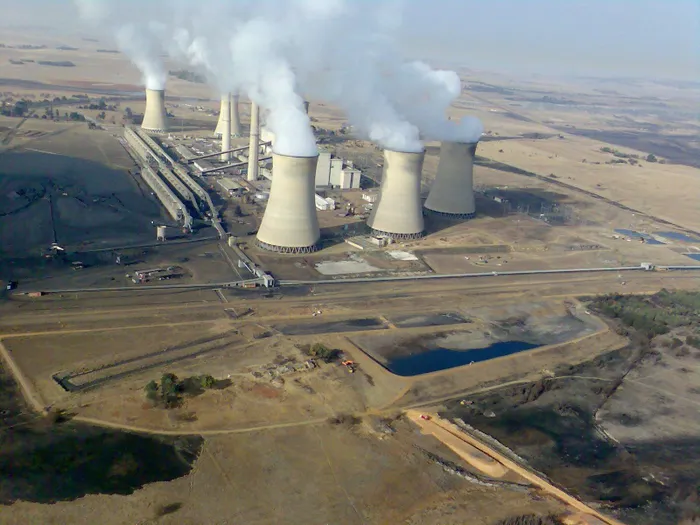
Arnot Power Station in Mpumalanga. As South Africa accelerates its energy transition, a gap is opening between financial planning and physical reality. Gillian Schutte compares DBSA’s modelling with Matshela Koko’s warning about near-term system strain, and asks who carries the risk when timelines collide with infrastructure.
Image: Wikimedia Commons
South Africa is under sustained pressure to abandon coal.
Coal is repeatedly described as dirty, outdated and incompatible with a modern economy, and this framing now dominates official energy transition planning.
At the same time, South Africa continues to export millions of tonnes of coal each year to countries that burn it for electricity and industry, including European states that publicly position themselves as climate leaders.
This contradiction sits beneath the growing tension between the Development Bank of Southern Africa’s energy modelling and the analysis advanced by Matshela Koko, former Interim Group Chief Executive of Eskom, on South Africa’s approaching electricity capacity cliff.
DBSA’s report, South Africa’s Energy Sector Investment Requirements to Achieve Energy Security and Net Zero by 2050, sets out a long-term pathway for the electricity system.
It concludes that system adequacy can be maintained through to 2030 and that zero unserved energy is achievable thereafter, provided coal performance remains within forecast ranges and planned investments materialise. Institutional weaknesses, policy fragmentation and financing gaps are acknowledged, yet treated as challenges that can be addressed through reform, coordination and capital mobilisation.
Koko’s paper approaches the problem from a different temporal and diagnostic position. Rather than modelling optimal future outcomes, it asks whether South Africa can replace ageing coal capacity fast enough to avoid power shortages before 2030, given the actual condition of the fleet, the state of the grid and the time required to build new infrastructure.
His answer is negative. Using the Cliff Intensity Index, Koko shows that coal capacity exits the system faster than replacement capacity can be integrated, even under highly optimistic governance assumptions.
Both analyses rely on the same underlying facts. Both acknowledge scheduled coal retirements, rising demand, the expiry of Cahora Bassa imports and uncertainty around Minimum Emission Standards compliance.
The Cahora Bassa power import agreement currently supplies more than a gigawatt of firm, dispatchable electricity into South Africa’s grid, and its expiry in March 2030 coincides almost exactly with the largest cluster of domestic coal station retirements.
The overlap is cumulative rather than incidental. A major external baseload source exits the system at the same moment ageing coal capacity is withdrawn, tightening supply margins within an already compressed window. Yet the two analyses reach different conclusions about near-term adequacy.
The difference lies in how time, flexibility and constraint are treated.
DBSA’s modelling allows coal retirement schedules to move. Plants can remain online through delayed compliance or scenario choice. In this framing, retirement timing responds to policy decisions. Koko treats a significant portion of coal retirements as driven by physical end-of-life constraints rather than discretionary policy.
Stations commissioned decades ago are failing through age-related defects, extended outages and declining reliability. These exits occur irrespective of policy preference and are compressed into a narrow window approaching 2030.
A similar divergence appears around replacement capacity. DBSA’s scenarios assume that once generation is procured, it enters the system broadly as planned.
Transmission expansion is acknowledged but not treated as a binding constraint on adequacy. Koko places grid readiness at the centre of the problem, drawing on transmission development timelines, environmental approvals and construction limits that impose delays no policy instruction can simply override. In this reading, capacity exists on paper long before it becomes usable electricity.
Coal fleet performance forms a further point of tension. DBSA’s scenarios rely on average Energy Availability Factors that keep the system balanced through the decade.
Recent history shows how fragile this assumption is. When availability drops, effective capacity disappears ahead of formal retirement schedules. Koko treats this volatility as central to system risk rather than as a temporary deviation.
Together, these pressures form the basis of Koko’s cliff framework. Coal exits faster than expected, replacement arrives slower than planned, and declining reliability accelerates effective capacity loss.
DBSA addresses these pressures individually and assumes they can be managed through policy alignment and investment sequencing. Koko demonstrates how they interact and compound.
DBSA has not publicly responded to Matshela Koko’s paper.
The divergence therefore emerges through juxtaposition rather than formal rebuttal.
As a development finance institution, DBSA’s reporting speaks primarily to multilateral lenders, bilateral donors, climate finance institutions and private investors. Its mandate includes mobilising capital at scale and aligning projects with international climate finance frameworks, including the Just Energy Transition Partnership announced at COP26. Within this role, a forward-facing presentation of adequacy supports the confidence required to sustain investment flows.
In this sense, DBSA is selling optimism to its financiers. It privileges long-term endpoint modelling over near-term system stress, and investor confidence over exposure to transitional risk.
Koko’s analysis serves a different function.
It is diagnostic rather than investment-facing. It interrogates whether the transition timetable is physically traversable rather than whether it is normatively desirable.
When electricity supply tightens, responsibility does not attach to modelling assumptions. It is assigned locally. Eskom is blamed for mismanagement.
Workers are blamed for resistance. Municipalities are blamed for non-payment. Sabotage and corruption circulate as explanations. Each may exist, yet the central design assumption remains largely protected from scrutiny: that coal can be retired and replacement infrastructure delivered fast enough to avoid a shortfall.
This debate unfolds within a global asymmetry. European states reopened coal plants and delayed closures in response to the Ukraine war, describing these decisions as necessary for energy security. South Africa supplied coal into that same system while being instructed that similar flexibility was unavailable to it. Coal is framed as unacceptable when it powers South African households, yet acceptable when it stabilises European grids.
Placed side by side, DBSA’s report and Koko’s paper reveal two approaches to energy planning. One sets out a long-term pathway shaped by investor reassurance and climate signalling. The other interrogates whether the system can traverse the next four years without fracture. The electricity system will register the outcome regardless of narrative preference. The unresolved question is who absorbs the risk when optimism collides with physical constraint.
Gillian Schutte is a South African writer, filmmaker, poet, and uncompromising social justice activist. Founder of Media for Justice and co-owner of handHeld Films, she is recognised for hard-hitting documentaries and incisive opinion pieces that dismantle whiteness, neoliberal capitalism, and imperial power.
IOL